
Sports
Islanders' fundraiser for convicted cop causes stir
ESPN News
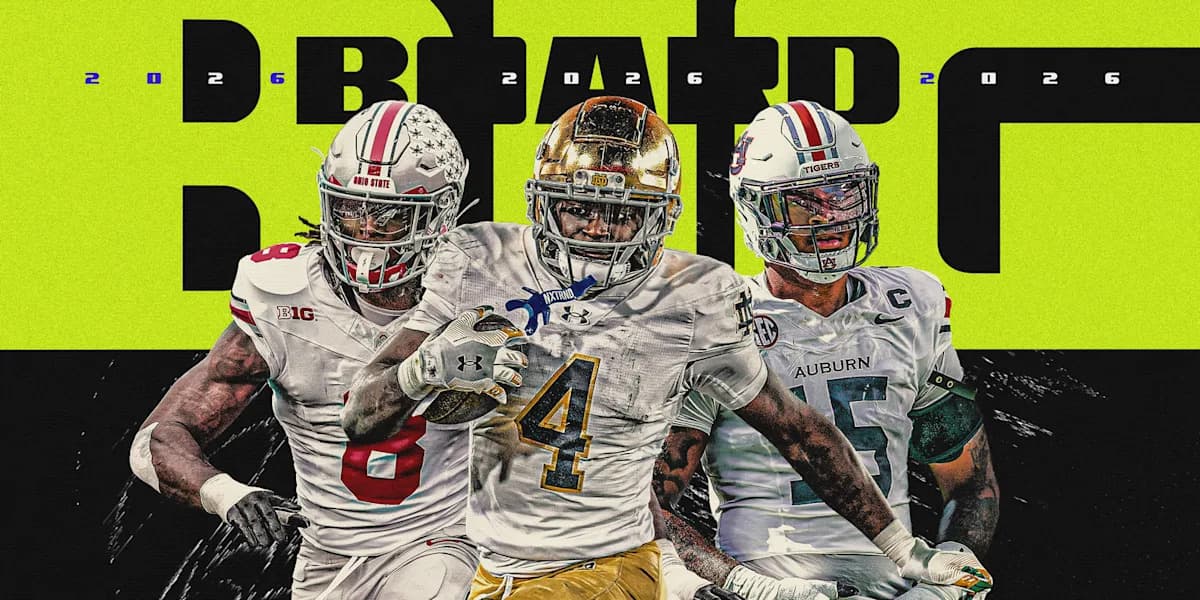
Fernando Mendoza is ranked as the top prospect for the 2026 NFL Draft, showcasing impressive skills as a quarterback from Indiana. Jeremiyah Love is also highlighted as a top-3 player in the draft class.
This is it. The 2026 NFL Draft is right around the corner, so it’s time to lock in prospect rankings ahead of the offseason’s marquee event.
Here are the top 75 players of this draft class according to Yahoo Sports’ Nate Tice.
Past individual big boards: 1.0 | 2.0
Mendoza’s production and Indiana’s success went through the roof under Curt Cignetti, but just traits-wise, Mendoza has a lot to like. He’s a tall athlete with good size, a loose arm and good overall frame. Mendoza can put some real zip on the football on underneath and intermediate throws. He made field out throws with college hashes seem routine. His footwork has polish and he already has rapid improved pocket movement. He also shows encouraging snaps of progressing and moving in the pocket to find answers on true passing downs and in high-leverage situations like third down and in the red zone. He’s consistently accurate at all three levels of the field, which is probably his standout trait. He already shows off a knack for locating the football away from defenders and is willing to push the ball in all types of situations. Those are encouraging signs against the tighter NFL windows he’ll face. Mendoza is also a good, athlete who can create a bit with his legs, but prefers to win as a thrower. He is an intriguing package of traits and polish with a high IQ (he’s deadly in two minute situations) and real feel for the position.
There are some similarities to Matt Ryan. Mendoza took a lot of sacks at Cal, but was cleaned up in Indiana’s much friendlier surroundings. Indiana’s offense is RPO-heavy, but Mendoza shows the real ability to drop back consistently and find the right answer. Mendoza has a style, accuracy and set of tools that point to a higher ceiling than he’s getting credit for, with a floor and polished understanding to play right away and not be a disaster.
A true defensive weapon. It’s hard to not notice Reese on the field even if he lines up all over it. Reese was a revelation this season. He can impact the game on the edge as both a run defender and pass rusher, and has real off-ball linebacker chops chasing down run plays sideline-to-sideline and in coverage. Reese is an outstanding athlete with strength and speed, and plays with an energy that is also infectious. In an NFL with more creative defensive coordinators who are willing to move their front seven defenders around, Reese is the ultimate version of a do-it-all defender. Even if he moves to playing on the edge full-time, he has already flashed the bend and explosiveness to win consistently as a pass rusher, with even more to tap into. If he stays off-ball, he reminds me of Jaylon Smith before he suffered his knee injury at Notre Dame.
Every touch has a chance to go to the house with Love. And while he has legit home run ability, he knows how to throttle between speeds to use it effectively. Love has good vision and is a strong runner who can take a steady stream of touches. He has the size and vision to work between the tackles and has a knack for setting up his blocks as a runner, all while constantly staying balanced and square to the line. The only blemish is his more upright running style. Love is a game-changer in the backfield and can turn any touch into a touchdown. If a running back is to get selected early in the draft, he has to have every-down ability as a runner, receiver, and pass protector. Love checks those boxes in permanent ink.
Ohio State’s other linebacker is a high-end talent in his own right. Styles’ intelligence stands out when watching Ohio State’s defense as he is a quick diagnoser and has the speed and explosive strength to make plays on the football. That speed and athletic ability are strong points for Styles, showing up constantly on the field (and again at the combine). Styles is young for being a true senior and has what can be considered excellent size in terms of how modern linebackers are built. And he has the skill set to fit into any type of defensive scheme at the next level. He can tackle in space and contribute as a blitzer, with his speed helping him hold up in coverage, too.
Downs is an explosive player with good size who can take over a game in a multitude of ways. Ohio State has used Downs as a rover-type defender (an aptly named “Monster Back” in some football parlances), allowing Downs to weaponize his upper-echelon football awareness, intelligence and ability to impact the game. Ohio State defensive coordinator Matt Patricia used Downs as a middle pole runner on Cover 2, on the line of scrimmage as a blitzer and as a box defender. Ignore the position label, Downs is a needle-moving defender who is constantly around the football. Safety prospects, even the most talented and highly regarded ones, seldom go high in the first round of the draft. Downs’ impact could outperform his final draft spot in the right defensive play-caller’s hands. There’s a lot of Budda Baker to Downs’ build and game.
A left tackle with excellent size and a frame who could add even more weight, Freeling is an easy mover who can get up to the second level in a hurry, with the agility and balance to adjust to a moving target in space or in pass protection against defensive twists. Freeling improved his hand usage and his strength in 2025, which is what has him rocketing up draft boards (including mine) even before the combine happened. His long limbs make him susceptible to defenders getting into his chest, but his improved anchor helped him adjust. Overall, Freeling is a very good athlete with length whose arrow as a player is pointing firmly up. His play over the final two months of the 2025 season can make you excited about what he can become at the next level. If he can keep getting stronger and continue to fill out his frame, while continuing to round out his technique, he projects as a very good blindside protector.
Bain is a strongly built defender who can impact the game in a variety of roles. He has the strength to hold his own at the point of attack and can constantly knock blockers back in one-on-one situations. He has light feet and can bend and is effective on defensive twists and games, too. Bain was one of the best defenders in college football this season, bullying blockers into the quarterback’s lap and showing up in big moments. Bain’s arm length is a talking point, and it shows up at times as he tries to disengage, but he does a great job of mitigating it because of how quickly he gets off the football and how he can get into blockers. Bain is kind of the epitome of what this draft is full of: good football players with a blemish that makes you squint. His build and powerful play style remind me a lot of Brandon Graham.
A smart player who is quick to read and react in coverage, Delane has had strong moments as both a zone and man coverage defender this season. He has the twitchiness to stay sticky in man coverage and his high football awareness shows up in zone coverage, where he has a knack for reading quarterbacks and making plays on the football. Delane doesn’t have top-end length and his athleticism might be more good than great, but he has a feel for playing in zone coverage and timing up his breaks on the football and that’s going to translate right away in the NFL.
Bailey is pure heat off the edge. He was a designated pass rusher during his time at Stanford, but showed real game-breaking flashes on his limited snaps. On a more extended run at Texas Tech, Bailey’s explosive athleticism constantly showed up with his ability to quickly turn the corner on offensive tackles. His violent hands and relentless energy kept blockers off-kilter. Bailey had a great showing in Indianapolis, with testing and measurements (6-foot-4, 251 pounds, 33 3/4-inch arm length, 4.5 40-yard dash) that makes you hopeful that he can keep improving against the run. While he has come a long way against the run, and plays hard, he seems like he will never be better than average there. But the reason a team would draft Bailey high is because of his ability to get after the quarterback. He can rack up pressures when he’s on the field, and any player who can win their one-on-one opportunities is going to be highly valued.
A long-legged and fluid outside receiver, Tate has good hands and is comfortable extending for catches away from his body, with a real knack for coming down with catches near the sideline. He has good game speed and can eat up ground with his strides, sometimes surprising cornerbacks with how quickly he is able to close space. Tate’s best asset as a route runner is his ability to throttle speeds and sink into his routes. He has a real feel for finding space against zone coverage and his sideline catches are just so enjoyable to watch. I really like Tate’s game as a pass catcher who checks a lot of boxes, even if he might not have the highest of ceilings. He can help out any offense and team setup.
A big, long right tackle who came to football late and went to JUCO before joining Arizona State, Iheanachor can easily be labeled as a “project,” but his film indicates more polish and refinement than you’d expect. He has ideal size and is an excellent athlete who can stay balanced and latched onto his blocks. His hand usage got much cleaner and more patient throughout his final season, an indication of the way Iheanachor can adjust and refine his game quickly. I’m bullish on Iheanachor. He has the strength to move defenders in the run game and is comfortable taking on the better athletes in pass protection. He can stay on the right side but has the movement skills to bump over to the left side down the road for a team that continues to develop him. He’s an exciting combination of tools with enough real film that playing right away won’t be too much for him.
Faulk is a smooth athlete who can bend and knife inside on stunts and really disrupt run games. He has developed a much better pass rush plan this season and with vastly improved hand usage. He is built like a traditional 4-3 defensive end, but Faulk aligns across the defensive line for Auburn and can be used as an inside pass rusher and even as a two-gapper in a three-down front. Faulk isn’t strictly a flashy player against the pass. He is willing to scrap against the run and will meet pullers at the point of attack and absolutely dominates tight ends in the run game. His fluidity, length and hard-working style has all the makings of a disruptive edge. Faulk still has room for improvement, but he’s young and has already shown the ability to take over games, but not quite consistently. Even if it doesn’t always show up in the box score, Faulk is already a strong run defender who will translate to the next level. Even if he becomes just an average pass rusher, that’s a good defender to have on your team.
McCoy is a quick-twitch athlete who constantly makes plays on the football. He has good size and already shows the footwork and patience to stay sticky with receivers and be consistent in man coverage. McCoy suffered an ACL injury in January of 2025, and he hasn’t played or really done much since then to show teams where he is at physically. There are times where he is indifferent against the run, but his skill set and athleticism are just too fun of a package at the cornerback spot to drop too far.
Mauigoa has good size and plays with a wide, balanced base. He is a strong and efficient mover, with his smarts showing up in how quickly he moves to his assignment in the run game, maximizing what might be a lack of high-end overall athleticism. He already displays polished technique with his hand usage as well. Guard might be his best spot in the NFL, but he is a good enough athlete to have a chance to stay on the outside because he completely understands what he is as an athlete and football player. He can sometimes get out over his skis when working to the second level or working to finish a play, something that again might indicate a lack of top-end athleticism. He still should be an instant starter at the next level because of his clean technique, size, smarts and overall game.
A smooth route runner in a big frame, Boston can easily get in and out of his breaks and is agile enough to be a dangerous punt returner despite being 6-foot-4, 212 pounds. Boston is a hands catcher with range who can quickly transition into a runner because of the confidence he has in his ball skills. His ability to consistently adjust for the football, combined with his frame, makes him a weapon along the sideline and in the red zone. Boston has build-up speed with the ball in his hands and can pull away with his long strides, and to cap it all off he has a knack for the little things like blocking and route timing. While Boston doesn’t seem to have overwhelming speed or burst, he is a fluid athlete who can win in isolated situations and at all three levels. It’s not easy to find a true “X” wide receiver body type with actual skills like this.
Lomu is an easy mover with a frame that has room to add even more weight. He already shows off polished technique with patient hands as a pass protector, and has improved his strength and pop in the run game, too. Lomu took over as Utah’s left tackle and moved his talented teammate Spencer Fano (who also appears on this big board) to the right side in 2024. He needs to continue to add to his play strength to help him sustain in the run game, but I do think he has already improved in that area. Lomu’s light feet and clean technique, combined with the length he has, even if it hasn’t all been perfect, makes me think he can be a good starting left tackle in the future and has me more bullish on his long-term prospects than many of the other offensive tackles in this class.
Yes, both of Utah’s tackles made the big board. Fano played left tackle before moving to right tackle in 2024 but I think he would be best kicking inside at the next level. He has a long and lean build, which he can look to add weight to, but already shows off the consistent ability to get tangible movement in the run game. Fano is a springy athlete (and tested like one in Indianapolis) who can constantly stay on his feet and with pass rushers and any post-snap movement, and he is also a strong finisher in the run game. Fano’s short arms (32 ⅛ inches) has me concerned about how he projects as a tackle at the next level and he would have a unique build for a guard or center, but the pop and drive he can get will help him out on the inside and his easy athleticism and movement ability would make him a weapon out in space as a puller or on screens. The four-position versatility is a definite plus when offensive line ability, and health, are as important as ever.
Miller has locked down the right side of Clemson’s offensive line for nearly threescores of games (54 career starts!) and is a very good athlete who maximizes his quickness and length with heady play. Miller plays upright, but still makes it work because he’s such a smooth mover. His long arms can get too wide and he can be all over the place with his strike point. If he can keep tightening his hands, it will help his balance and ability to engage even more. He looks like he can be a good starter at the right tackle spot because of his brisk movement and length, especially on a zone-heavy team. With the added bonus that he’s not a total nothing in pass protection.
An excellent athlete who runs like a gazelle, Sadiq wasn’t used frequently in 2024 and only a notch or two more in 2025. But Oregon’s staff still found a variety of ways to draw up plays for him, including run plays like jet sweeps. Sadiq is dangerous with the ball in his hands and can create explosives on any touch with his speed and balance. He is a good enough athlete to split out against defensive backs, but he is also a very willing blocker, even in-line, and more than holds his own in that area. Oregon started to find more downfield plays and targets for Sadiq, and it’s been exciting to see his ability to run routes and adjust for the football on those snaps (notably his two touchdowns against Rutgers). Sadiq’s explosive athleticism and real receiving ability make him a valid threat to split out at the next level, and his blocking chops only open up more options for offensive coordinators. Sadiq might be maxed out physically, which limits his appeal as a true in-line player and he isn’t the most natural catcher of the football. Sadiq is somewhere on the Vernon Davis/Tommy Tremble spectrum of tight end.
Woods has flashed like an interior game-wrecker who has the quickness to shut a play down in the blink of an eye and the overall athleticism to play across the line. Woods has light feet for his size and can impact the run or pass on every down. His top-notch combination of strength and agility would fit in any type of defense, but there are still more flashes than sustained high-end play in Woods’ game so far. Woods underwhelmed this past season on a disappointing Clemson squad. Missed tackles and a lack of pass rush refinement and effort show up a bit too often at this point in time in Woods’ film. His lack of length might be the culprit (31 ¼-inch arm length) for both negatives. While Woods does have the ability to blow pass blockers back and collapse the pocket, but if he doesn’t land his first move, he becomes a bit too easily nullified as a rusher. He’s essentially a sawed-off shotgun that sometimes misses. He doesn’t capitalize enough on his best attribute: using his quick feet and hands to get into the backfield and leave offensive linemen in a daze. He’s a young player, and the talent is there, but I think he’ll be all over the place on teams’ boards.
Concepcion is an explosive weapon that has had college coaches at multiple stops figuring out every type of way to get the ball in his hands. He’s a twitchy athlete that can create big plays as a receiver, rusher or returner and evolved his game to showcase a more “real” wide receiver skill set in 2025 at Texas A&M in terms of winning on the outside. His route running still lacks polish, but his play strength, balance and quickness helps him stay free and create space from physical cornerbacks. Concepcion can create with the ball in his hands, something always highly valued, but still needs to refine his route tree and consistency catching the football (seven drops this past season on some easily catchable passes, too).
He’s kind of what Kadarius Toney was supposed to be.
Ioane is a big guard-only prospect who has a wide frame and plays with a consistent sturdy base. He has good strength and once he latches onto a defender, it’s hard for an opponent to disengage because of his strong hands. Ioane can struggle at times to adjust to moving targets in space, but his quickness and balance were improved in 2025. He ideally would play in a gap or duo-based run scheme as opposed to one that majors in zone runs, but he looks like a solid starter at guard who can contribute right away.
A twitchy athlete with good size, Tyson has now been productive at two locations in college (he transferred from Colorado). Tyson is explosive at the catch point and his ability to adjust for the football is notable. He is a reliable target who shows up over the middle of the field and in the red zone, with a full route tree potentially available to him. Tyson has injury concerns and still needs to work on refining the details of his route running, but explosive plays are the name of the game, and Tyson would provide that element instantly for an NFL team.
A toolsy safety with size and explosiveness, McNeil-Warren plays with an edge on every snap that’s palpable. It’s hard to not notice where the future NFL prospect is located when watching Toledo’s defense. He’s a hard hitter who also has the length and range to play as the deep safety in coverage. His burst and physicality show up when he has to come down and play the run or when jarring the ball loose from pass catchers over the middle. He has a knack for being around the ball and forced a heaping of fumbles, but can be a bit inconsistent in how he closes in the run game. I like McNeil-Warren’s game in any type of modern defense, with his size being an asset against bigger wide receivers and athletic tight ends, there’s something to him and how he is always around the football.
Thieneman did a little bit of everything for the Ducks, including being used in a rover position that is becoming increasingly popular. Being centrally located, whether on the back end as a deep safety or playing somewhere in the box, is where Thieneman does his best work. He is perfect for teams that will run quarters-based coverages that allow him to be a true two-way defender against the run and pass and would unlock his play recognition, overall athleticism and burst to close on the football. But I think he can find a role in any type of defense and be a good player for a long time.
Hood is a frisky cornerback who can consistently stay sticky in man coverage. He does a great job of never getting out of whack with his footwork and will stay balanced while staying latched onto his assignment. He is a good athlete who can close quickly on the football, and his competitiveness really shows up when defending the run. He’s a consistent tackler and doesn’t play with any fear. Hood’s competitive style can get him in trouble at times as he can get a little too handsy, but he checks a lot of boxes as an athlete and with his ability to play in man and having the awareness and burst to fit into zone-heavy schemes as well.
Smooth. That’s the best way to describe Johnson. An easy mover that can mirror wide receivers without getting too handsy. Johnson has the athleticism and balance to play in man coverage, but he also has the awareness and eyes to be a valid zone corner with real ball skills to take advantage of his positioning. He’s a competitive player that is willing to take on blockers and is more than willing to stick his nose in to make the tackle. Overall, Johnson looks like a good outside starting corner that can fit in any type of defensive scheme at the next level.
The strength of McDonald’s game is his, well, strength. He is a true run-stuffing defensive tackle, with the typical pass rushing abilities associated with such a profile. He has good initial pop and can plug the interior and hold up against double-teams, which makes him a valuable player on early downs, with the added bonus of having the awareness and soundness to actually be involved in the tackle on the play; 65 combined tackles and a steady helping of TFLs is not nothing for a player usually tasked with eating blocks. He needs to continue to add to his pass rush arsenal and plan to make him a more dynamic player, but he’s still an easy enough mover that he can stay on the field on pass rushing downs. It’s easy to envision McDonald as an effective plugger.
Banks’ quick yet heavy hands show up time and again when watching him win after the snap and get into the backfield. Those explosive flashes and Banks’ massive frame (6-foot-6, 327 pounds, 35-inch arms at the scouting combine) is what keeps him relatively high on my board, despite missing a large chunk of the 2025 season. Banks can create true disruption on his own, but sometimes will be inconsistent against the run and finishing plays. He will also miss tackles a bit too often. And the good and bad show up whether he is playing the run or pass. If he can stay healthy and learn to play under control and with more consistency, he has all the athleticism and size of a game-wrecker.
Parker is a powerful defender who is effective against the run and pass. He has strong hands and likes to push the pocket as a pass rusher. He’s not the bendiest athlete, but he’s also not a total stiff. His play strength opens up kicking inside on passing downs, too. It's a versatility that only adds to Parker’s appeal. Parker’s strength and ability to impact the run and pass will let him translate easily to the next level, even if he might not ever be a high-end impact player.
A quick and twitchy route runner, Lemon does his damage primarily from the slot. While Lemon doesn’t have outstanding size he can play bigger than his height and weight because of his great hand-eye coordination and ball skills. Those traits show up in contested catch situations and in the red zone. Lemon is a chainmover from the inside and also a big-play threat because of his speed, after-catch ability and knack for finding soft spots against zone. I have some questions about how Lemon’s game will look on the outside or against more press-happy NFL cornerbacks. If he can win from on the ball and show that press doesn’t stifle him as much as it did at times in college against larger cornerbacks, then Lemon’s ceiling and thus value is higher. But, as of right now, I consider him a slot-only player, a good one, but I can get only so high with that archetype.
Terrell is a tenacious and lightning-fast defender can stay in the hip pocket of receivers. He has below-average size (186 pounds at the scouting combine), but is a tough defender willing to tackle and scrap against bigger receivers. Clemson underwhelmed this past season, but Terrell was still competitive game-in and game-out. His aggressive play style, play recognition, and ball skills make him another exciting young slot dynamo to enter the league.
A mountain of a man, Proctor can completely wipe out defenders as soon as he gets his hands on them in the run game. Despite being so large, Proctor has above-average balance and footwork. Like most large players, he can play high at times and can get caught getting slow out of his stance against speedier edge rushers. He can also lack sustain in pass protection and fall off his blocks in the run game against players that he’s unable to fully latch onto, something that might get harder at the next level. Proctor still has to work on his consistency, but he’s young, and his weight (352 pounds) was encouraging at the combine. His tools probably have NFL offensive line coaches excited to try and take Proctor’s game to the next level. But I do have reservations when considering the history of players succeeding with his frame.
Hill has excellent sideline-to-sideline speed and length puts him around the football constantly against the run and pass. He has the athleticism to turn and run in coverage and the length to challenge bigger pass catchers. He is a good tackler in space and can close on the ball carrier all around the field. Hill’s burst also shows up as a blitzer because of his bend and sheer speed. His play recognition is solid, and if the game slows down for him even slightly he could flourish at the next level because of his explosiveness and ceiling as a player. I like Hill as a three-down modern linebacker that can do a little bit of everything for a defense, even if he still needs a little work.
Bisontis is an explosive athlete that can fire out of his stance. His athleticism shows up with his ability to bend, create leverage and readjust his blocks with some real pop on delivery. Bisontis is light on his feet as a puller and can consistently adjust when working on the second level. He can get upright as a pass protector, which will cause his footwork and balance to unravel, and combined with his lack of overwhelming length (31 3/4-inch arms) led to some flags in his career. He looks like an early starter at guard who can fit in any type of scheme because of his movement ability and play strength that he has.
He's a rugged defender who doesn’t have ideal bend but can knock blockers back to collapse the pocket and has the strength and length to set the edge in the run game. Young has some versatility to move across the defensive line in sub-packages and is an overall competitive player who takes it to blockers every snap and will try to chase plays down. His heavy-handed style reminds me a bit of old Patriots defender Trey Flowers.
Good things seem to happen when the ball goes Cooper’s way. Cool things seem to happen, too. Cooper’s contact balance and ball skills lead to exciting, and explosive, plays. He is a tough runner with burst, feels like the first tackler never brings him down. There is some rigidness with his movement, but he is a strong player who can keep his feet going and find ways to create a few yards with the ball in his hands. His hand-eye coordination is also an asset and makes him a valid weapon in the red zone and in contested situations. He primarily worked from the slot, but has some strong reps on the outside. He at the very least looks like he can be a strong inside option that can moonlight on the outside, too. He’s almost like a premium version of Khalil Shakir.
Age (he will be 25 on draft day) and medicals are going to be Mesidor’s big hang-ups. But, man, he can rush the passer and is relentless in doing so. Mesidor can vary his pass rush moves and has shows the ability to win with an arsenal of moves or with power. He doesn’t have overwhelming length, but can get his hands inside to drive blockers back. He also has aligned across the defensive line over his college career, opening up positional versatility for sub packages at the next level. Mesidor looks like he can be a good secondary pass rusher for a team that plays with relentless energy. But he might be maxed out as a player, too.
Allen does it all in the middle for Georgia's defense. He is a tenacious run defender and is a true leader who constantly puts himself in good position in coverage. Allen fits in any type of defense because of his intelligence and validity as both a run and pass defender. He doesn’t have high-end size or speed, but Allen is above-average or better in just about every aspect of linebacker play and can be a solidifying force for a defense in the middle.
Nussmeier had an inconsistent final season as he survived the death throes of the Brian Kelly era in Baton Rouge. He has a below-average build and isn’t an overwhelming athlete, but his gunslinger mentality maximizes every concept that’s run for him and he knows how to get the ball in play. Nussmeier will push the ball and does so with clean timing and ball placement. He has plenty of arm and maximizes it with his timing. He can get himself in trouble with his aggression, but he really makes constant good decisions with the football and plays to win the game rather than just find the safest answer. I see a potential solid starter in the right situation with a good understanding of properly playing the quarterback position.
Miller provides beef in the middle that can eat blocks and keep his teammates clean. He is a solid enough athlete to be effective on the constant slants and twists that Georgia’s defense asked him to do, but I like him best in a defense that allows him to use his length and size to two-gap rather than penetrate and attack. He still has to work on overall consistency and can be a bit slow to react to run plays, but I do think that can get cleaned up in a more straight-line defensive system rather than Georgia’s defense that features a smorgasbord of play calls.
Ponds is just a football player. He lacks size, but he’s explosive, intelligent, and tenacious, a combination that lets him play bigger than his size and impact games constantly. I understand if there’s a cap on how high he ends up going, but Ponds could stick on the outside in a zone-heavy system because of his explosiveness and ball skills. Or he could end up being a slot dynamo because of his toughness, awareness, and competitiveness. Just a player you like having on your football team.
Orange is a sturdy body in the middle but will surprise blockers with his quickness and violence right after the snap. Orange will get into the backfield and disrupt plays, but doesn’t have a lot of production to speak of. Some of that is because of how Iowa State plays defense, but some of that is also Orange’s lack of consistency in capitalizing on his instant wins. He also shows real effort in trying to run after the quarterback and ball carriers down the field on things like draws and screens. I do think there’s something here with his length, quickness, and play strength to both eat blocks and get into the backfield. His passing down role is still limited right now, but he is valid on defensive loops and twists to stay on the field on late downs. Overall, I like Orange's combination of length, violence, and quickness that speaks more than what his college career production pointed to.
Simpson is willing to let that football fly. Even with less-than-ideal size (6-1, 211 pounds) at the quarterback position, Simpson has plenty of arm to push the football and is willing to do so. He has a consistently quick release and can push the ball without having much room in the pocket to work from. He is a good athlete who can create a bit with his legs. While Simpson’s overall accuracy is solid enough, he can have moments where throws get away from him, and his aggressive play style can also lead to some negative plays and stretches. The optimistic view is that he wasn’t healthy for all of 2025 and that he should improve with more starts. The pessimistic view is that that’s because he would take a few too many hits on a smaller frame and is already 23. I think Simpson’s ceiling is fairly low, but his aggressive play style and good understanding of timing will give him fans among evaluators who think he can overcome his less-than-ideal build and the low amount of career starts with more to tap into.
Lance, yes he’s Trey’s brother, is a springy athlete who is a valid three-level weapon because of his size, ball skills, and sheer speed and overall athleticism. Despite being all of 6-foot-3, Lance is consistently smooth getting in and out of his breaks, with real burst to maximize the separation he creates. He easily overwhelmed the competition at the FCS level, but that matches his high-end testing at the combine. Lance benefits from routes that allow him to use his speed, and his route running could still use further polish, but he snatches the football consistently away from his body, shows loose movement on vertical route stems, and has explosive play ability that never goes out of style.
A tall but quick athlete who plays with polished technique, Barber has been a consistent player despite turmoil in Gainesville. Barber doesn’t have crazy length, but he does have light feet, technique, and solid play strength that allow him to be effective as a run and pass blocker. He has experience at both tackle spots, with good, consistent play and enough tools to make him an interesting Day 2 option.
Raridon has the size, strength and experience to be a legit in-line “Y” tight end at the next level. He has the length and clean technique, along with athletic bend, to sustain as a run blocker (and even accomplish tasks like backside cutoffs), with enough pop to move edge defenders consistently at the college level. What makes me excited about Raridon as a prospect is the fact that he combines his size and blocking ability with real athletic ability to stretch the field and adjust for the football. Raridon has suffered two ACL injuries, but played every game over his past couple of seasons in South Bend. A “Y” tight end that can hold up in-line and also be a valid threat as a receiver is a hard player profile to find.
Stowers is an excellent athlete that both plays and tests like one. He is a former quarterback that is a natural catcher of the football and is comfortable snatching throws away from his body. His flexibility and loose hips allow him to adjust for throws without losing momentum. He is a TINO (Tight End In Name Only) at this point in time and is a late convert to the position, almost exclusively aligning detached from the line, operating as a power slot more than from the backfield or in-line. He is rarely asked to block, and his forays as a blocker leave a lot to be desired. That being said, Stowers is a true upper-echelon athlete that can attack vertically and consistently win against the better athletes at the defensive back position while being fluid enough to be able to get up the field quickly to create some yards after the catch. I don’t think he’ll ever be a mauler, but he has enough size and length that he can at least be an off-ball blocker with some work and development. Most tight ends take time, and Stowers might be two years away from being two years away. He’s a project who at times looks like he has no idea what he’s doing, but he’s an incredibly fun one with the highest of high-end tools to work with.
Bell is if Adonis played the wide receiver position. A player with a top-shelf combination of height, weight, and burst, Bell made Miami’s defense look slow once the ball was in his hands. He is still raw as a route runner and benefits from routes that let him build up his speed and not have him do too many nuanced breaks, but he can snatch the football without breaking stride with his big hands (10 inches at the combine) and he eats up yards after the catch with his size and explosive athleticism. Bell is more of a force of nature than a wide receiver at this point in time. He suffered an ACL injury and is still a raw player, but there is a fun bundle of tools to work with for a team that can be patient with his development. His draft range is going to be wide depending how each team weighs how much development he needs.
Crawford is a fireball off the edge. He is a bendy athlete who can turn the corner while maintaining his speed and balance. His acceleration is notable when he is closing on the football, and that athleticism shows up when he is asked to drop into coverage as well (which is part of the reason his pass rush production is more good than outstanding). He doesn’t have ideal length and is still learning the more advanced aspects of rushing the passer, but his twitch and relentlessness, along with some positional versatility — he was asked to drop in coverage at a decent clip — make him an interesting prospect that’s easy to like, even without high-end production and the lack of real size to hold up at the point of attack in the run game.
Jacas is a durable and strong edge defender with big hands (10 inches at the combine) that can truly push the pocket after his initial pop on contact. He is a competitive player that is always working to affect the play somehow, whether it’s with his hand usage or chasing down the ball carrier. He can be inconsistent with his technique, which can lead to him losing at the point of attack in the run game and his lack of high-end athleticism limits his counters. He also also can have issues finding the ball as he attacks and might need to ditch the spin move. But he is a hard-working player that could earn a steady diet of snaps early because of his ability to muck things up against both the run and pass.
Stribling has experience working from both outside and in the slot. He has good size with big hands who can snatch the football in tight spaces and is a willing blocker with good strength in the run game. Even as a long strider with a bigger frame, he is not stiff and is fluid enough to move around players, with real burst to get upfield with the ball in his hands. He is an older prospect (23), which limits his appeal. But I really like Stribling’s combination of strength, ball skills and long speed as a receiver. He can make an impact early as a blocker, too, which opens up possibilities for snaps as a power slot.
Stukes is a former walk-on and older prospect, but it’s hard to not to love how he plays. He is a smart player who shows off his experience with his play recognition and how he can read the quarterback, with a real feel for when to break on the football when working from the slot. He has good size and length and tested well, but is better going forward than when he has to flip his hips. That’s why I like him best as a starter in the slot who can hold his own in coverage with the size and tackling skills to hold up against the run, with the added bonus of being a tough defender against underneath quick hitters and as a blitzer. Stukes also provides safety versatility in two-high schemes or with defenses that like to disguise and invert their coverages. I’m a fan of Stukes’ game.
One of the litany of prospects in this year’s class that projects to be designated pass rushers at the next level, Thomas plays exactly like his 6-2, 241-pound frame would indicate: with speed and a quick get-off to overwhelm offensive tackles. Thomas does have some pop when he is able to go from speed to power, where he drives his hands inside on tackles. That shows up in the run game as well. However, if he isn’t able to win instantly, his lack of length and size do show up. He struggles at times to disengage and counter if his instant attacks aren’t fruitful, which will likely limit his roles to passing situations and special teams.
The other Notre Dame running back is a talent in his own right. Price wins with his vision and ability to tempo his runs. His play strength and balance make him an effective runner between the tackles, but he has enough speed to get to the edge. He’s also been a dynamic kick returner in his career, something that only adds to his appeal. Price is also a valid receiver and pass protector who can stay on the field for every down and fulfill a variety of roles. He should be a good pro who can split a backfield or eat a majority of touches as long as his size can withstand it.
A guard-only prospect with good length and big hands (11” at the combine). Pregnon has good upper body strength to latch onto defenders and use his length, but can get caught playing high and would preferably add to his lower body mass to help him sustain his blocks once he hits the NFL. His length is an asset in pass protection, but he can still work on bringing his feet with him as late moves can get him to fall off blocks. Overall, Pregnon is an older prospect who can start at guard early in his career, but with just a few technique things to refine so he can use his strength and length more consistently to give himself a chance to sustain success at the next level.
Dennis-Sutton had an excellent showing as far as testing at the NFL combine, but that didn’t always show up in his play during college, even with a good deal of playing time. He has good size and has the length and play strength to hold the point in the run game. He can shock blockers with his hands, but at times lacks the bend to dip or counter off of his initial move and can get caught playing high. He does do a lot well, even if none of his play really “wows” you, despite the testing numbers. I do think he can be a starting edge who can hold his own in the run game and as a pocket pusher, with some positional versatility on passing downs to move inside. The athleticism might show there is even a bit more to tap into at the next level, but he still shows all the makings of a steady contributor.
Linear and long edge defender that flashes quick hands. Lawrence has straight-ahead speed but has rigidness when moving side to side. He’s an all-or-nothing player that can have trouble redirecting as a pass rusher and disengaging as a run defender if his initial burst or flurry of hands doesn’t work, and won’t get in on as many tackles because of it. Having said that, when he gets a step, he will make plays in the blink of an eye when his advanced hand usage does work.
Howell wins with his get-off and quickness at the snap of the football. He has the agility to turn the corner and give slower tackles issues, with the twitchiness to close on the quarterback in a hurry. His historically short arms (just over 30 inches) hinder his ability to counter and affect the play if he doesn’t win right away, and also limit his impact in the run game. I like him more as another rotational pass rusher to throw at offenses on passing downs.
Fields is a big outside wide receiver (6-foot-4 1/2, 218 pounds) who wins with his size, ball skills and surprising quickness for a player with his frame (and a lack of timed speed, considering Fields ran just a 4.61 40-yard dash at the combine). He really grew on me the more I studied him. He’s a physical player that is not overly fast, but has good ball skills and has little nuances to his route running that help him out. And even though he is a bigger prospect who lacks that high-end timed speed, Fields is able to comfortably get in and out of his breaks and create space for himself on breaking routes. He’s a competitive player (he ran down a interception return against Boston College and made a great tackle) who could benefit from more snaps inside as a power slot. You’re hoping he can end up as a Jauan Jennings-like player, another former quarterback turned physical wide receiver like Fields.
Haulcy is a well-built safety whose intelligence and ability to quickly recognize plays helps him constantly be around the football. He has the size and physicality to hold up in the box and closer to the line of scrimmage, and the burst, awareness and range to play on the back end as well. It’s wildly entertaining to watch Haulcy close on the football from a deep safety spot either against a throw over the middle or when tracking a runner. He can get himself in trouble when he attempts to take advantage of his read too quickly and make a play, which will sometimes lead to big opportunities for the opponent. Haulcy transferred multiple times and was an impact player at each stop. His combination of size, speed, IQ and playmaking ability is a skill set that’s hard not to like.
Feisty is the best way I can describe Abney. He has quick feet and consistently closes with a burst on the football. Even though he doesn’t have great size (5-10, 187), Abney plays physically and is willing to tackle. Abney can get a bit too upright in his backpedal, and it can lead to penalties when combined with his lack of size and tendency to get handsy in coverage, which is why I like him best primarily in the slot. I could see a defense that majors in cover 2 or cover 6 (like the Seahawks, for example) as being a good fit if they want to try Abney on the outside because of his awareness, tenacity and nose for the football.
Tiernan is a massive offensive tackle prospect with surprisingly iffy length (sub 33-inch arms), but with polished technique that reflects his vast starting experience at both tackle positions. Tiernan has clean feet and his hand usage is a standout aspect of his game. He will show off advanced feigns and adjustments that helps maximize his lack of length. He can have issues against longer defenders that can maintain leverage with their length, and will fall off blocks in the run game because of his lack of sustain. But Tiernan looks like a potential solid starter that could provide versatility as a swing tackle.
Rutledge is a light mover on his feet in a good frame. He moves well as a puller and is particularly good at executing backside cutoff blocks on zone runs. Rutledge has a top-heavy build and could develop lower body strength to help him stay engaged on his block. He can play upright, which will cause him to get off-balance in pass protection and when he attempts to sustain, but does have good length and big hands. Rutledge has potential versatility at center, and even if he didn’t play there in college, he has the movement ability to be a fit. His medicals might also get dinged by teams.
Rodriguez is an athletic player that coaches have constantly tried to get on the football field before he settled in at linebacker. And while he is more of a great athlete than a great linebacker at this point in time, that’s not to say he is lost at the position. Quite the opposite, as he has a real feel for blowing up screens and reading out play action. But, he can lack the pop and physicality at the point of attack that can lead to some leakiness when he’s making a tackle. Teams are going to like his speed, quickness and ability to constantly be around the football, even if he isn’t an overwhelming box presence.
Scott is another older prospect (turns 25 in August) in this draft class. But that experience shows up with his play recognition and close on the football. He is best working from the slot, where he can show off his versatility against the run, versus screens and as a blitzer, but has limited versatility outside of playing there. He is an aggressive player that shows up constantly around the ball, but he doesn’t have much versatility outside of playing in the slot because of his lack of ability to turn and run and defend down the field.
Bernard is the rug that ties the wide receiver room together. He can do a lot of things well, and can be an effective and winning player in a variety of roles. He is a good route runner from the slot and on the outside and can consistently snatch the football away from his body. He can pick up yards after the catch with his contact balance and toughness, even if he doesn’t have true gamebreaking speed. He’s also a willing blocker that isn’t afraid to scrap with defenders. Bernard might not have star potential, but he is one of those players that fit any type of offense and personnel around him.
Sarratt is a big body outside receiver with plus body control and hand-eye coordination. He can consistently contort his body and come down with throws, and has a real feel for positioning himself and finishing back shoulder throws. He doesn’t have gamebreaking speed or burst, and is more of a smooth athlete that could benefit with a move to a power slot role or one where he can move around the formation. He might have star upside, but he can definitely be an effective secondary target underneath and to the outside because of his ball skills and easy working game.
Cisse needs to improve in his route recognition on the outside. He will yield too much space and have to use his explosiveness to recover, and needs to clean up his hand usage (he can be a bad combination of grabby but not disruptive). But it’s that explosiveness and twitch, with solid size, that makes you think he can help out somewhere, whether it’s on the outside or with a move into the slot, or perhaps just to actual safety.
Williams is a steady and easy-moving slot-only receiver. He was productive and the calming presence in an offense, and team, that seemed to go astray constantly in 2025. Williams lacks a big build, which limits his appeal as an outside wide receiver and consistency against press and more physical cornerbacks, but his clean route running and consistent ability to be a friendly option for his quarterback will give him a role in offenses that use a more specialized, non-burly slot option.
Delp’s lack of production wasn’t indicative of his real ability. He is a great athlete with the size and desire to hold up as an in-line blocker, even if he still needs some work in the area. Delp’s speed to stretch the field, along with his size and strong hands make him another intriguing “Y” tight end candidate that can scrap in the run game and also be an explosive option in the passing game. He will be a better pro than college player.
Trotter is a hammerhead linebacker with good size and a game that befits his namesake (he’s the son of former NFL linebacker Jeremiah Trotter). He has some similarities to Chiefs linebacker Nick Bolton. He is not a great mover in space, but makes up for it with his play recognition ability, size and physicality. He will need speed around him to help in coverage, but he is not a total stiff. I like his ability to hold up in the box and help stifle run games, while doing enough in the passing game to hold his own.
Hunter is a bowling ball at nose tackle with light feet, but can be inconsistent in his effort and how low he stays after the snap of the football. He has a thick build and can flash surprising quickness to beat blockers against the run and even as a pass rusher. Hunter’s good plays are very good, creating explosives for the defense as he gets in the backfield while also having the play strength to hold up at the line of scrimmage. He might even have some more pass rush juice to tap into. But his impact comes and goes and he had a middling showing with his tests in Indianapolis, so he might not be for everybody.
Burke has excellent size (almost 6-9, 35-inch arms, 10+ inch hands) and experience playing both offensive tackle spots. He is a bit older (will be 23 when drafted) and is a late bloomer who slowly worked himself up from Gardner-Webb to FIU then finally Memphis. Although he is big, he is not a plodder. He is light enough on his feet to adjust and recover, but can get his footwork crossed up at times in pass protection. But his negative plays will also show positive snaps of recovery. He will also have times where he can duck his head when attempting to sustain. Either way, Burke has size, experience and enough athleticism to be an intriguing Day 2 option to find a potential starting tackle.
Although Slaughter doesn’t do anything particularly great, he does a lot of things well and checks a lot of boxes at the center position. He’s smart with experience and was asked to handle a ton pre-snap in Florida’s offense. He is taller with enough size and length to hold up against bigger interior defenders (though he could stand to add more leg strength because he lacks overwhelming pop and strength). While he doesn’t have a ton of snaps of dominance, he seldom is out of position as a blocker in the run game and in pass protection because of his intelligence and foot quickness. Slaughter might not overwhelm you when you watch him, he is a winning player that has all the makings of a center that can start early and solidify a line.
Jonah Coleman, RB, Washington
Sam Hecht, C, Kansas State
Romello Height, Edge, Texas Tech
Ted Hurst, WR, Georgia State
Davison Igbinosun, CB, Ohio State
Max Klare, TE, Ohio State
Marlin Klein, TE, Michigan
Derrick Moore, Edge, Michigan
Chandler Rivers, CB, Duke
Mike Washington, RB, Arkansas
Share this article
The top prospect for the 2026 NFL Draft is Fernando Mendoza, a quarterback from Indiana.
Fernando Mendoza's key strengths include his size, accuracy, footwork, and ability to perform well under pressure in high-leverage situations.
Jeremiyah Love is ranked among the top three players in the 2026 NFL Draft big board.
Fernando Mendoza is a standout quarterback prospect due to his combination of athleticism, accuracy at all levels, and high football IQ, particularly in critical game situations.

See every story in Sports — including breaking news and analysis.