Sports
How will Browns use their two first-round draft picks?
ESPN News

The 2026 NFL Draft QB class is considered weak, with Indiana's Fernando Mendoza as the likely No. 1 pick. A statistical formula developed over 15 years aims to identify successful NFL quarterback prospects but has not yet proven effective.
Mentioned in this story
Getty Images
The 2026 NFL Draft QB class is special, but for all the wrong reasons. It turns out that all the talk you've heard about how weak this class is outside the presumed No. 1 overall pick -- Indiana's Fernando Mendoza -- is warranted.
Back in 2012, I made it a mission to find a statistical formula based on a college quarterback's performance that could help identify the prospects who would go on to succeed at the NFL level. Considering I'm about to publish my findings here for the 15th consecutive season, it's clear that I've failed. Had I succeeded, I might be running your favorite NFL team right now.
Oh well, I like my job just fine anyway.
[2026 NFL Draft: Ranking the top 32 prospects based on their college football careers
Brandon Marcello
While I have not cracked the code, now that I have 15 years of data and results to look back at, what I can confidently say is I've found something that's at least useful. My formula cannot identify future greatness, but it has done a solid job of identifying prospects who aren't likely to succeed at the next level. My formula is complicated, but simple at the same time. I look at how college quarterbacks performed in three distinct situations: against top-50 defenses, passing situations on third and fourth downs, and in the red zone. These are the three areas that most closely resemble what they'll be dealing with on an every-down basis in the NFL.
The 2026 NFL Draft QB class is deemed weak due to a lack of standout talent outside of the presumed top pick, Fernando Mendoza.
The top quarterback prospect for the 2026 NFL Draft is Fernando Mendoza from Indiana.
The statistical formula developed aims to assess college quarterbacks' performance to predict their NFL success, but it has not yet yielded reliable results.
The QB performance formula has been in use for 15 consecutive seasons since its inception in 2012.

Nnamdi Madubuike has neck surgery but may return to play this season.

The trend of smaller shin guards in soccer raises safety concerns after Lewis Holtby's injury.

Jaden McDaniels criticizes Nuggets' defense after playoff win.

Edwards critiques his 30-point game as 'ass'; Wolves defend Gobert after DPOY snub
John Isner expresses concern for Carlos Alcaraz's wrist injury ahead of Roland-Garros
See every story in Sports — including breaking news and analysis.
Here are the results for the quarterbacks listed as prospects on NFL.com this year. One minor note: I do not have access to the same data at the FCS level that I do at FBS, so players like North Dakota State's Cole Payton are not included in the rankings.
| Rank | QB | School | Fornelli Rating | 2025 Stats |
|---|---|---|---|---|
| 1. | Fernando Mendoza | Indiana | 8.61% | 3,535 yards, 41 TD, 6 INT |
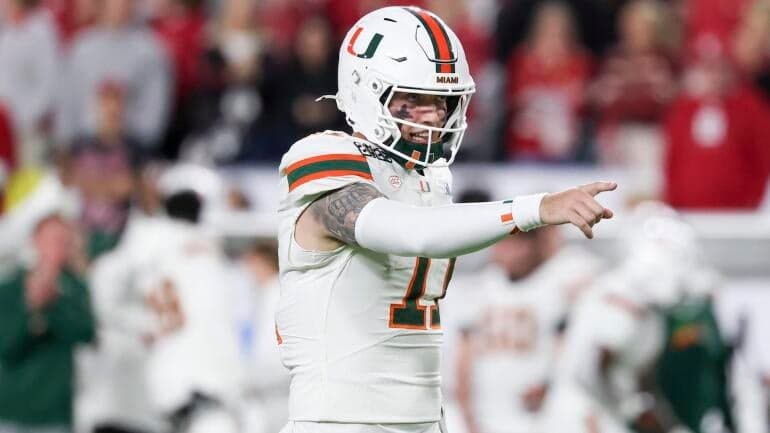
| 2. | Carson Beck | Miami | 2.02% | 3,813 yards, 30 TD, 12 INT |
| 3. | Diego Pavia | Vanderbilt | 1.90% | 3,539 yards, 29 TD, 8 INT |
| 4. | Joe Fagnano | UConn | 1.76% | 3,446 yards, 28 TD, 1 INT |
| 5. | Luke Altmyer | Illinois | 0.22% | 3,007 yards, 22 TD, 5 INT |
| 6. | Ty Simpson | Alabama | 0.06% | 3,567 yards, 28 TD, 5 INT |
| 7. | Cade Klubnik | Clemson | -0.88% | 2,943 yards, 16 TD, 6 INT |
| 8. | Joey Aguilar | Tennessee | -1.09% | 3,565 yards, 24 TD, 10 INT |
| 9. | Jalon Daniels | Kansas | -1.12% | 2,531 yards, 22 TD, 7 INT |
| 10. | Drew Allar | Penn State | -1.21% | 1,100 yards, 8 TD, 3 INT |
| 11. | Haynes King | Georgia Tech | -1.41% | 2,951 yards, 14 TD, 6 INT |
| 12. | Behren Morton | Texas Tech | -1.48% | 2,780 yards, 22 TD, 6 INT |
| 13. | Taylen Green | Arkansas | -1.91% | 2,714 yards, 19 TD, 11 INT |
| 14. | Garrett Nussmeier | LSU | -3.12% | 1,927 yards, 12 TD, 5 INT |
| 15. | Sawyer Robertson | Baylor | -4.45% | 3,681 yards, 31 TD, 12 INT |
Fernando Mendoza's score of 8.61% means his score was 8.61% better than the average score of the current class. Sawyer Robertson's score of -4.45% means he was that much worse than the average score. As you can see, most of the players in this class are near the average score, but Mendoza is leaps and bounds ahead of everybody else.
Mendoza's score ranks eighth all-time among the 181 players I've tracked over the last 15 years. It's a great score! It's also the only score in this entire class that ranks in the top 50. Carson Beck's score of 2.02% is good for second in this class but ranks 59th all-time.
What's even more remarkable is this: this is the first season since I began tracking in which the average score of a QB class dropped from one year to the next since the 2022 class. However, the 2021 class score was the highest of all time and can be attributed to an entire season of games played in empty stadiums and fewer games overall, so I don't really consider that a reliable marker.
Furthermore, not only did the average score drop for the first time, but it's the lowest average score of any class since 2018. This is why I use percentiles rather than the raw average. Quarterback play is improving every season at the college level due to advances in both training/practice habits as well as offensive design (not to mention rule changes that help offenses).
In other words, it's not just your eyes telling you this QB class isn't great. The numbers back it up.
As for what the numbers mean for the future, they do not guarantee that Fernando Mendoza will lead the Las Vegas Raiders to greatness. His score more strongly suggests that he's not going to be a bust. No, the busts are usually the players who finish with negative scores.
For every Josh Allen (-1.65%) or Lamar Jackson (-2.92%) that breaks through, there are a lot more Anthony Richardsons (-5.28%), Drew Locks (-5.37%), Kenny Picketts (-2.17%) and Josh Rosens (-2.44%). From what I've noticed, the players who overcome the negative scores are typically the tremendous athletes like Allen and Jackson. After all, my formula only accounts for what a player does as a passer in college; it does not take into account their rushing output. Also, in the case of Josh Allen, he had a small sample size when it came to performances against top-50 defenses (he played at Wyoming), and his accuracy in college was a serious issue. He has improved across the board at the NFL level.
Mendoza truly did blow the doors off everybody else in the class. He finished second to Miami's Carson Beck in performance against top-50 defenses, but only by 0.2 points (minuscule). Nobody came close to him in third/fourth down situations or in the red zone. I don't know how well he's going to perform at the next level. Like most players, the organization he's a part of will play a large role there. That said, I would be extremely hesitant to use a first-round pick on any other player in this class. If I were running an NFL team and needed a QB, I'd probably tank this year and try my luck next spring.
Beck is an interesting case. Alabama's Ty Simpson is the name you hear the most often as a possible first-rounder, but I think Beck is the smarter choice. He certainly has flaws of his own, but he spent his entire career playing at winning programs, and while there are blemishes on the resume (he has a knack for mind-numbing interceptions), the closer I look, the more convinced I become that Beck will have the second-best career among this class.
I was surprised by Pavia's score, but only because I felt so much of his utility came with his legs. Pavia didn't finish lower than seventh in any of the three categories and was second behind Mendoza in red-zone situations. If he were 6-foot-1 or 6-foot-2, he might be a first-round pick, but he's not. He's 5-foot-10, and that's going to matter quite a bit.
If I were to bet on one player with a negative score to break through, it'd be Arkansas' Taylen Green. He's nearly 6-foot-6 and ran a 4.36 40 at the combine. As I mentioned earlier, it's the tremendous athletes who seem to break the negative score curse here. I won't be shocked to see a QB-needy team take him in the third round as a lottery ticket.
Some NFL front offices will fall in love with Drew Allar because of his measurables. I know this because I did when he first showed up at Penn State. But, man, for whatever reason, the production just is not there, and it's reflected in his score. Never say never, but unless there's a level of confidence that suddenly emerges in him that I never saw at Penn State, I don't see it happening.
These ratings are a nice tool to have and look at, but they're only a part of my final evaluations. Here's how the 2026 NFL QB Class stacks up on my big board.