
NBA
Blazers' lack of fan T-shirts invites questions
Portland Trail Blazers to skip fan T-shirts for playoff games
ESPN News1 min read

It’s NFL Draft week! Analyst Joel Smyth breaks down the 2026 RB class for fantasy football. With several teams looking for hope this offseason, who are the college running backs that can provide fantasy value for your teams?
Measurables: 6'0", 212 lbs
Projected Draft Pick: Top-10 Selection
The NFL RB class in 2026 is virtually Jeremiyah Love, and then everyone else. After 40 touchdowns over the last two seasons and a third-place finish in Heisman voting, the Notre Dame star is projected to be a top-10 pick in the NFL Draft. It’s rare company as a running back, as only six others have been selected inside the top-10 over the last 10 years.
He is clearly a talented RB, but maybe the most important part of his fantasy value comes in the receiving game. If he wanted to play receiver, he could. His innate ability to make plays in the passing game sets him apart from other first-round RB talents. Jahmyr Gibbs, Christian McCaffrey, and Bijan Robinson were the top-three fantasy RBs last season in PPR leagues. Guess who were also the top-three in receiving fantasy points? De’Von Achane was close behind, and even Jonathan Taylor ranked 14th in points through the air.
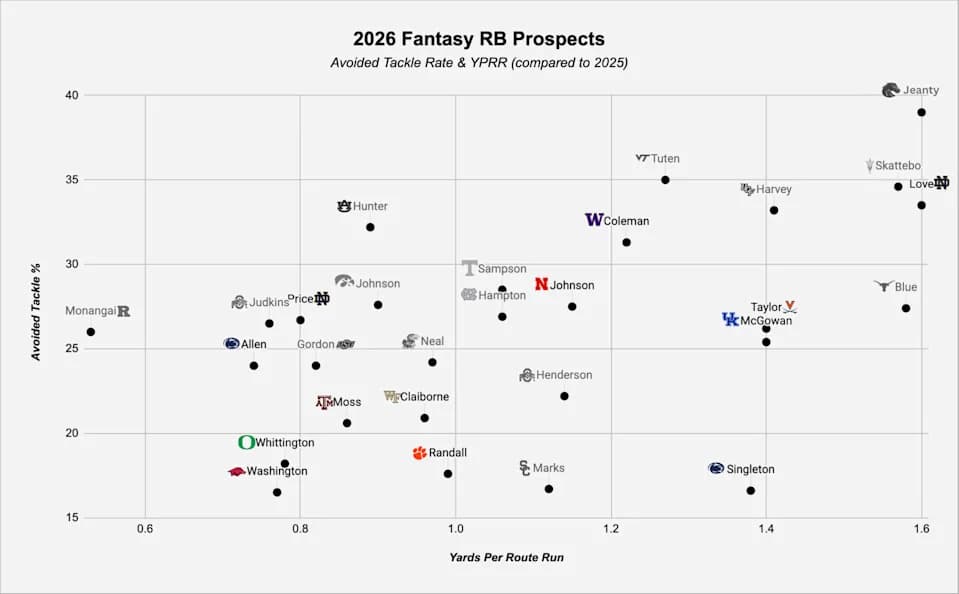
Here's a look at avoided tackle rate and YPRR compared to 2025.
The skill earns the draft capital, and top-level draft capital usually equals long-term opportunity as a bellcow. And most of the time, it works right away. The last eight RBs drafted top-12 averaged 17.3 PPR fantasy points per game in their rookie season, with the two lowest being Robinson and Ashton Jeanty, who, although they produced and looked the part, were held back by their team. Over the last decade, nearly half of Round 1 RBs have turned into immediate fantasy RB1s, with only a few failing to be at least an RB2. When you combine talent and volume potential, the product tends to pan out.
Even though we’ve seen players like Robinson and Jeanty struggle early because of other factors, it doesn’t always mean that “poor” landing spots equals poor rookie seasons. Saquon Barkley’s overall RB1 season on the 2018 Giants, Leonard Fournette in Jacksonville, Breece Hall on the Jets, and many more show the elite of the elite can overcome most faults. Tennessee and other landing spots may be flawed, but they are nowhere near the only factor in play for Love’s Year 1 success.
The two main factors to keep an eye out for are true competition and pass blocking (primarily signs via coachspeak in the preseason). Love will be selected in August drafts to be a fantasy RB1, meaning he would most likely need bellcow volume for the majority of the season. For Jeanty, this wasn’t an issue, but when Rhamondre Stevenson or J.K. Dobbins are playing efficient football, 50% of the touches becomes a problem. At that point, you’d have to get Gibbs’ level of receiving, which brings me to my next area.
Pass blocking is one of the major growth areas for young backs. It doesn’t score any fantasy points, but it does keep them on the field in valuable passing situations. Love’s PFF pass blocking grade last season at Notre Dame was an underwhelming 55.5. With the bottom-three NFL RBs in pass blocking grade from 2025 being rookies, it’s something to monitor.
Overall, when it comes to fantasy, I see Love as a worthwhile ceiling pick. Recency bias hurts the perception of top rookies after Jeanty and Robinson failed to live up to expectations. If Love drops in drafts out of fear, I like the hope of him paying due with a rookie season more similar to Gibbs and the RBs from a few years back, such as 2022 Hall (pre ACL), 2021 Najee Harris and the dominance of rookies from 2016-2018.
Measurables: 5’11”, 203 lbs
Projected Draft Pick: Early Round 2
Right behind Love at Notre Dame and in the consensus rankings is Jadarian Price. He is the main reason Love doesn’t have much tread on the tires through college and will have even less after only 295 touches. For comparison, Jeanty finished college last season with 830, and CMC had 413 NFL touches in 2025 alone.
Being second to Love isn’t much of a negative. We saw just last season Quinshon Judkins and TreVeyon Henderson be selected inside the top-four RBs after playing in the same college backfield and both flashed in their rookie seasons. Price should be selected around the same range as the OSU pair from last season, with Seattle at 32 becoming a popular mock-draft spot. Dating back to 2015, 43% of Round 2 RBs have averaged 12+ PPG as rookies, or right inside the RB2 range.
I see Price as similar to Blake Corum in fantasy. The Rams’ running back was a Day 2 selection out of Michigan, known for his short-yardage ability rather than his receiving, but was much smaller than your average power back. Price was the Irish’s goal-line back in college, even though he weighs in right around 200 lbs. I’d expect him to slide into a similar committee role that has upside if injuries were to occur.
Measurables: 6’1”, 223 lbs
Projected Draft Pick: Early Round 3
In terms of long-term value, Achane stands alone among Round 3 RBs since 2020. Others, such as Bucky Irving, Chase Brown and even Cam Skattebo, have been drafted later on, but the overall odds are not in favor of these RBs. Can Washington and the following running backs join those late-round heroes?
A few months ago, Washington was seen as just another Day 3 RB. Then came the offseason. After popping at the Senior Bowl, Washington went on to have a historic combine with athletic testing that made him impossible to ignore. Although he didn’t do agility drills, Washington finished with a 10.00 Relative Athletic Score, AKA the most athletic running back of all-time. The hype has brought him all the way up to third among RBs in the consensus draft boards.
So if he was the most athletic running back in combine history, why was he originally going to be drafted in Round 5? If you scroll back up to the graph in Love’s breakdown, you'll see the college production for the Arkansas RB… at the worst point possible. He was great in 2025, don’t get me wrong, but those analytics are career long. What matters more is the question. One breakout year in the SEC as a fifth-year senior, or his first four so-so years at smaller schools?
Round 3 draft capital for fantasy RBs is high in 2026. If he lands in a running back-needy spot rather than falling to Round 4 or being selected as an RB2, then the upside is still very evident.
Measurables: 5’8”, 220 lbs
Projected Draft Pick: Round 3
Washington’s Jonah Coleman is a 180 from Washington’s prospect profile. He’s not the most athletic running back in the world, measures in at 5’8”, and yet performed well on the field his entire career. His college production wasn’t at an Jeanty level, but he was able to put up great numbers all around as a receiving power back. He won’t hit the home runs, but he won’t put the ball on the turf or drop any passes coming his way either.
In his first eight games of 2025, Coleman scored versus every team not named Ohio State. His leg injury to end the season heavily impacted his last month of play on top of taking him out of NFL Combine workouts. He’s now back to full health and ready to contribute early.
The odds of becoming a weekly staple are against him, though his skill set as an all-around player helps. I see Coleman being a solid backup at RB, maybe not a plug-and-play starter, but one who could take on a large workload when necessary.
Measurables: 5’10”, 202 lbs
Projected Draft Pick: Round 4
Emmett Johnson was one of the only players at the NFL Combine to go through all the testing, which I applaud him for, but it didn’t help his stock. The Nebraska running back broke into the scene in 2025, leading the Big Ten in rushing after largely being a non-factor before this season. The production in his final year helps mask the lack of athleticism, especially when focusing on games versus top competition.
He had 239 yards versus Iowa in his final game of his college career, 151 against Penn State and another 97 versus Michigan. He did not have a bad game all season! The 85 yards he had versus Houston Christian was his lowest, and believe it or not, it was due to a lack of touches in a blowout rather than the stout defense of HCU.
Johnson does just about everything right, just with somewhat limited capabilities. He’s most likely to be a rotational player who can slide into multiple roles at the next level.
Measurables: 6’0”, 219 lbs
Projected Draft Pick: Round 4
The Penn State back was once seen as a staple of the 2025 RB class. It’s now 2026 and he will most likely be selected in Day 3. The former No. 1 RB out of high school never fully lived up to his sky-high potential after a dominant freshman season. That ended up as the top rushing year of his career, with his final season in college being his worst.
For such a fun and talented player, it raises major concerns with his rushing analytics falling off dramatically alongside production. He’s extremely strong, setting Penn State squat records, and is no doubt very athletic, but it hasn’t fully translated at a consistent level. Still, he is projected as a Round 4 selection, which can still be considered somewhat early for modern running backs. “The new Round 3 RB is a Round 4 RB”.
Singelton’s main strength entering the league is his receiving ability. Of the top RB prospects in the class, only Love has a higher yards per route, as Singleton’s rivals RJ Harvey’s from last year’s class. The chances are low, but I’d rather hope in Singleton’s upside over most in this range because of his receiving and natural talent.
Measurables: 5’11”, 216 lbs
Projected Draft Pick: Round 4
Penn State in 2022 didn’t have one star freshman RB, but two. Unlike Singleton, however, Allen’s best season by far came in 2025, averaging over 100 rushing yards per game. His receiving is sub-par at best, especially compared to that of Singleton, but his reliability as a rusher will be attractive to teams on Day 3.
Allen showed off his workhorse capability down the stretch after 3.5 years of split time. In his final six games, he averaged 23.3 carries for 139.3 rushing yards after beginning the season with 11.7 carries for 77.8 yards. If he can secure a short-yardage role, he could be a solid bench option in fantasy down the line.
Demond Claiborne, Wake Forest — A small, speed back that can also contribute on special teams. Despite his build, he’s not the strongest in the passing game, both receiving and blocking.
Seth McGowan, Kentucky — The biggest cons are off-the-field issues and age. After an arrest and bouncing around outside the FBS, McGowan proved he belonged the last two seasons. More of a dirty-work RB than an explosive back, which isn’t necessarily ideal for fantasy.
Le’Veon Moss, Texas A&M — Injuries are the story for Moss. The raw numbers don’t pop off the page, but the tape will get him drafted. With a lack of RB depth in the class, I’d rather take a dart throw on Moss in dynasty leagues and hope he stays healthy.
J’Mari Taylor, Virginia — Would be an extreme outlier if he is more than just a receiving-role player. Taylor played five seasons in the FCS before his sixth-year senior season at Virginia, where he put up an impressive 113 scrimmage yards per game versus Power-4 opponents.
Adam Randall, Clemson — This year’s Brashard Smith. A WR for his first three seasons, turned RB in his senior season. After over 1,000 yards and 13 TDs, he’s intriguing as a 6’3 speedy-receiver RB, an oddly rare combo.
Portland Trail Blazers to skip fan T-shirts for playoff games

Steph Curry and Paige Bueckers party at Coachella 2026!

Duke center Patrick Ngongba II announces return for next season after NBA draft consideration.

John Korir wins Boston Marathon with a record time of 2:01:52!
Texas Longhorns football celebrates inclusion in Junior Tuupo's top five!
Chicago Bulls kick off search for new head of basketball operations, interviewing multiple candidates.
See every story in Sports — including breaking news and analysis.