
SoccerInjury Update
Injured White a major doubt for World Cup
Arsenal's Ben White out for the season, doubtful for World Cup.
Sky Sports1 min read

The NCAA Tournament will expand to 76 teams, while the College Football Playoff is likely moving to a 24-team format. This expansion aims to increase revenue for power conferences amid rising player compensation demands.
Getty Images
A frenzy of postseason expansion has officially engulfed college sports, as the disjointed enterprise barrels clumsily toward a future designed to extract every possible dime from a system that must support unfettered player compensation. The next NCAA Tournament will be the first to feature 76 teams, and the next College Football Playoff is likely to be the last featuring only 12 teams.
While the specifics of CFP expansion are still being hammered out, a 24-team format championed by the Big Ten seems most likely.
The power conferences pushing for postseason expansion are eyeing future brackets that feature more of their teams competing in matchups that they hope will funnel more TV revenue into their budgets. A decade ago, their budgets could be spent on lavish facilities upgrades, exorbitant coaching salaries, non-revenue sports and a small army of associate athletic directors with nebulous titles and six-figure salaries.
Now, schools must also worry about how to pay their on-field talent. In an era when a top-10 college basketball roster costs around $15 million and a similarly competitive football roster might come in around $30 million, the squeeze is on. Between more than $20 million in revenue-sharing obligations and the redirection of millions more in donor contributions to third-party athlete compensation avenues, the well is running dry under the old model.
[With NCAA Tournament expansion imminent, some of the game's biggest coaches still aren't sold on the idea
Matt Norlander

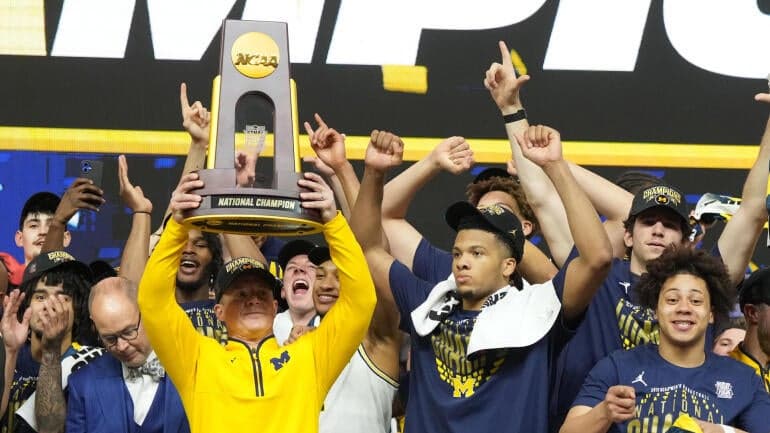
The NCAA Tournament will feature 76 teams starting in 2026.
The College Football Playoff is expected to expand to a 24-team format.
Power conferences aim to increase their representation in tournaments to boost TV revenue.
The need to support unfettered player compensation and maximize revenue is driving the expansion.
Arsenal's Ben White out for the season, doubtful for World Cup.

Xabi Alonso faces a tough choice between Chelsea and his dream job at Liverpool.
Paul Skenes is the frontrunner for the NL Cy Young Award in 2026.

Discover how Chad Mustard transitioned from basketball star at UND to NFL journeyman.
UND women's track and field team aims for Summit League title in Fargo.
Chargers ink 2nd-round pick Jake Slaughter as they finalize draft class.
See every story in Sports — including breaking news and analysis.
Thus, we get a mad dash for postseason expansion and a host of winners and losers that come from the fallout.
If the CFP existed under a 24-team format last season, five of the additional 12 bids would have gone to teams from the Big Ten and SEC. The Big 12 would also have been a huge winner with four additional teams. Meanwhile, the already treacherous paths for Group of Six qualifiers James Madison and Tulane would have only become more difficult. Instead of needing to win four games to claim a national title, JMU and Tulane would need to win five games.
The likelihood of a G5 team ever being a true factor in the CFP was already slim. It will become even slimmer with expansion, even if expansion occasionally makes it easier for the G6 to get two representatives. A 24-team CFP might as well be branded as the Power Four Playoff.
Similarly, NCAA Tournament expansion will result in six play-in games between the bottom 12 teams in the bracket, each of whom are coming from low-major leagues. Thus, by the time Thursday rolls around and the bracket is down to 64, a larger percentage of the teams still standing will be from the high-major ranks. As a result of expansion, many quality mid-major conference champions will also be dropped a seed from where they would have slotted under the old 68-team format. Consequently, they will face more challenging opponents in the round of 64, which will only heighten the challenges they face in advancing through a tournament that will be dominated more exclusively by the big spenders from the high-major leagues.
[Winners and Losers of NCAA Tournament Expansion: Who benefits or suffers in new 76-team March Madness bracket
David Cobb

Expansion wouldn't be happening if the major conferences didn't want it, and even though the SEC and Big Ten don't see eye-to-eye on CFP expansion, both leagues are operating from positions of strength. They are the CFP decision makers. Similarly, they were the driving forces behind NCAA Tournament expansion.
There will be fewer high-stakes showdowns between highly ranked teams in college football's regular season if/when the playoff expands to 24. If you're looking for consequential postseason stakes in a late-season contest under a 24-team format, they are more likely to be found in a game between 7-4 Minnesota and 7-4 Wisconsin competing for the No. 23 seed than they are to be found in Michigan vs. Ohio State.
In a bygone era, Ohio State's 13-10 loss to Michigan to close the 2024 regular season would have cost the Buckeyes dearly. It was Ohio State's second loss, and it would have eliminated the Buckeyes from consideration for the 4-team playoff. It also would have eliminated them from any consideration for a spot in the title game under the old BCS system.
But in the 12-team CFP, the Buckeyes landed as the No. 8 seed and hosted a first-round game. While the 2024 Michigan loss cost Ohio State a first-round bye, it didn't hinder its championship march. The penalty for a loss to Michigan under those same circumstances would be even lower in a 24-team CFP. The Buckeyes still would have received a first-round bye with a win or a loss to the Wolverines.
Plenty of games will still feature significant postseason stakes around the cut line for the 24-team CFP, and there will be some significance for teams around the cutoffs for first-round byes or first-round home games. But, on the whole, top-10 showdowns won't mean what they used to mean. The margin for error for those teams will be too great, which devalues the significance of what has always been America's most important regular season.
Alternative postseason events were already waning in significance. Seeing teams decline NIT bids or bowl invites has become an annual occurrence. But the appetite to compete in a non-championship postseason event will only diminish amid expansion fever, especially for power conference programs.
This past season, we had interesting non-CFP bowl matchups that were actually worth watching. The Pop-Tarts Bowl (Georgia Tech vs. BYU), TaxSlayer Bowl (Virginia vs. Missouri), Texas Bowl (Houston vs. Texas), Alamo Bowl (USC vs. Texas), Citrus Bowl (Texas vs. Michigan) and ReliaQuest Bowl (Iowa vs. Vanderbilt) were each examples of competitive games between teams who missed the 12-team playoff. But in a 24-team playoff, none of those matchups would have happened as bowl games.
Perhaps playing in a bowl will still be enticing to Group of Six programs or lower-tier Power Four teams. But a 24-team playoff would cut off what little oxygen bowl games still had in the 12-team CFP era.
Similarly, the pool of basketball teams for the NIT and College Basketball Crown to pull from will only get worse amid NCAA Tournament expansion. We'll be just fine if the College Basketball Crown ceases to exist, but bowls and the NIT are part of the historic fabric of college sports, and postseason expansion pushes them to the brink of extinction.
Coaches and the agents who have constructed contracts with lavish bonuses for postseason appearances will make out like bandits. Most deals contain nice payouts for reaching the NCAA Tournament or College Football Playoff. Achieving those milestones will be significantly easier in the postseason expansion era, which means more cash will flow into their pockets.
Common sense suggests that future deals will feature less lucrative incentives for merely reaching the CFP or NCAA Tournament. Qualifying for a 76-team NCAA Tournament should be the bare minimum level of achievement for a high-major college basketball coach. But common sense also suggested that coaching salaries would plateau in the player compensation era. That hasn't happened. In fact, Alabama football coach Kalen DeBoer now makes more than Nick Saban.
If you thought the 2025 college football coaching carousel was wacky with three head coaches of CFP teams accepting new jobs before the CFP began, buckle up. That will likely become an annual tradition if the CFP expands to 24. Outside of a drastic alteration to the recruiting/portal calendar, teams with vacancies will be pressured to get hires lined up in time for the Early Signing Period in early December. They will be looking at playoff-caliber coaches, which means we're going to get more situations like the ones we had with Lane Kiffin (Ole Miss to LSU), Bob Chesney (James Madison to UCLA) and Jon Sumrall (Tulane to Florida). Chesney and Sumrall stayed with their former schools through the CFP, but they were pulling double-duty.
Within college basketball, the value of a conference tournament championship for high-major schools is already up for debate. The physical toll of playing 3+ games in consecutive days the week before the NCAA Tournament begins is significant. Additionally, most teams in the running for a conference tournament title have already secured their spots in the NCAA Tournament. That will only become more true amid expansion 76. Conference tournament titles are meaningful for the winners, and they can have some level of impact on the bubble discussion. But on a certain level, they are glorified postseason jamborees.
In college football, momentum is growing for the eradication of conference championship games altogether. Winning a conference championship used to mean something. But in an era when Duke can win the ACC title game and not even reach the 12-team CFP, their diminishing significance has never been more obvious. Why expend the effort to play a physically grinding contest against a quality opponent when it's likely to have a negligible impact on your CFP seeding?