SoccerTransfer
Arthur Melo is now expected to return to Juventus in the summer
Arthur Melo is expected to return to Juventus after a loan at Gremio.
Yahoo Sports1 min read
Tyler Andrews and Karl Egloff are set to attempt a speed record on Mount Everest's south side during the upcoming climbing season. Both athletes bring unique backgrounds and skills to this challenging endeavor.
Mentioned in this story
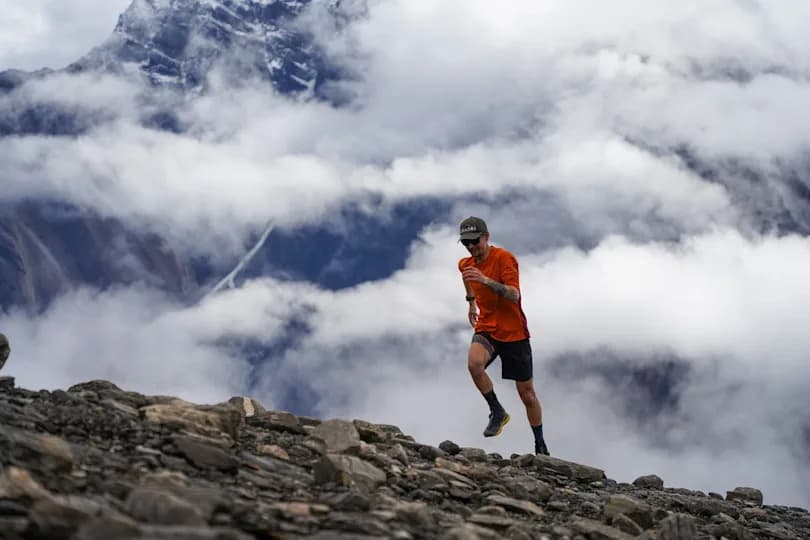
Tyler Andrews in the Nepal Himalayas Chris Fisher
Climbing the tallest mountain on earth is such a battle—against the wind and the cold and against the snow and the thin air—that vanishingly few people even think about trying to move fast on Mount Everest. When the mountain’s meager, roughly two-week-long climbing season opens later this month, though, two super athletes will aim to dash up and down the south side—the Nepali side—in record time, in a season when the mountain will be, dangerously, may be more crowded than ever.
Karl Egloff and Tyler Andrews are a study in contrasts. Egloff, 45 and inclined to metaphysical meditation, is Ecuadorian-born resident of Switzerland. His father was a mountain guide; he began climbing Ecuador’s giant peaks in pre-school and later became a world-class mountain bike racer. Andrews, who’s 35, grew up in the suburbs of Boston. He was a high school band geek before becoming, in college, a talented distance runner. Now a 2:15 marathoner he lives in Quito, Ecuador, training in the same cragged Andes that shaped Egloff. He only dedicated himself to big mountain running when the pandemic shut down road racing, but then he went big. In 2021, he emblazoned his chest with a huge tattoo of Rucu Pichincha, the Ecuadorian volcano on which he frequently trains.
Karl Egloff, who is attempted to set a record on Mount Everest, poses on a snowy mountain. Courtesy Geigele Communications
Neither Egloff nor Andrews are among the 7,500 or so people who’ve stood atop Everest since Sir Edmund Hillary made the world’s first-ever trip to the top in 1956. Now both will climb with the aid of fixed ropes but without supplemental oxygen as they try to make record time, round trip, over the mountain’s most popular route. They’ll begin in the Everest Nepali Base Camp, at 17,598 feet, then they’ll climb the dangerously shifting Khumbu Icefall. They’ll push on through a gentler glacial valley, the Western Cwm and continue on up the steep, icy Lhotse Face towards the mountain’s two most congested spots–the Cornice Traverse, only two feet wide in places, with thousand-foot drop-offs on both sides, and then the Hillary Step, an almost sheer ice slope, which sits 200 vertical feet beneath the summit, making it a place where big mountain newbies often stand in conga lines, waiting and freezing.
Tyler Andrews is a 35-year-old distance runner from Boston, while Karl Egloff is a 45-year-old Ecuadorian mountain athlete residing in Switzerland.
They aim to climb Mount Everest's south side in record time during the mountain's climbing season.
The climbing season is expected to be more crowded than ever, increasing the risks associated with climbing the mountain.
Egloff has a history in mountain climbing and biking, while Andrews transitioned from road racing to mountain running during the pandemic.
Arthur Melo is expected to return to Juventus after a loan at Gremio.
Analyst suggests Celtics should rest Jayson Tatum for Game 7 against 76ers

Packers sign five 2026 draft picks; only Cisse left unsigned
Winter Olympics champion Matt Weston receives freedom of Crowborough
Juan Soto's choice to join the Mets over the Yankees backfires.
The Vikings made significant improvements to their secondary in a unique NFL Draft re-do, selecting All-Pro cornerback Derek Stingley Jr. after franchise tagging Justin Jefferson. This mock draft combined players from the last five draft classes in an unprecedented format.
See every story in Sports — including breaking news and analysis.
Except in a few flattish places, Egloff and Andrews won’t actually be running–think of them as power walking in uber adverse conditions. They won’t be racing either. The two climbers aren't likely to depart basecamp simultaneously, and if Andrews got his way he wouldn’t even be scaling the same route as Egloff. His original scheme was to climb the north side of Everest in pursuit of a record set by Killian Jornet, a Spaniard who in 2017 went up and down that face of Everest without oxygen in 26 hours. He reasoned that the north’s “longer, more gradual approach plays to my strengths. It’s more trail-running in character.” But the China-Tibet Mountaineering Association isn’t issuing permits to climb the north side this year, so we’ll soon have Ali-Frazier in the Himalayas.
Or something like that. The two climbers have spent the past several months insisting, in stiff, gentlemanly tones, that they’re not competing. Andrews: “Karl has been a huge inspiration for me.” Egloff: “Well, we know each other. We spent time on base camp last year. He has his goals, and I have my goals.”
While Andrews will try to speed up and down, he’ll focus mainly on the South Face’s no-bottled-oxygen ascent record–20 hours, 24 minutes, set in 1998, by Kenji Sherpa. “The ascent record,” he explained to National Geographic, “is where the competition and the history live."
There isn’t a widely publicized round-trip record for Everest’s south side, but that matters not to Egloff, who views up and down as inextricable. “A mountaineer has to climb the mountain and also descend the mountain,” he explained to NG, “and to me, looking for ways to be safe and to conserve your energy on the way down is just part of the chess game.”
Egloff’s and Andrews’s quest for records will play out amid multitudes. With the north side effectively closed this year, all Everest climbers will gravitate to the south side, and the Nepali government has issued 450 climbing permits, much more than in most years. Factoring in Everest’s Sherpa guides, who don’t need permits, there could be up to 900 people plying the same route as the record seekers–and they’ll be doing so amid a new danger.
The legendary team that sets ropes on the Khumbu—the Icefall Doctors—was stalled for over two weeks this year, thanks to a 90-foot high-pillar of ice, or serac, hanging above the falls. They were only able to open a path through the Khumbu on Tuesday, after the serac partially melted and crumbled, and it's still unclear when the route to the summit will be fully roped and opened. Everest’s climbing season could be compressed, its usual bottlenecks worse than ever.
Meanwhile the serac is still very much there on the Khumbu, albeit downsized. It looms precariously above the route climbers will take up the icefall, and according to the Sagarmatha Pollution Control Committee, which oversees the Ice Doctors,, this serac “has multiple cracks and may collapse at any time.
“Move quickly through this section to minimize exposure time,” the SPCC advised climbers in a recent press release.
Thom Pollard, a mountaineer and filmmaker who hosts the YouTube channel Everest Mystery, says the record seekers “are going to want to avoid the crowds at all costs. So it's going to put the pressure on them to either go early or wait until the very end.”
Pollard suspects that the speed climbers will coordinate with the Expedition Operators Association of Nepal in hopes they can begin moving toward the summit the moment the ropes are set. They can also deploy scouts to radio base camp when crowds are thin, and if there’s a short, climbing-friendly weather window, Egloff and Andrews might be able to exploit it and climb an unpeopled mountain.
But there’s a good chance the speed climbers will find themselves mixing with slower climbers and beseeching them to let them squeeze by on the rope-lined route. As Pollard sees it, this could prove both obnoxious and harrowing. “A lot of these people,” says Pollard, “they’ll be like, ‘I just shelled out $40,000 to climb this mountain, and I’m not stopping.’” To pass such plodders, Pollard says, faster climbers often unclip and then take a couple steps either uphill or downhill. “This,” he says, “amps up the danger” for the faster climbers. In 2024, when a cornice high on Everest collapsed, six climbers began sliding downhill. Four of them were roped in and stopped sliding. But the other two, Daniel Paul Paterson, a Brit, and his Nepali guide, Pas Tenji Sherpa, were unclipped. They slid to their death.
Through a publicist, Karl Egloff declined comment on the unclipping issue. Andrews insisted he won’t take the risk of unclipping. “I always have two safety cables on my harness,” he explained, “so if I'm passing someone, I can stay clipped in on the downhill side and clip my second cable around them on the uphill side before unclipping the downhill side.”
Neither Egloff or Andrews are revealing how they’ll decide when to leave base camp. But it’s a safe bet that they’re agonizing over their 2026 Everest tack: Both are veterans of failed attempts on the 29,032-foot mountain.
Last May, Egloff spent 50 days in Nepal. When he finally went for the Everest summit late in the climbing season, he made it to 23,000 feet, but then extreme cold and brutal winds compelled him to turn back. Failure left him feeling depressed–ensconced, as he wrote on Instagram, “in a strange silence” and “emptiness.”
Andrews, meanwhile, made three summit bids last spring. On his first go, the zipper on his boot broke. Soon, snow encrusted his foot, threatening frostbite so badly he had to descend. Later, he bowed to the same windstorm that defeated Egloff and then made a final spring attempt, only to discover that he was spent. At 26,000 feet, he vomited; he hallucinated. On the plane home to Quito, he reckoned that he’d have to wait a whole year to try Everest again. “Oh my gosh,” he thought dejectedly. “That's a really long time.”
But then Andrews learned that a Polish ski mountaineer, Andrzej Bargiel, would be visiting Everest in September, in hopes of becoming the first person ever to schuss from the summit to Base Camp. Sherpas would be setting climbing ropes for Bargiel. Andrews returned to the mountain, wildly hopeful–Everest is almost empty of people in the fall. It’s more deeply buried in snow, however, and this makes hurrying harder. In his first autumn attempt, Andrews fell into a crevasse low on the mountain–on the Khumbu Ice Fall–and found himself dangling from a rope. Later, he got stopped by snow drifts. He tried again a few days later, and once more the drifts forced him to abandon his summit quest.
After such defeats, what makes Egloff and Andrews think that this year they can overcome the crowds and successfully speed-climb Mount Everest?
As Tyler Andrews sees it, almost anything can be achieved via dogged determination. The 5’8,” 130-pound harrier has in recent years notched fastest known times on some imposing peaks–on Kilimanjaro, for instance, and on Nepal’s Manaslu, the world’s eighth tallest mountain–but only by muscling past steep odds.
Thirty years ago, at age six, Andrews missed half of first grade and spent three weeks in Massachusetts General Hospital struck by a rare disease, aplastic anemia, which left his bone marrow scarcely producing blood cells. At the time, nearly 30 percent of juveniles suffering aplastic anemia didn’t survive.
Andrews underwent chemotherapy and numerous blood transfusions; in time he recovered fully. But when he ran cross-country in high school, he typically finished his five-kilometer races a half-mile back from Massachusetts’ prep-school elites. Athletic stardom seemed unlikely when Andrews began at Tufts University in 2010, bringing with him a guitar, a banjo, a mandolin and his pet turtle, Esther, but at Tufts he ran up to 140 miles a week. He practiced “heat training,” donning full sweats on scorching spring days, and before graduating he lopped almost four minutes off his high school 5k personal record, running 14:45.
Andrews moved to Ecuador in 2013 and then ran in the US Olympic Marathon Trials in 2016 and 2020. Eventually, he set his sights on notching FKTs (Fastest Known Time) in the mountains–and also, it seems, stepped up his self-flagellation. On on a single day early in 2026, Andrews woke up at 3:30 a.m. and did two hours of sprints on a 19,347-foot Ecuadorian volcano, Cotopaxi, then ran more sprints, this time on a treadmill, and then immediately transitioned to a two-hour weight workout.
In January, Andrews shattered the Cotopaxi FKT, set by Egloff in 2022, by more than five minutes. He ran up and down in 1 hour, 21 minutes and 49 seconds and then issued what sounded, in the context of the uber polite Andrews-Egloff showdown, almost like a taunt. “Now, well,” he said to his elder on Instagram, “it’s your move.”
Several days after Andrews’ Cotopaxi dash, Egloff told a reporter he didn’t even know about the American’s climb. He doesn’t track what Andrews does, he claims. He was a top soccer prospect as a teen, and after he began racing bikes at age 26, it took him only a year to make it onto the Ecuadorian national team and one more year to reach the World Cup circuit. In his dozen years as a competitive mountaineer, he’s held speed records on the highest peaks on four continents–Africa’s Kilimanjaro, North America’s Denali, South America’s Aconcagua and Europe’s Mount Elbrus.
Egloff is not young, though, and last year he experienced what he called “athletic burnout” for the first time. He complained of “mental fatigue” and “lack of motivation” and on social media he asked of Everest, “Shall I do it again?”
He recharged his batteries by spending time at home in Switzerland with his wife and two children, and then in September he decided that he would try Everest one last time. This winter, he spent three monkish months training in the mountains of his native Ecuador. He logged over 230 hours sleeping in a hypoxic tent, subsisting on air as oxygen-deprived as the flanks of Everest.He’s spoken of his training, just as punishing as Andrews’, with both hope and a spare wistfulness. “Cold mornings,” he wrote recently to his followers. “Thin air. Legs that don’t always want to move. Inclines. Long runs. Bike. Breathing hard. Ego quiet. Some days feel strong. Some days just feel honest.”
As Egloff sees it, his age and his meditative outlook are assets. “One of the most important tools a climber can have,” he told National Geographic, “is patience. On Everest, you have to know when to push and when to get out.”
Patience combined with fitness may not prove enough, though. Dawa Steven, an 18-year Everest guide who will serve as the leader of Andrews’ expedition, believes that another factor is more central to shaping success or failure on the world’s tallest mountain. “You have to be lucky,” Dawa Steven says. “Everything needs to line up for you.” There is the weather and the crowds, he notes, and, “You need to feel well–and not just on the day you climb. No, you need to be up in the mountains, acclimatizing, for a month and a half or two months, and if even a small thing goes wrong–if somebody walks into base camp with the Khumbu Cough, well, then it’s quite possible that your shot at the record is gone.”
Both Egloff and Andrews are in Nepal now, waiting for the perfect moment to climb. It remains to be seen whether this will be, for either one of them, the lucky year.