MLBRecap
Giancarlo Stanton accidentally sent a shot at the Red Sox after Yankees win
Stanton acknowledges fierce Yankees-Red Sox rivalry after recent win
Yahoo Sports1 min read

It may be time to sell high on Munetaka Murakami as fantasy baseball analysis highlights key hitters' skills and luck factors. The article examines bat speed and fast-swing percentage risers to identify potential trade candidates.
Last week, we debuted the weekly hitter skills and luck factors examination, covering Jordan Walker, Cam Smith and more. To identify the players to discuss, we’ll use the Yahoo player rater for the past two weeks to provide a small sample to choose from. Besides those hot hitters on the player rater, we’ll discuss other hitters generating plenty of buzz throughout the fantasy baseball community.
Most of my analysis focuses on hitter skills, luck factors and other underlying metrics that could be contributing to the player’s outcomes. Our first hitter leaderboard involves bat speed and fast-swing percentage risers. Statcast defines fast swing percentage as the percentage of swings at 75 mph or more. Think of fast swing rate as something similar to hard hit percentage. However, I like that the bat speed metrics provide the inputs for potential exit velocity outputs.
We filtered by hitters with 100 plate appearances in 2025 and 10 plate appearances in 2026 to provide a wider sample. Then we examined hitters who had an above-average bat speed at 73 mph or more, with a 25% fast-swing percentage or higher in 2026. That said, here’s a look at the hitters who met those thresholds while showing a 1 mph bat speed increase in 2026.
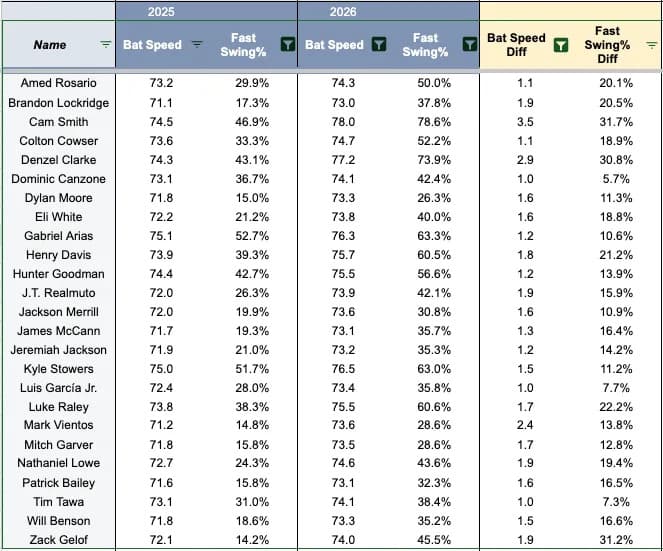
Hitters with an increase in bat speed and fast-swing rate in 2026. (Photo by Corbin Young/Yahoo Sports)
Like any leaderboard, there’s a mixture of noisy and notable players. The most fantasy-relevant players include Cam Smith, Colton Cowser, , , , (on the IL), , , , Luis García Jr., and . That doesn’t mean the rest don’t matter, but , , and others may only be relevant in deeper formats.
Selling high on Munetaka Murakami may be advisable due to his fluctuating performance metrics and potential for decreased value.
Bat speed refers to the speed of the bat during a swing, while fast-swing percentage is the proportion of swings taken at 75 mph or more.
Key hitters can be identified by analyzing their underlying metrics, such as bat speed and fast-swing percentage, along with their recent performance.
Metrics like bat speed, fast-swing percentage, and hard hit percentage are commonly used to evaluate hitters' performance and potential.
Stanton acknowledges fierce Yankees-Red Sox rivalry after recent win
Remco Evenepoel y Specialized firman un acuerdo de por vida, consolidando su larga relación.
Reds lead NL Central but need to buy bats for a Cinderella run
Why the Rams are gearing up for aggressive trades in the 2026 NFL Draft

Clippers owner Steve Ballmer raises fraud concerns about Aspiration's Joe Sanberg ahead of sentencing.
Mike Vrabel seeks counseling and will miss Day 3 of the NFL Draft after photo controversy.
See every story in Sports — including breaking news and analysis.
Meanwhile, we’ve seen Canzone, Smith, Jackson and Raley raise their stock and roster percentages in most formats.
Let’s examine five hitters who have been performing well and whether they’re legitimate or not based on the skill, luck factors and underlying metrics.
Hoerner was a potential player to fade for me earlier in the offseason, but he’s shoved that in my face early on. He’s already hit four home runs in 107 plate appearances; his career-high of 10 homers was in 2022. Since April 5, Hoerner has been consistently deployed in the leadoff spot, which surprised us to see more RBI (22) than runs scored (15). Hoerner’s strong plate discipline remained similar to the career norms, but we’re seeing him pull (42.2%) and lift the ball in the air (41% flyball rate) in 2026. For context, Hoerner’s pull and flyball rates in 2026 have been 6-7 percentage points above his career average.
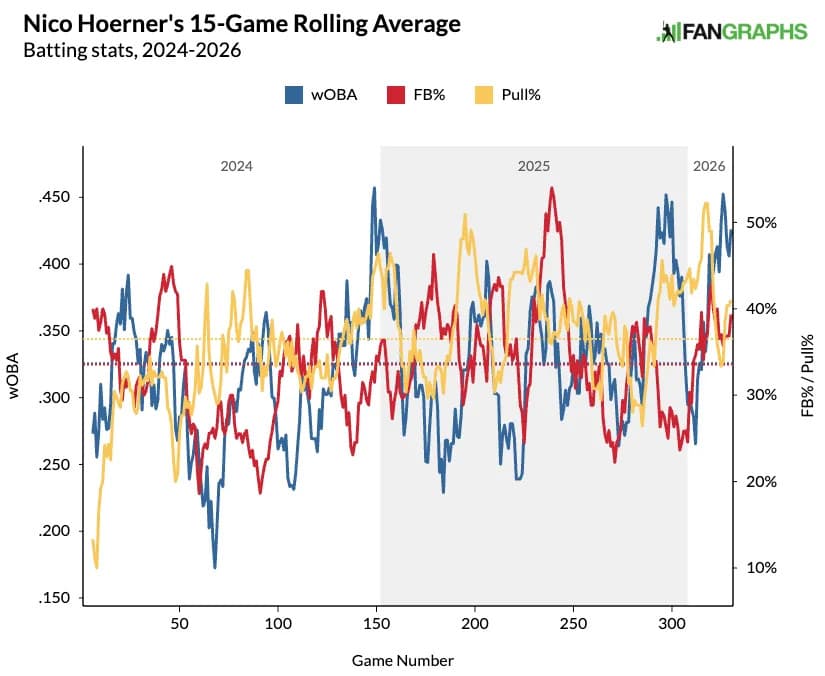
Nico Hoerner's rolling pull and flyball rates. (Photo by Corbin Young/FanGraphs)
That coincides with Hoerner’s 24.1% pulled air rate in 2026, up from a career average of 14.6%. Though we haven’t seen his bat speed, average exit velocities and barrel rates shift when he pulls the ball and overall, Hoerner showed a 75-76% ideal attack angle on pulled balls over the past two seasons. That’s a nearly 20-point jump in Hoerner’s ideal attack angle overall throughout his career.
A reminder that the ideal attack angle rate is the percentage of swings between 5 and 20 degrees, typically leading to quality outcomes and consistent launch angles.
Unsurprisingly, Hoerner’s pulled batted balls in the air tend to be around 90+ mph in average exit velocity and a 70.1 mph bat speed over the past two seasons. We should continue to see a career-high barrel-per-plate-appearance rate (2.8%), which might only hover near the league average (5%). That matters because league-average power usually means 12-15 home runs as a floor, making Hoerner a massive value, especially if he maintains his 24% stolen base opportunity rate, three points above his career average.
Hoerner’s skills have been consistent across the board, with the most notable being the pulled air rate, potentially leading to a career-high in home runs. That will be a big miss for me, and we’ve seen hitters with good plate discipline add power and bat speed like Brice Turang. Hoerner should also be on track for career-highs in runs and RBI, given the lineup context and lineup spot.
Adding even league-average power increases Hoerner’s value.
There were rumors about Riley stealing more bases with a new baserunning coach, Antoan Richardson, this season. Riley has shown above-average Sprint Speeds in 2025 (73rd percentile) and 2024 (66th percentile), with similar numbers in 2026. In the early 2026 sample, Riley’s stolen base opportunity rate is 8%, compared to a 1% career average. That’s not a significant change in stolen base opportunity rate, but he is on pace to surpass his career high of three.
Stealing bases tends to be a mix of opportunity, coaching decisions and athleticism. Riley has possessed above-average athleticism throughout his career. If Riley’s stolen bases hit double-digits, with consistent skills and outcomes across the board, we could see a peak season from him.
Injuries have been a challenge for Riley over the past two years, so we haven’t seen those peak 30+ home run seasons since 2023. Riley’s plate discipline can also be an issue, evidenced by his 73.2% contact rate, similar to his career average. He still boasts high-end power skills with a 74.9 mph bat speed and 6.8% barrel per plate appearance rate in 2026. Weirdly, Riley’s pulled air rate dipped to 12.9% in 2026, down from 24.2% (2025) and 19.4% (2024). However, that might be fluky since Riley typically taps into his pull-side, flyball approach.
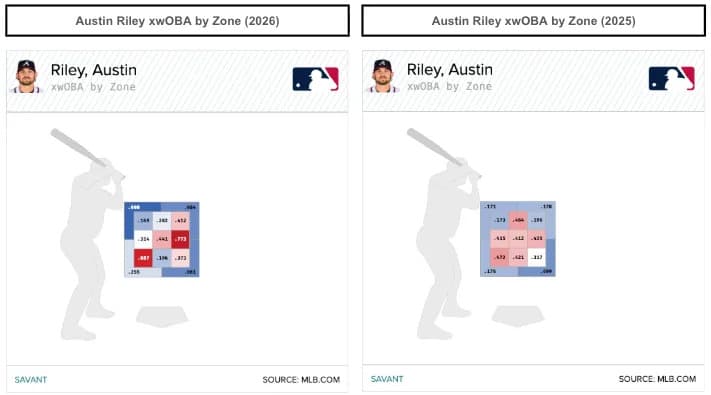
Austin Riley's xwOBA by zone. (Photo by Corbin Young/MLB.com)
Or, it might be a concerted effort for Riley after having 29.5% of his barrels on pulled batted balls from 2023 to 2025. For context, Riley has one barrel (14.3%) on pulled batted balls in the small 2026 sample. Riley has been taking those pitches on the outside corner and doing damage. It’s a tiny sample of 41 batted ball events, but Riley has a .500 xwOBA, five barrels (23.8%) and a 96.9 mph average exit velocity on pitches on the outside corner. That’s significantly better than Riley’s success against outside pitches in 2025 (.336 xwOBA) and in 2024 (.427 xwOBA).
It looks like an intent to trust his swing and hit the ball to the opposite field. Any time there’s a slight approach change to attack outside pitches, it will impact a hitter’s ability to pull the ball, like we’re seeing with Riley early in 2026. Riley has the bat speed to turn on inside pitches, and this could unlock another level if he can cover the plate better. That should lead to more contact and loud batted balls.
Hitting more opposite-field batted balls shouldn’t impact Riley’s power significantly. With the potential spike in stolen bases, however, Riley should provide 30+ home runs while pushing toward 10+ steals, making him a value at his draft cost.
Murakami’s calling card was power, and we’ve seen that early in 2026. He already ranks among the top hitters in home runs, showing he belongs in this group. However, Murakami’s 30-grade hit tool was concerning, especially with better competition in MLB. That’s evident in Murakami’s 62-64% contact rate throughout his time in the Nippon Professional Baseball League (NPB), nearly identical to his 60.9% contact rate in the majors.
For context, Murakami’s contact rate would be the sixth-lowest in a season behind Joey Gallo (2017), Keston Hiura (2020), Miguel Sanó (2020), Matt Wallner (2026) and Garrett Mitchell (2026) since 2015. Like Mitchell (24.5%), Murakami has a chase rate below 25% (21.5%) in 2026. Thankfully, Murakami has shown elite power.
The visual below shows the top 20 qualified hitters sorted by Exit Velocity 50, which we’ll explain below as a strong marker for exit velocity numbers.
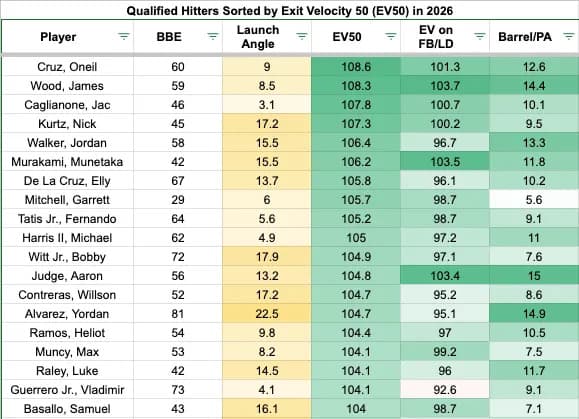
Top-20 hitters by Exit Velocity 50 (EV50). (Photo by Corbin Young/Yahoo Sports)
As a left-handed hitter, Murakami taps into a pull-heavy (51.1%) and flyball (48.9%) approach. That aligns with Murakami’s near-elite power skills, evidenced by his 74.5 mph bat speed, 50.7% fast swing rate (percentage of swings 75 mph or more), 11.8% barrel per plate appearance rate and 106.1 mph Exit Velocity 50 (EV50). For context, Murakami’s EV50 ranks sixth behind Nick Kurtz, Jordan Walker, Jac Caglianone, James Wood and Oneil Cruz. A reminder that EV50 is the average of the hardest 50% of a player’s batted ball events, as a more reliable stat than average exit velocity.
Like other hitters who have plate discipline issues, Murakami’s expected batting average tends to be higher than his actual batting average because of his near-elite power metrics. The scouting reports mentioned Murakami struggled with high-velocity fastballs. However, he tended to whiff more against non-fastballs like offspeed and breaking pitches.
There’s no denying Murakami’s power, but the low contact rate is scary.
The visual below shows Murakami’s xwOBA and whiff rates by zone to provide an idea of where he hits the ball hard and where he whiffs.
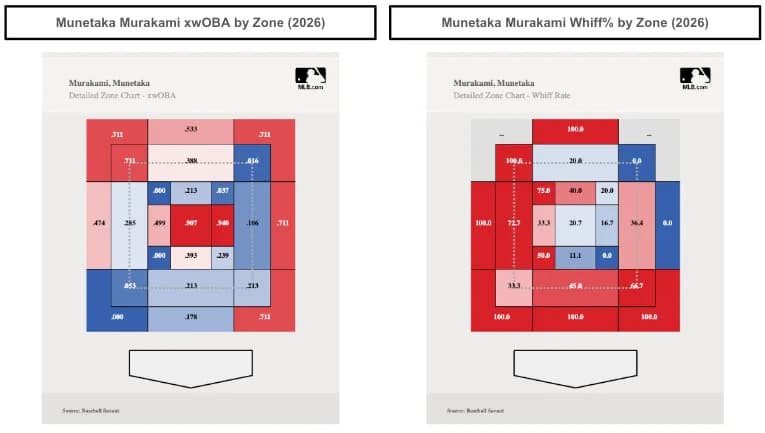
Munetaka Murakami's whiff percentage and xwOBA by zone. (Photo by Corbin Young/MLB.com)
In the early sample, Murakami has a 13.6% swinging-strike rate against fastballs at 95 mph or harder, which isn’t worrisome. Meanwhile, Murakami struggled against sliders (26.2% swinging-strike rate) and changeups (26% swinging-strike rate) for a combined 26.1% swinging-strike rate. Sweepers have been a challenge for Murakami, given his 19.2% swinging-strike rate in a sample of 26 pitches. Murakami destroys pitches in the middle of the zone, with tons of whiffs on the edges of the zone.
This looks like an opportunity to sell high on Murakami for a hitter or pitcher who might be underperforming their underlying metrics. Of course, it’s fun to watch Murakami destroying baseballs because there’s a chance he can be an outlier.
That said, Murakami hit another home run on Wednesday — just as we’re submitting this piece.
Pages has been one of the best Dodgers’ hitters in 2026, though his .455 BABIP fuels his .366 batting average. After 27 home runs, 14 stolen bases and a .272 batting average in 2025, Pages has been showing the power, speed and batting average in 2026 (5 HR, 4 SB). Pages’s plate discipline (78.6% contact rate), bat speed (73.1 mph) and 5.6% barrel per plate appearance rate have been similar to his career averages. That suggests luck factors like BABIP and home run rate (22.7% HR/F) look favorable for him early in 2026.
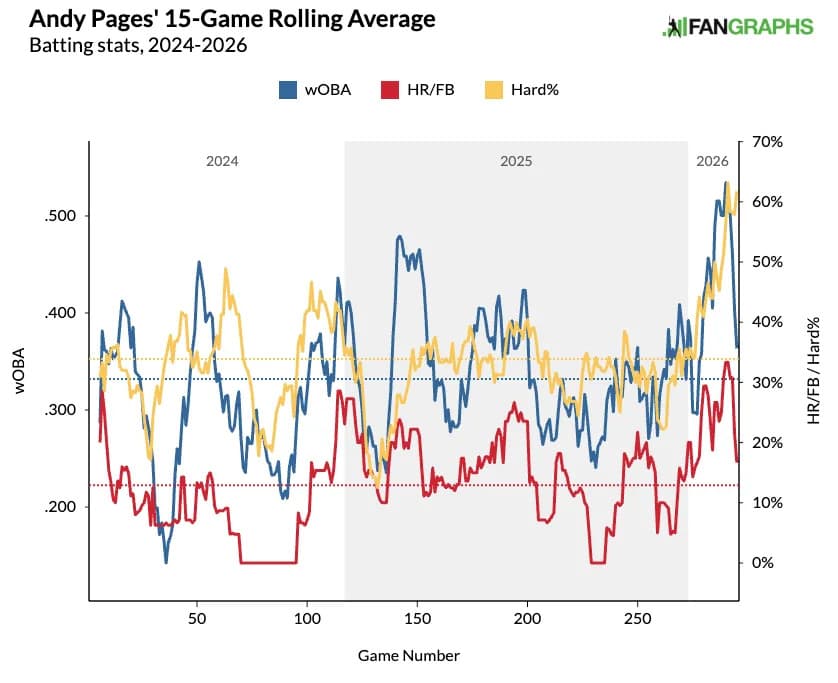
Andy Pages' rolling HR/F and hard-hit percentage. (Photo by Corbin Young/FanGraphs)
Since Pages possesses above-average power skills, he might be able to maintain a higher HR/F, though expect the current number to regress. His current HR/F sits nearly 10 percentage points above his career average (12.9%), indicating home run efficiency. There’s a chance that Pages’ power metrics could lead to a peak season in home runs. That’s especially true since Pages saw his EV50 jump to 102.8 mph (No. 40) in 2026 compared to 99.3 (No. 182) in 2025. Expect Pages to raise his barrel rates, especially since he has been hitting the ball harder in 2026.
Pages converted 66% of his stolen base chances, which was awful in 2025. However, we’ve seen it increase to 80% while maintaining a 15-18% stolen base opportunity rate. If Pages converts a higher rate of steals, 15-20 SBs feels reasonable in 2026, given his high-end Sprint Speed (79th percentile) and defense (Outs Above Average) metrics in the 75th percentile or higher.
Pages looks ready to build on his 2025 to push toward another level, contributing power, speed and batting average as a sneaky five-category producer. There will be some regression in the luck factors (BABIP and HR/F), but the skills support the outcomes.
Dingler has been a top-125 player over the past two weeks. Since most Yahoo leagues tend to be one-catcher leagues, Dingler’s roster percentage probably won’t spike too much higher unless teams put him into a utility spot. Dingler had a productive 2025 season, with 13 home runs, 111 runs plus RBI and a .278 batting average. He is already on pace to set a career-best in home runs in 2026, with five in 83 plate appearances.
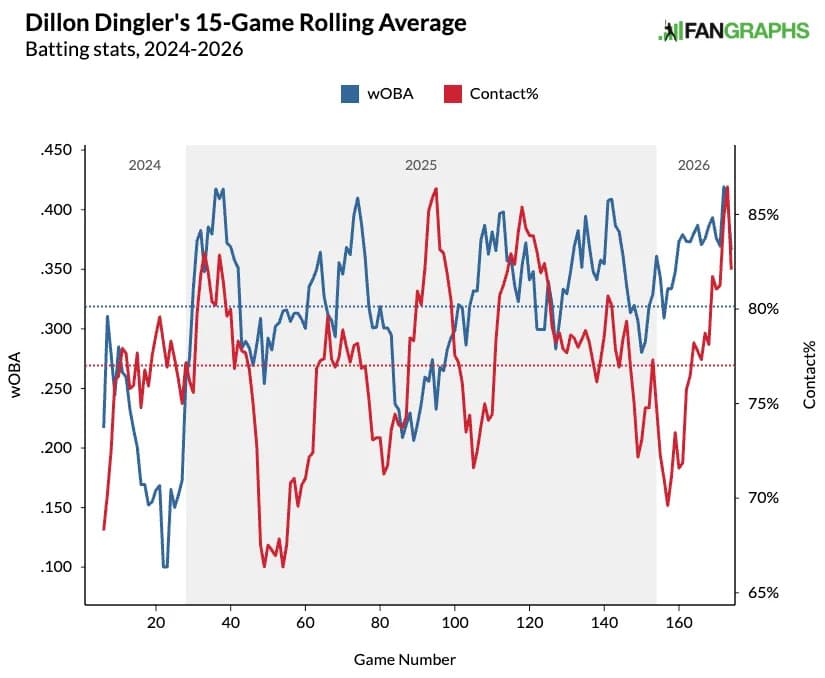
Dillon Dingler's rolling contact rate. (Photo by Corbin Young/FanGraphs)
He lowered his strikeout rate by 6.5 percentage points in 2026, mainly by making a three-percentage-point increase in his contact rate. From the right side, Dingler pulled the ball more often (44.8%), over four points higher than in 2025 (40.2%). There was a slight uptick in Dingler’s flyball rate by a few percentage points in 2026, coinciding with his consistently above-average pulled air rate (18-19%) over the past two seasons. That’s notable because the Tigers’ home park ranks 11th in the three-year rolling home run park factors for right-handed hitters.
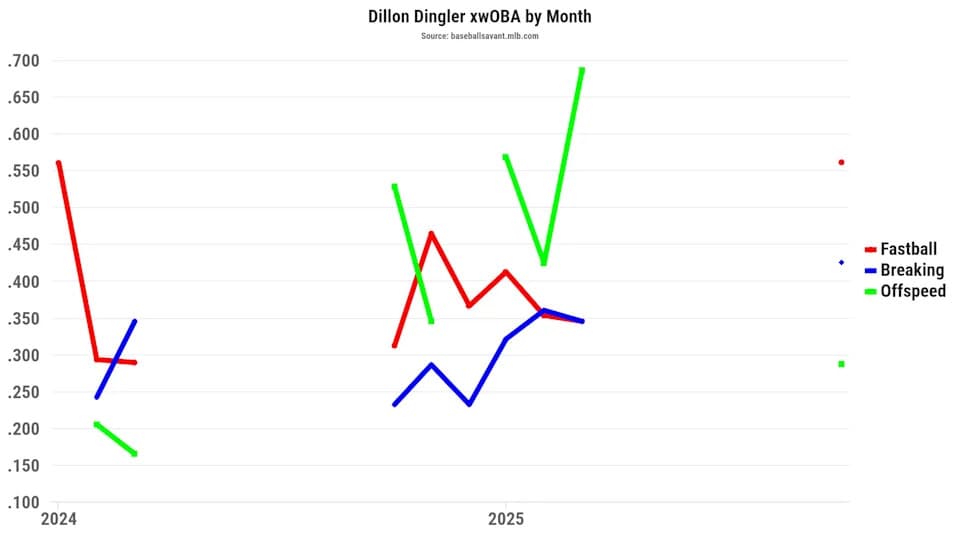
Dillon Dingler's xwOBA by pitch type. (Photo by Corbin Young/BaseballSavant)
Dingler has been using a more open stance by five degrees and moved nearly 2.5 inches farther back in the box. That might allow slightly better pitch recognition, specifically against breaking pitches. Dingler performed well against fastballs (.353 wOBA, .373 xwOBA) and offspeed (.435 wOBA, .458 xwOBA) pitches in 2025. With the strong start, we’ve seen Dingler perform well against fastballs and offspeed pitches again. However, there has been a slight improvement in Dingler’s production against breaking pitches (.403 wOBA, .425 xwOBA) in 2026.
Dingler’s ideal attack angle jumped to 61.1% in 2026, compared to his career average (51%). That indicates Dingler’s percentage of swings at those optimal attack angles (5 to 20 degrees), likely leading to greater launch-angle consistency. Theoretically, Dingler’s swing is more consistently leading to optimal launch angles.
All those components of Dingler’s skill set make him a strong-hitting catcher who will produce power and batting average. Dingler’s power skills support the current and future outcomes.