
Crypto
Strategy Resumes Bitcoin Treasury Buys With $330M Purchase
Decrypt
Bitcoin (BTC) faces a fresh showdown this week as macro tensions contrast with a bullish BTC price trend reversal.
On longer time frames, the weekly chart has become a source of hope for Bitcoin bulls this week.
The weekly close reclaimed the 200-week exponential moving average (EMA) trend line, but more than that, a classic BTC price metric is about to produce a key bull signal.
On a weekly basis, the moving average convergence/divergence (MACD) hinted that Bitcoin’s latest downtrend is in the process of reversing.
“Holding this level is crucial for the entire Crypto industry,” X commentator Crypto Seth argued on Monday, noting that Ether (ETH) was also due an MACD cross.
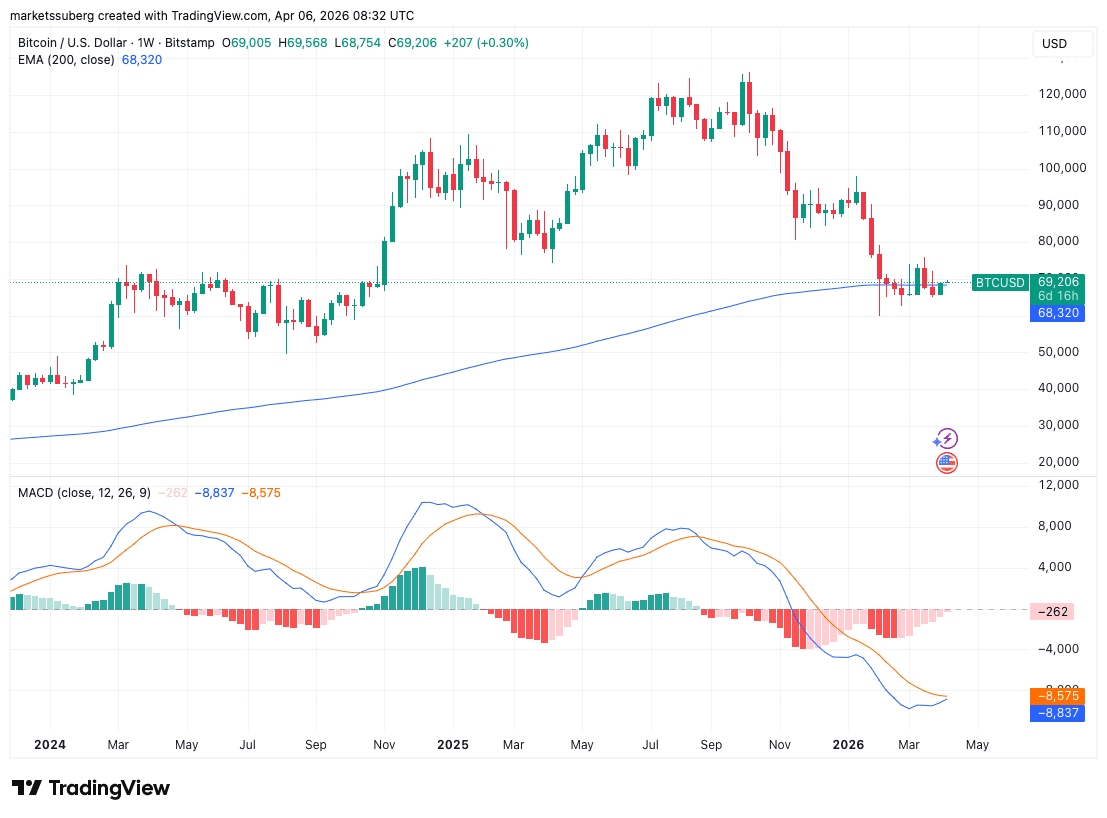
BTC/USD one-week chart with MACD data, 200 EMA. Source: Cointelegraph/TradingView
Bitcoin’s last bullish weekly MACD flip occurred in May 2025, around one month after BTC/USD put in its 2025 low near $74,500. Over the following two months, price went from $94,000 to $119,000, setting new all-time highs.
Continuing on the phenomenon, X trading resource GalaxyTrading flagged key MACD comparisons across Bitcoin’s past two bear markets.
“In the 2018 bear market, it took around 245 days for the weekly MACD to turn positive,” it noted.
“In 2022, it also took 245 days to turn bullish. In 2026, we will reach 245 days by the end of April.”
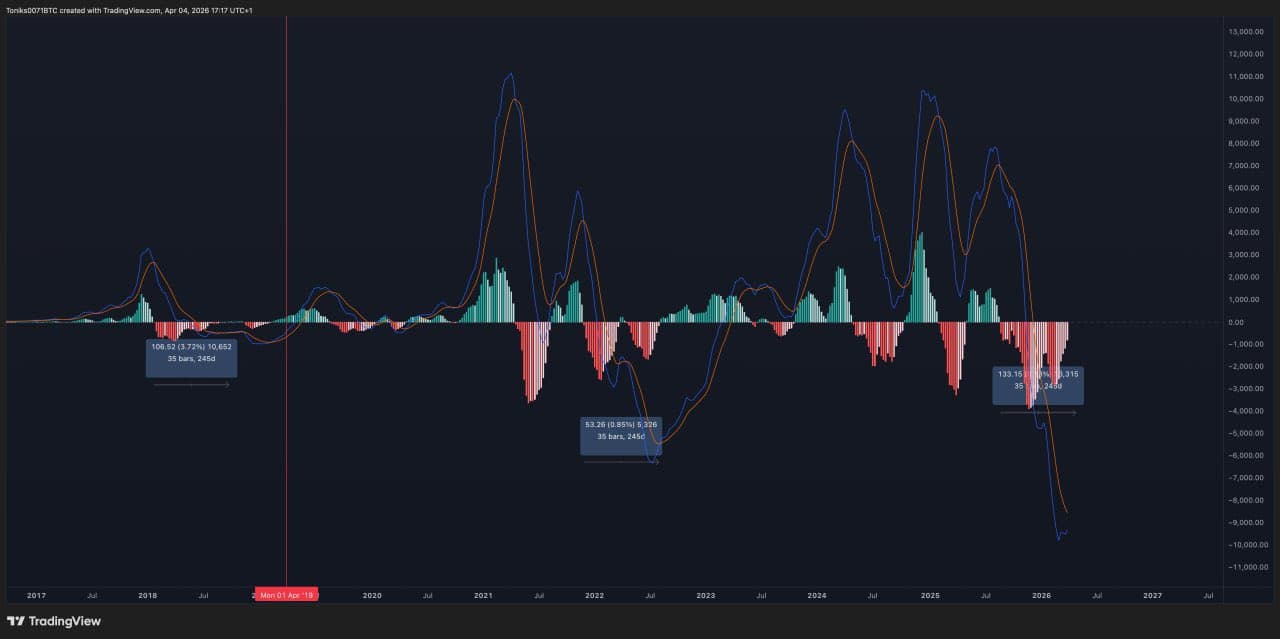
BTC/USD MACD data. Source: GalaxyTrading/X
Bitcoin managed a trip beyond $70,000 after the weekly close, data from TradingView confirms, reaching new April highs.
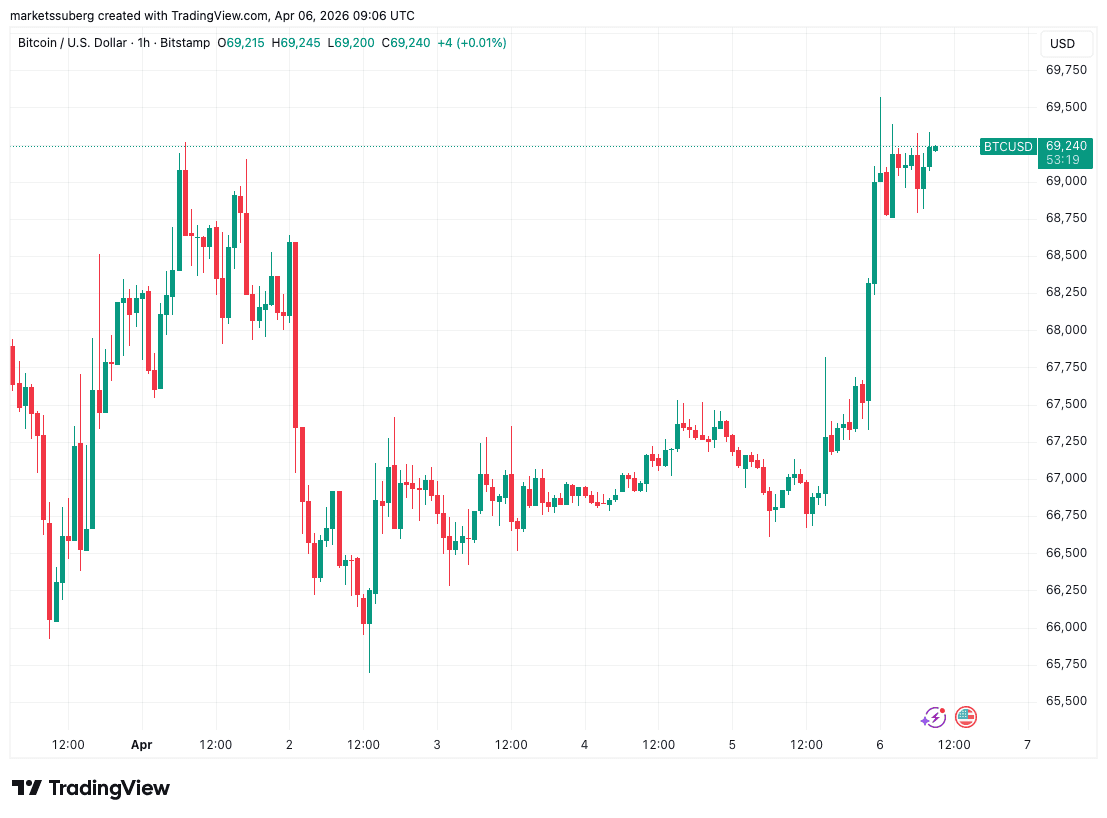
BTC/USD one-hour chart. Source: Cointelegraph/TradingView
While some traders remained skeptical over pre-market price action, the close itself was notable, bringing back both the 200-week EMA and old 2021 all-time high as potential support.
As Cointelegraph reported, both levels have courted suspicion over their reliability.
$BTC pumping on a Sunday and everyone celebrating…
You guys will never learn.
— Roman (@Roman_Trading) April 6, 2026
The move to the local highs caught short positions off guard, with total crypto liquidations passing $250 million over the 24 hours to the time of writing, per data from CoinGlass.
In his latest analysis, trader CrypNuevo continued to eye longs closer to $64,000 for a potential liquidity hunt to the downside.
“There are some HTF liquidations between $64k-$64.5k. This adds fuel a move lower. I don't see conclusive data on LTF liquidations,” he commented in an X thread on Sunday.
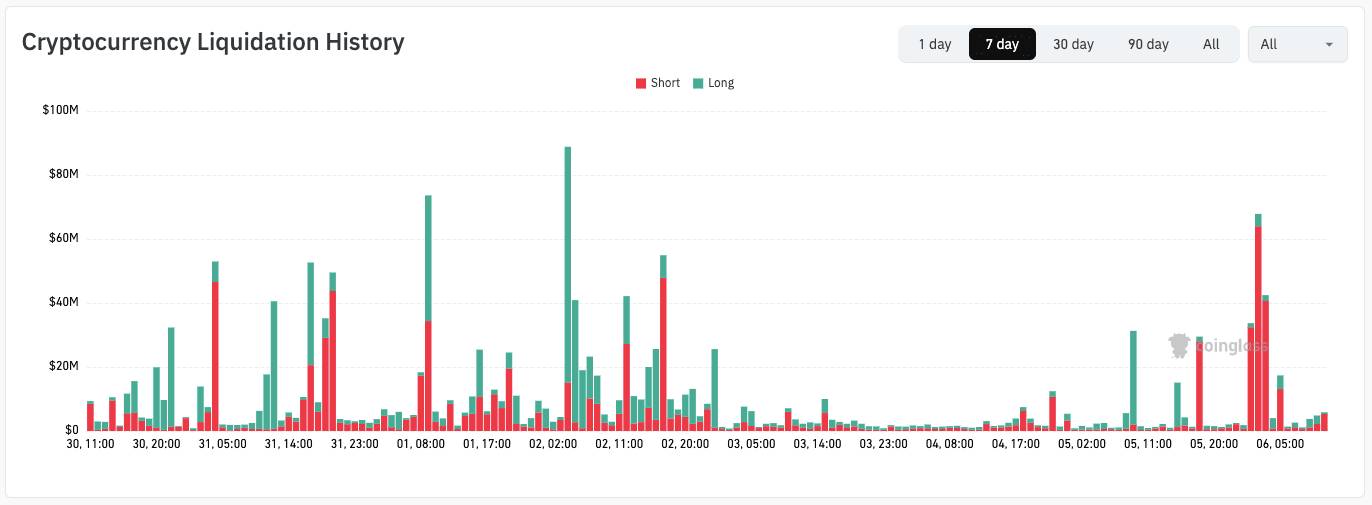
Crypto liquidation history (screenshot). Source: CoinGlass
In one of its “QuickTake” blog posts, onchain analytics platform CryptoQuant flagged the return of “aggressive short-term positioning” — spikes in both cumulative net taker volume and open interest on Binance.
This matters because Bitcoin’s move is being driven not only by price strength, “but also by renewed speculative participation in derivatives,” contributor Amr Taha commented.
“In simple terms, traders are becoming more willing to add fresh exposure as BTC pushes higher. If this trend continues, it could reinforce short-term momentum.”
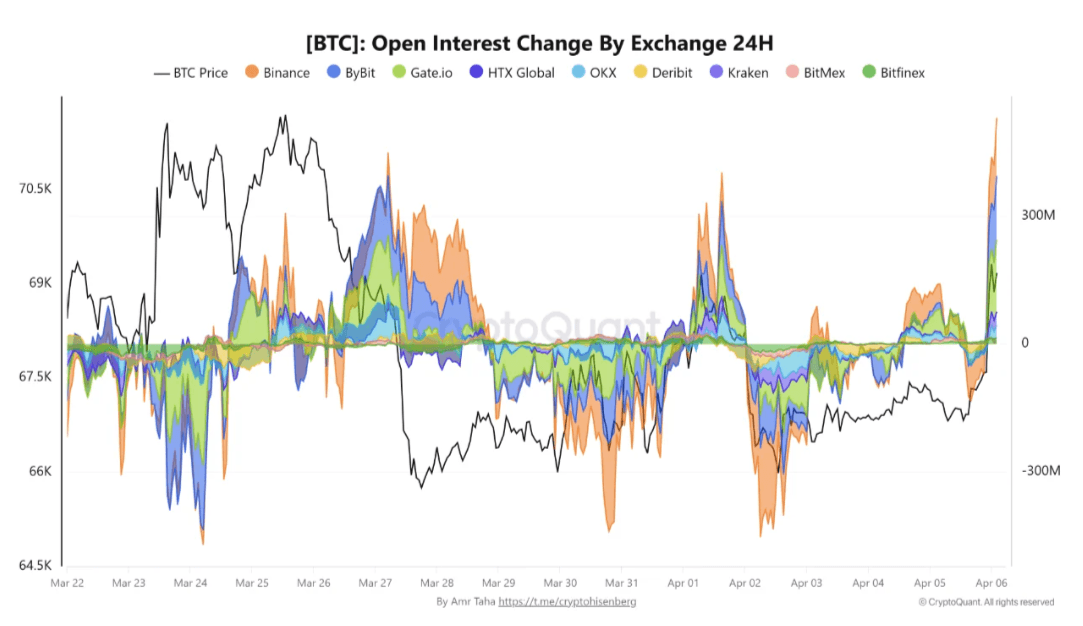
Bitcoin open interest change by exchange (screenshot). Source: CryptoQuant
A combination of geopolitics and key US inflation data makes for a week of “extreme volatility,” analysis predicts.
The US-Israel and Iran war continues to guide market sentiment, and oil prices reflect the uncertainty over the fate of key issues such as the partial closure of the Strait of Hormuz. WTI crude oil started the week with a trip above $115 per barrel.
Traders are now eyeing one deadline in particular when it comes to how the conflict might play out: Tuesday, 8pm Eastern time. This is when US President Donald Trump promises major infrastructure strikes if no deal with Iran is reached.
In a post on Truth Social at the weekend, Trump appeared particularly impatient, calling the day of the deadline “Power Plant Day” and "Bridge Day” while demanding that Hormuz reopen.
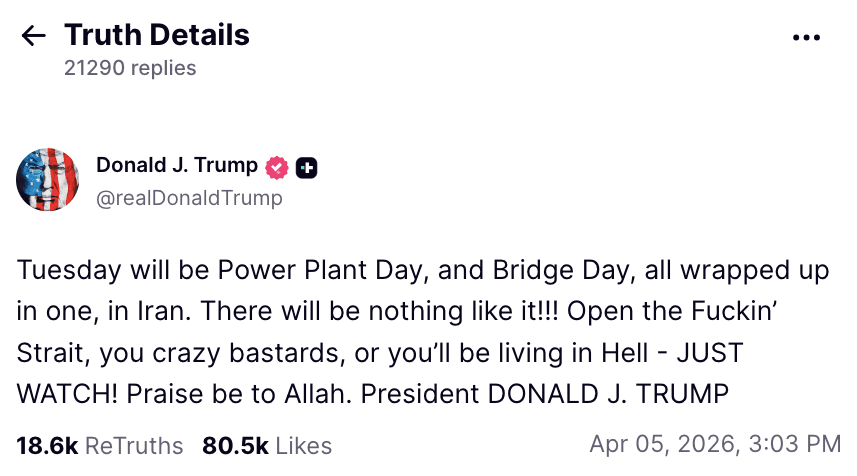
Source: Truth Social
Headlines remain mixed, however, with talk of a 45-day ceasefire now a focus.
“This is being described as a ‘last-ditch effort’ to prevent ‘massive strikes on Iranian civilian infrastructure,’” trading resource The Kobeissi Letter reported on X.
Kobeissi noted that S&P 500 futures “erased all losses” on the news, underscoring risk-asset vulnerability to war-related triggers. As Cointelegraph reported, Bitcoin remains no exception.
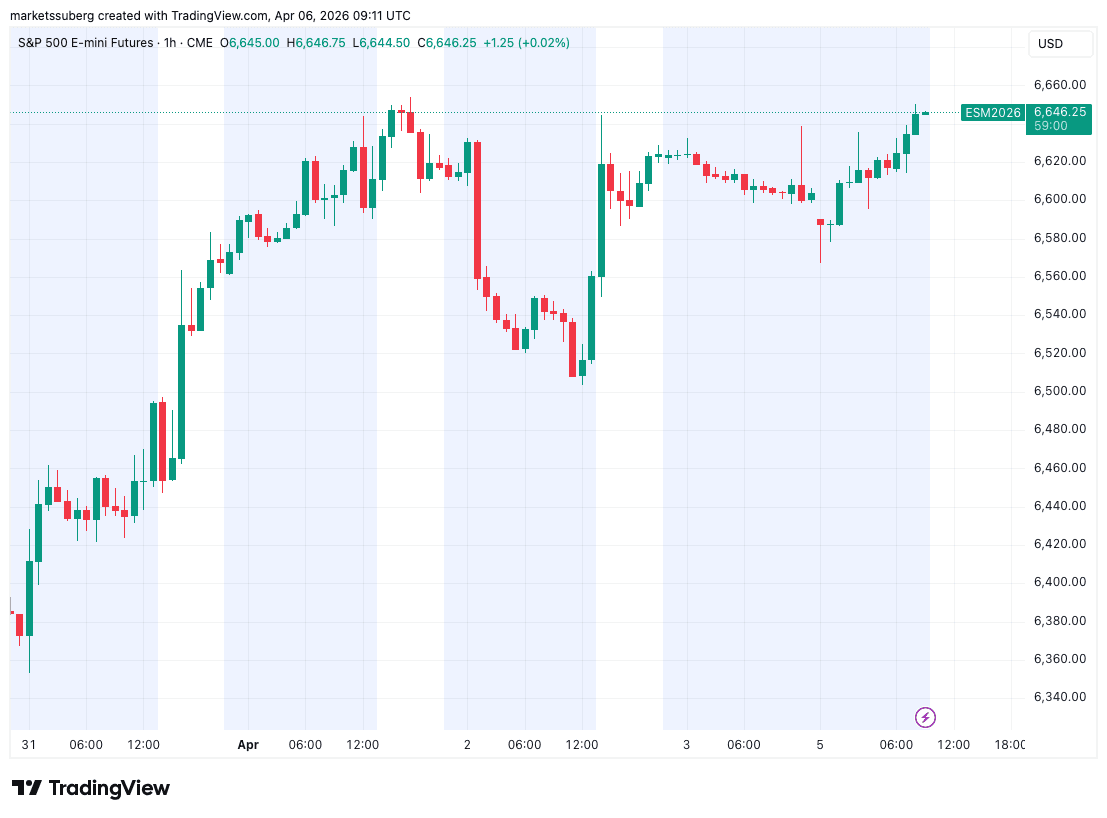
S&P 500 futures one-hour chart. Source: Cointelegraph/TradingView
Last week, macro investor and former hedge fund manager James Lavish nonetheless said that markets were pricing in odds of the war ending sooner rather than later.
A potential drawdown for BTC price action should markets experience a “black swan” event, he told Cointelegraph, could be up to 20%.
Markets will thus be juggling war shocks and inflation data concurrently this week, with multiple US prints due.
Among them is the Personal Consumption Expenditures (PCE) Index, known as the Federal Reserve’s “preferred” inflation gauge.
February’s PCE release matched market expectations, but did not reflect inflation trends after the war had started.
“Following the jump in oil prices and potential spillover impact from fertilizer shortages on food prices, challenges around the inflation outlook still poses a major risk,” trading resource Mosaic Asset Company summarized in the latest edition of its regular newsletter, “The Market Mosaic.”
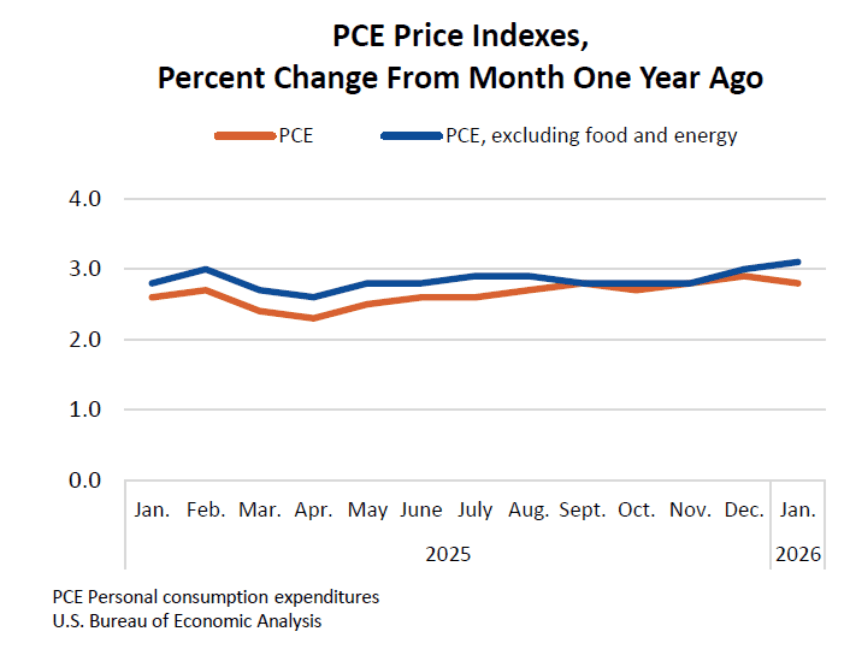
US PCE % change (screenshot). Source: Bureau of Economic Analysis
That risk also applies to the week’s last and arguably most important inflation number: the Consumer Price Index (CPI).
Here, the oil-price jump is especially pertinent, thanks to its direct impact on CPI inflation trends.
“Oil prices are now crossing above $115/barrel in the US. As a result, our models indicate that if current levels are sustained another ~7 weeks, US CPI inflation will rise to ~3.7%,” Kobeissi commented.
Kobeissi said that its “base case” for CPI inflation was now 3% — considerably higher than the Fed’s target.
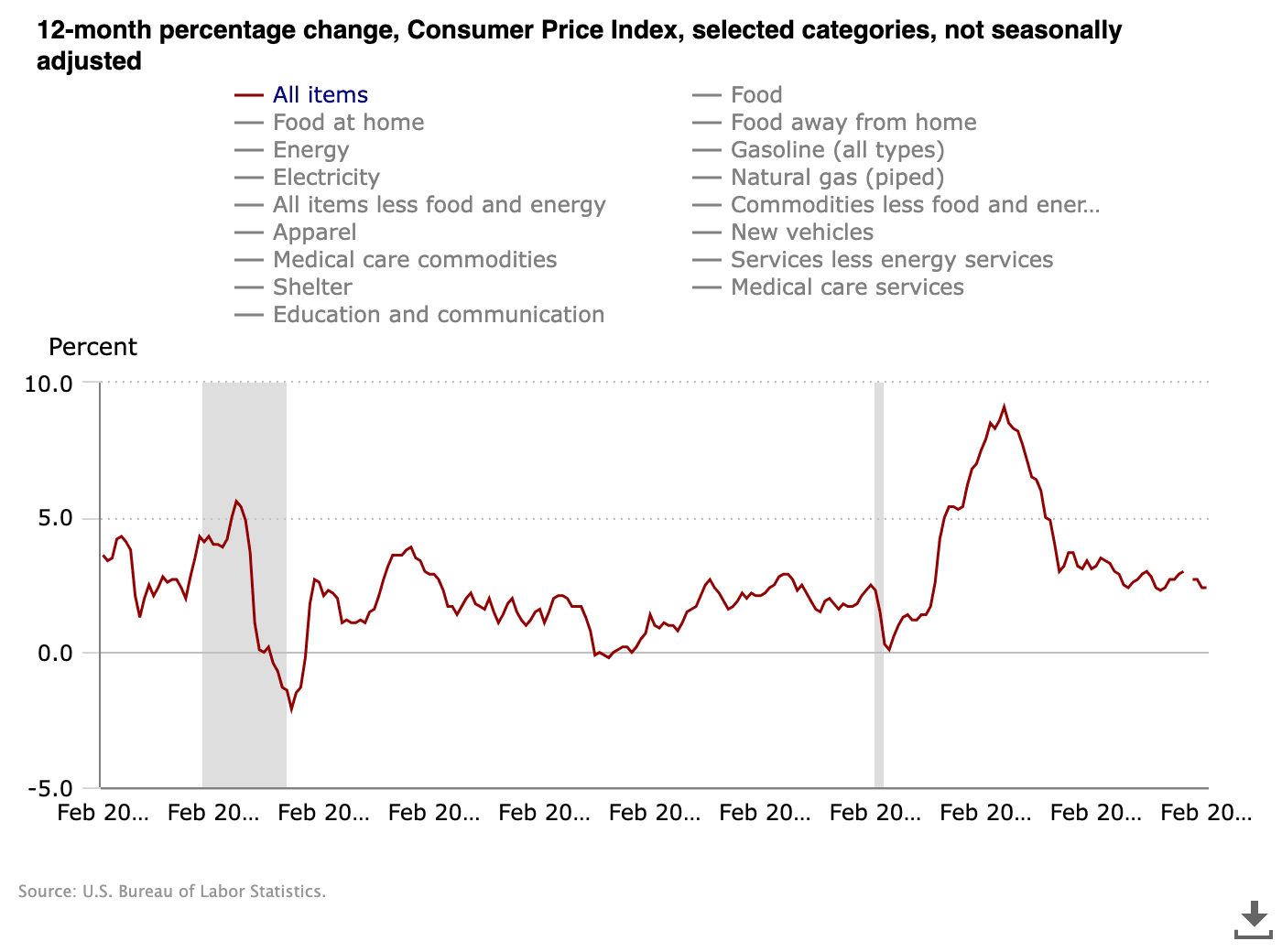
US CPI 12-month % change. Source: Bureau of Labor Statistics
Like PCE, the most recent CPI print was flat, helping temper the impact of previous overshoots.
The latest data from CME Group’s FedWatch Tool meanwhile shows practically no chance of the Fed either raising or lowering interest-rates at its next meeting at the end of April.
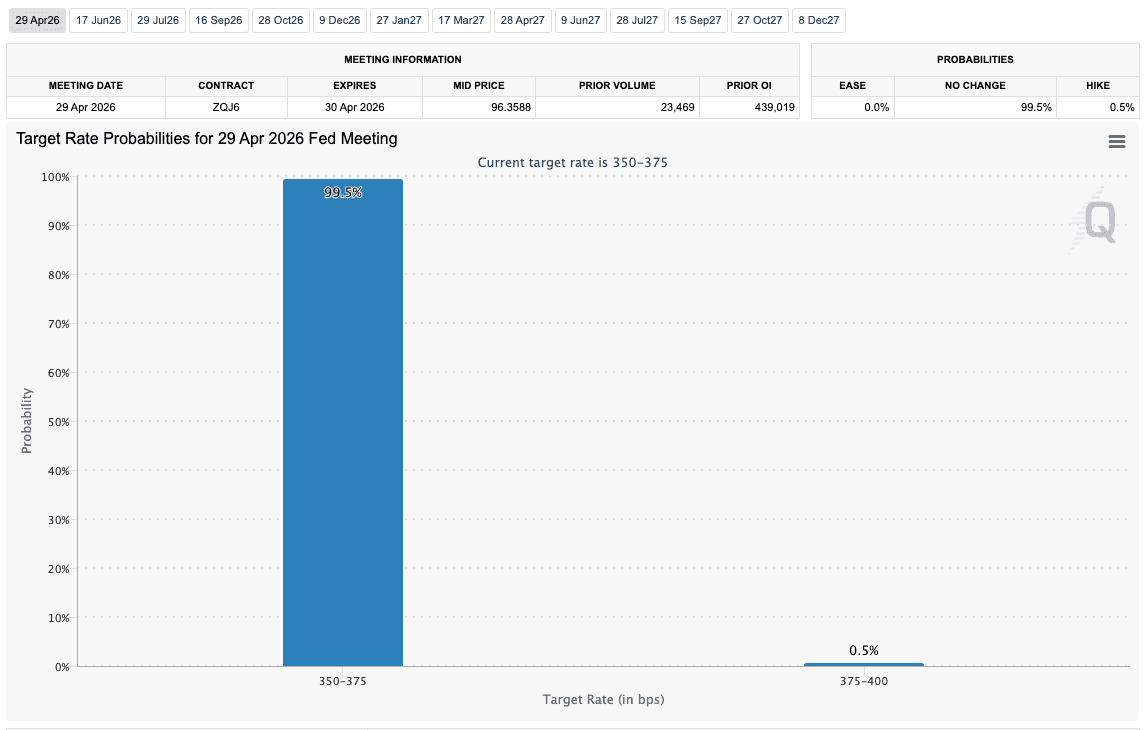
Fed target rate probabilities for April FOMC meeting (screenshot). Source: CME Group
As macro events play out, Bitcoin still has a specific cloud hanging over it that traders fear will only lead price downward.
Related: Bitcoin 'done' with 85% crashes, says Cathie Wood amid new $34K target
BTC/USD continues to battle for support at the bottom of its second bear flag of 2026. The first, which appeared in January, resulted in a drop of roughly $25,000.
“Structurally, $BTC price action is still nearly identical to the prior bear flag structure,” Keith Alan, cofounder of trading resource Material Indicators, warned last week.
“Nothing says that it has to continue to mimic that price behavior, but I'm following it like roadmap until price deviates from that path.”
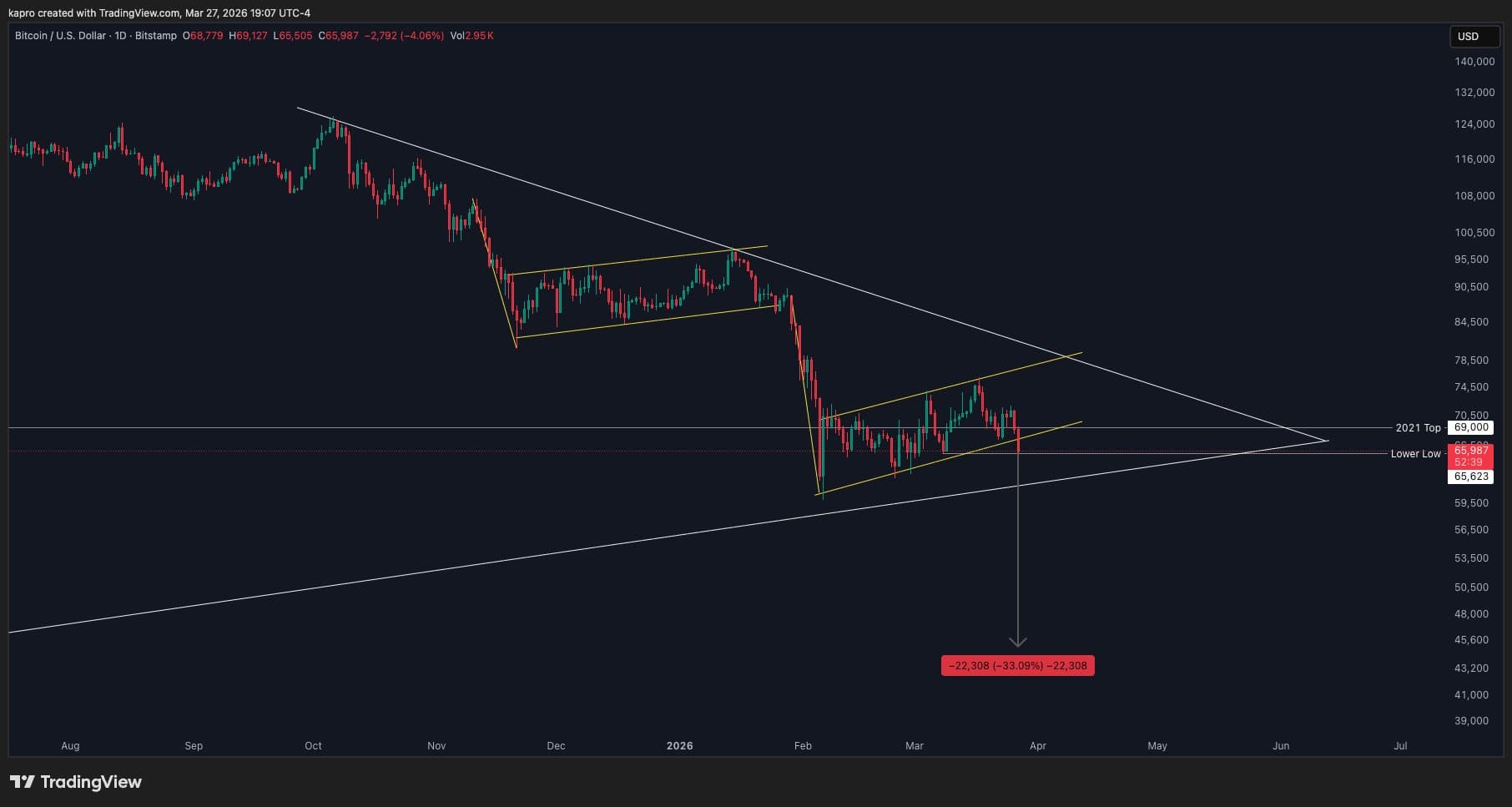
BTC/USD one-day chart. Source: Keith Alan/X
When it comes to new lows, Cointelegraph reported on broad consensus that February’s downside wick below $60,000 will be revisited.
“When that breakdown eventually happens, watch the behavior closely. If price starts repeatedly sweeping the lows, making it psychologically difficult to enter longs, that’s when a true bottom is more likely forming,” pseudonymous trader LP told X followers this weekend.
LP said that new lows were “likely just a matter of time.”
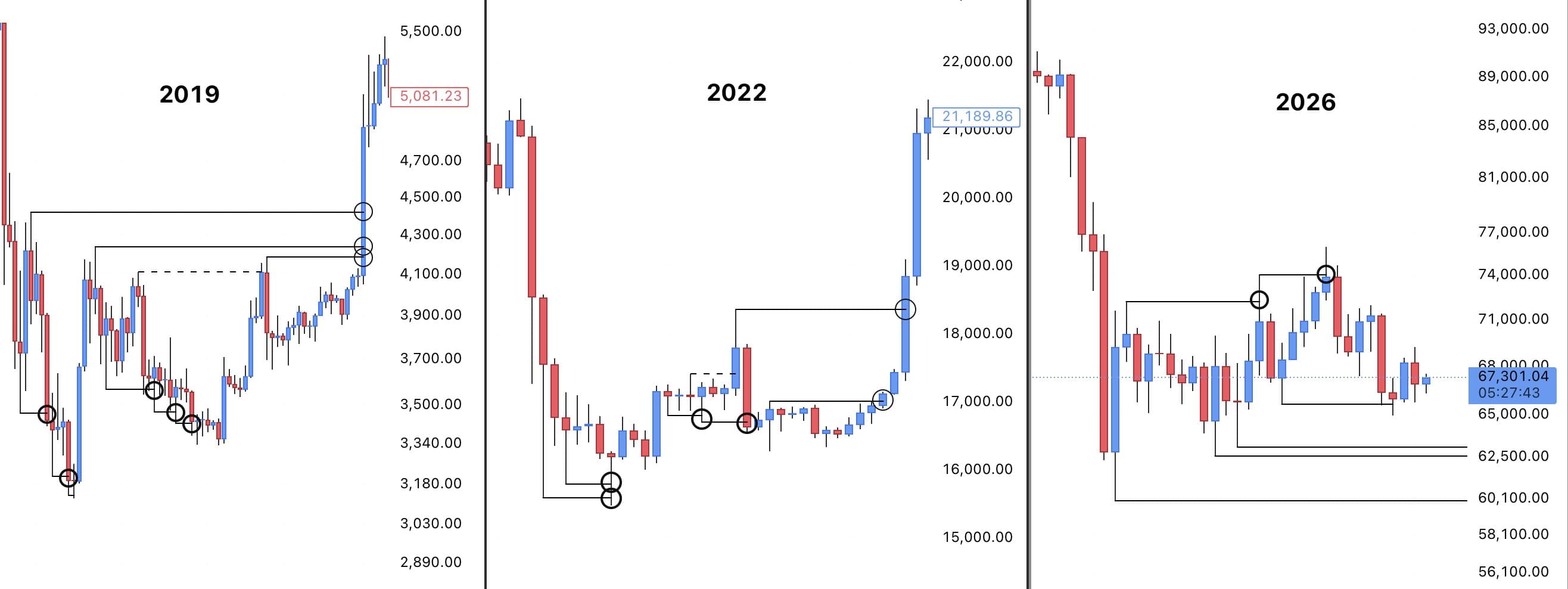
BTC price comparison. Source: LP/X
Alan, meanwhile, eyed a trip to the mid-$40,000 range as part of a “measured move” below bear-flag support.
“Expecting to test resistance in the $67k - $69k range before the next leg down,” he wrote while discussing the topic on X.
“End to the war or a really strong Q2 Open could invalidate the bear flag and challenge resistance at the MACRO structure.”
Share this article





See every story in Crypto — including breaking news and analysis.