News
Viktor Orbán's Hungarian experiment runs out of steam
BBC News
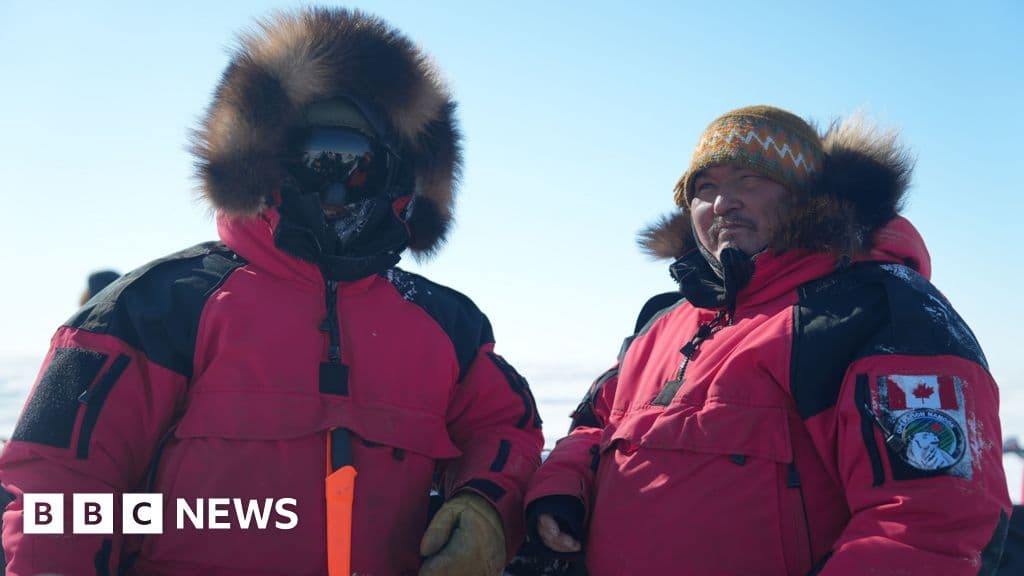
Canadian army reservists completed a historic 5,200km Arctic mission, the largest in Canadian Rangers' history, after two months of navigating extreme conditions. They faced temperatures as low as -60C and various hazards, including polar bears.
A simple row of spruce trees marked the finish line for Canadian army reservists and combat members after a marathon two months pushing through one of the harshest environments on Earth: Canada's vast Arctic.
The patrol, which ended on Friday in Churchill, Manitoba, was the largest northern mission in the history of the Canadian Rangers - a branch of the Canadian Armed Forces responsible for monitoring the country's remote regions. For 5,200km (3,200 miles), they moved across the Arctic, following a route that had not been attempted in 80 years.
They drove snowmobiles across ice-covered terrain, navigating blizzards and high winds as they travelled for hours between remote northern communities. Some nights, they camped on the ice in tents as temperatures plunged to -60C (-76F).
On the final night, on the frozen shores of the Hudson Bay, they set up camp next to an abandoned trading post as the ice crackled beneath them while the northern lights danced above.
There were constant hazards to be wary of, from polar bears to frostbite and cold-weather dehydration.
The patrol is part of an annual Canadian Armed Forces operation to showcase Canada's military presence in the north.
A total of 1,300 military personnel took part this year, with a mission to survey the land, learn more about climate change, unlock new travel passageways and test Arctic survival and warfare capabilities in a region that accounts for 40% of Canada's landmass and 70% of its coastline.
The mission has taken on increased relevance amid the geopolitical scramble for the Arctic's resources as the climate warms. And it comes after US President Donald Trump threatened in January to annex Greenland, a Danish Arctic territory neighbouring Canada, ramping up tensions between Nato allies.
These statements were met with alarm by politicians from across Europe and Canada, and led to a scramble by Nato members to show that they are still focused on defending the Arctic.
Mark Carney, who was born in the Northwest Territories and is the first Canadian prime minister from the north, has unveiled a multi-billion dollar defence plan that includes upgrades to existing northern military sites.
But despite recent tensions, Trump's remarks have had "zero effect" on how Canadian forces and their allies work together, said Brig Gen Daniel Rivière, commander of the army task force responsible for Operation Nanook-Nunalivut.
This year's operation, which ran from mid-February to the beginning of April, included a contingent from Greenland who had asked to observe the Canadian Rangers in action, Rivière said.
Army members from the US and the UK were invited to monitor progress from a command centre in Edmonton, and French and Belgian soldiers conducted ice-diving missions with the Canadian military.
Rivière told the BBC the mission was meant to prepare Canada for "the worst case scenario". He noted that Russia remains "a formidable force" in the Arctic despite its ongoing war with Ukraine.
Russia reportedly has dozens of permanent military bases in its Arctic, while Canada has none.
"They still fly, and they still probe" in the region, Rivière said, adding that joint exercises between Russia and China on international waters have also increased.
"Is that an immediate threat? No. But are they getting smarter about Arctic waters? Absolutely."
Another threat is climate change, which has made navigating Canada's Arctic region much more challenging.
Lt Col Travis Hanes, one of the Rangers on the 52-day patrol, has witnessed the unpredictable weather first hand.
"Rivers that are normally completely frozen have overflowed where they hadn't historically," he told the BBC, causing layered, unstable ice sheets that are hazardous to travel over in winter months.
On the other extreme, this winter was also unusually cold, Hanes noted, opening new passages over Arctic waters that had not previously frozen over in recent memory.
A key component of the Canadian Rangers is its indigenous Inuit members, whose deep knowledge of Canada's northern territories has been essential to finding safe paths and keeping army members alive – both on this most recent patrol and other operations across the Arctic.
"We would've failed without them," Hanes said.
They are often described as the "irreplaceable boots on the ground" in Canada's north, with expertise in manoeuvering snowmobiles between the remote Arctic communities they call home, the know-how to survive in the cold and the ability to notice when something is amiss in the water or on the land.
During the patrol, they shared dried Arctic char and caribou – what the Inuit commonly refer to as "country food" – with those who needed more sustenance than protein bars and beef jerky, and lent gloves and boots made from coyote and caribou fur for anyone who got dangerously cold despite layers of modern winter gear.
One of the Inuk rangers, Julia Elanik from Aklavik in the Northwestern Territories, drove the length of the patrol with a rifle on her back in case a polar bear crossed the group.
The patrol, which included a core group of 20 snowmobiles at any given time, also relied on more than a dozen Inuit communities to house them along the way, and other Inuit Rangers who served as local guides from one hamlet to the next.
Barnie Aggark, a Canadian Ranger from Chesterfield Inlet in Nunavut who had joined the patrol to guide them through their final 500km, told the BBC that he saw a responsibility to help both his community and his country.
"It has everything to do with our land and sea and how we control it, and who is allowed in it," Aggark, who has been a Canadian Ranger since 1999, said.
"We have to let the rest of the world know that we are here, and this is our home, and we are going to protect it with everything that we have."
The patrol also received support from the Canadian Air Force, who flew twin otter planes above them to survey the terrain as their snowmobiles travelled forward. They also relied on satellite intelligence and ice-monitoring technologies, some of which were being tested for the first time.
Reflecting on the end of the mission, Chief Warrant Officer Sonia Lizotte, who was involved with the operation, told the BBC: "We have tested the limits, and we can now see the future."
Canada has recently made the Arctic a focus of its national security policy, asserting in 2024 that Canada's sovereignty in the north "is the most urgent and important task".
Carney has taken aim at his political predecessors for neglecting the region.
"After decades of limited and piecemeal investments in the North, Canada's new government is acting with a scale of ambition worthy of this vast region and its peoples," he said in March.
The money will also be spent upgrading airports and highways that can be used by both civilians and the military. Getting around in Canada's north is difficult due to limited infrastructure, with flights between towns often costing thousands of dollars.
The Conservative opposition have criticised the Liberals for neglecting the Arctic over the last decade, arguing it has caused a "gaping vulnerability" for Canada.
They have also called on the government to build new permanent military bases in the north.
"We need to see real action, not more announcements," Conservative MP and shadow minister for national defence James Bezan said last month.
Still, new funding has been welcome by both locals and the military. "It looks like we're serious about building," Rivière said.
He added there are plans to add more military assets to Canada's Northwest Territories and increase war fighting tasks in the north, "because we always like to be ready for the worst".
Not everything on this year's Arctic mission went according to plan.
An exercise to fire off a howitzer, an artillery weapon, was called off due to an extreme blizzard in Cambridge Bay, Nunavut. Canadian Rangers on the patrol suffered a bout of food poisoning, likely from the military rations they were eating. One Ranger cracked a rib after his snowmobile flipped over, but "he kept on going", Lt-Col Hanes said.
Another got frostbite and was flown out of the mission before it worsened.
With all the challenges, Lt-Col Hanes classified the operation as a success, saying it is a testament to Canada's growing expertise in an unforgiving climate.
"One major injury out of 250 people? Those are far better than anyone else's stats."
Share this article
The Canadian forces covered a distance of 5,200km (3,200 miles) during their Arctic mission.
The reservists faced temperatures that plunged to -60C (-76F) during their Arctic patrol.
The Arctic mission lasted for two months, concluding on a Friday in Churchill, Manitoba.
The Canadian forces encountered hazards such as polar bears, frostbite, and cold-weather dehydration during their patrol.


See every story in News — including breaking news and analysis.