
SoccerRecap
Hearts edge closer to historic title with comeback win over Rangers
Hearts secure comeback win over Rangers, edging closer to the title!
Sky Sports1 min read
The Oklahoma City Thunder, the defending NBA champions, will face the Los Angeles Lakers in the second round of the 2026 NBA playoffs. The series starts on May 5 with the Thunder as the top seed and the Lakers as the fourth seed.
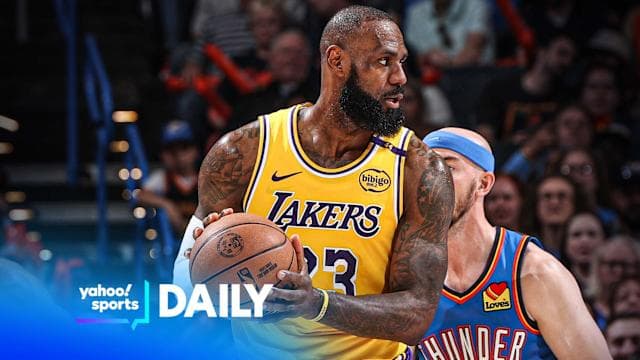
The Western Conference’s top-seeded Oklahoma City Thunder, the defending NBA champions, will play the fourth-seeded Los Angeles Lakers in the second round of the 2026 NBA playoffs. The two franchises have not faced off in the postseason since 2011-12, when the Kevin Durant/Russell Westbrook/James Harden-led Thunder defeated the Lakers in the second round on their way to the NBA Finals.
Schedule | Odds | Thunder breakdown | Lakers breakdown
Head-to-head | Matchup to watch | Key question | Prediction
Game 1: Tue., May 5 at Oklahoma City (8:30 p.m., NBC/Peacock)
Game 2: Thu., May 7 at Oklahoma City (9:30 p.m., Prime Video)
Game 3: Sat., May 9 at Los Angeles (8:30 p.m., ABC)
Game 4: Mon., May 11 at Los Angeles (10:30 p.m., Prime Video)
Wed., May 13 at Oklahoma City (TBD)
Sat., May 16 at Los Angeles (TBD)
Mon., May 18 at Oklahoma City (TBD)
The series schedule includes Game 1 on May 5, Game 2 on May 7, Game 3 on May 9, Game 4 on May 11, Game 5 on May 13, Game 6 on May 16, and Game 7 on May 18.
In their last postseason matchup during the 2011-12 season, the Thunder defeated the Lakers in the second round on their way to the NBA Finals.
Key players include LeBron James for the Lakers and the Thunder's star players, who were previously led by Kevin Durant, Russell Westbrook, and James Harden.
Predictions suggest that the Thunder are favored to win the series, with some forecasts indicating they could take it in five games.
Hearts secure comeback win over Rangers, edging closer to the title!
Arnav's cricket success is fueled by his wheelchair-bound mother’s support.
Duke men's lacrosse makes NCAA Tournament as unseeded team, set to face Richmond.
Check out the Rams' rookie jersey numbers for 2026, including Ty Simpson at 15!
Hardik Pandya misses out, Rohit Sharma returns as MI opts to bowl first against LSG.
Rival GM Impressed by Patriots' Gabe Jacas and Eli Raridon
See every story in Sports — including breaking news and analysis.
*if necessary
Oklahoma City Thunder (-2000)
Los Angeles Lakers (+950)
That age is nothing but a number.
Let’s put aside the fact that LeBron James, at 41 years old, led the charge in the elimination of an energetic, extremely physical and talented Rockets team by averaging 23.2 points, 7.2 rebounds and 8.3 assists per game in nearly 40 minutes a night. That alone is an absurdity in itself.
It’s how impactful and pivotal he was over the course of six games, even without the assistance of Luka Dončić and Austin Reaves (for two-thirds of the time). Los Angeles won James’ minutes by 5.8 points per 100 possessions (the equivalent of a top-8 team during the regular season) and was outscored by 9.1 points per 100 when he sat, an efficiency that would slot nicely between the Utah Jazz and Sacramento Kings. That drastic of an on/off split places LeBron among the top-10 most impactful postseason performers thus far, with the caveat that six of them are 20 years younger than James and four of them have since been eliminated.
Because the playoffs, and this series in particular, will be about the tactical tête-à-tête, the Lakers will have their work cut out for them. But head coach JJ Redick relentlessly tweaked his game plan against Houston, constantly pinning the Rockets back and exploiting their weaknesses. That approach might have worked against a weaker Rockets team, but the Thunder are the most-equipped team in basketball with minimal blind spots. Expect the Lakers to lean heavily on Reaves’ ball-handling and shot creation against an outstanding Thunder defense, Luke Kennard and Rui Hachimura for much-needed floor spacing, and Marcus Smart for, well, everything else.
At 41, LeBron James averaged 23.2 points, 7.2 rebounds and 8.3 assists per game in Round 1. (Photo by Joshua Gateley/Getty Images)
(Joshua Gateley via Getty Images)
Nothing we don’t already know.
Oklahoma City made quick work of Phoenix, the league’s No. 1 defense holding the Suns to a lowly 107.6 offensive rating in their first-round sweep, an output ranked lower than the regular season Brooklyn Nets, dead last in the NBA. Jalen Williams and the status of his hamstring injury have the potential to make things a tad bit more complicated, but Chet Holmgren, who stepped up with 19 points in Game 2 and 24 in Game 4, remains a viable second option when the Lakers shift all their attention to Shai Gilgeous-Alexander.
Still, all roads lead back to the reigning Finals MVP, who somehow took a historic regular season, maintained the same usage rate and scoring proficiency, and became an even more impactful playmaker and efficient ball-handler. It’s possible that the basketball world has become complacent with SGA’s offensive brilliance, given it’s essentially expected at this point, but his ability to command in the half-court, coupled with the Thunder’s depth and penchant for collective creation, has them on a clear-cut path back to June.
Even if Williams is forced to miss time during this series — it’s been about two weeks since the initial injury — the likes of Cason Wallace and Alex Caruso are more than capable to fill in the gaps. During the regular season, the Thunder performed at a top-five offensive and defensive rate in the non-Williams minutes, a 50-ish game sample size large enough to predict future outcomes. In other words, Oklahoma City will be just fine.
Oklahoma City swept the season series 4-0.
The November opener, a lopsided 121-92 victory, did not feature James, an absence felt by the Lakers, who coughed up the ball 20 times and shot just 40% from the field and 31% from behind the arc. The Thunder were without both Williams and resident pest Lu Dort (Oklahoma City also shot poorly from 3), but 30 points from Gilgeous-Alexander and 21 points from key reserve Isaiah Joe were enough in a comfortable wire-to-wire win.
Neither Dončić or SGA appeared in the February rematch, a much more competitive 119-110 outcome, but 54 Thunder bench points (combining for 11 made 3s in a team-wide 42% shooting effort) proved the catalyst. Oklahoma City won the final two games by a total of 79(!) points, the April 3 matchup most notably remembered by Dončić’s Grade 2 left hamstring strain and the biggest indication of the talent gap between the two franchises (the Thunder led by 42 when Dončić officially went down).
Not much to see here.
The transition attrition
If the Lakers are to extract any ounce of a chance in this series, they’ll need to find advantages on the margins — limiting turnovers that can ignite transition opportunities and attacking the offensive glass.
There’s a slight problem with that theory, one that combines the Lakers’ internal crash-or-not line of thinking, protecting the rim and a Deandre Ayton question. Oklahoma City, during the regular season, was a top-five transition team that ranked 18th in frequency, much of which is attributed to teams smartly opting against combating both Isaiah Hartenstein and Chet Holmgren in favor of retreating.
The Lakers, who actually fared decently in transition chances despite their ball security woes, allowed the ninth-most fastbreak points among Oklahoma City’s opponents, a slight uptick from their season average. Among playoff teams, their 14.8 opponent fastbreak points rank second worst.
So what does this mean? It would be unwise to suggest that the Lakers adopt a similar strategy as the Suns did in their defensive approach — Phoenix hovered around the top five in opponent transition rate all year, understanding its lack of size and abundance of speed. In two meetings against the Thunder, Ayton’s offensive crashing rate registered at 11.1 and 12.5, among the middle upper class of players and a sign that Los Angeles still expects the veteran big to be aggressive.
Could it be due to Ayton’s lack of rim protection on the other end, though? According to databallr, the Rockets converted a whopping 76.6% of looks at the rim while Ayton was on the floor, compared to just 42.6% while he sat. This, to me, certainly feels like an in-game fluidity, where the Lakers are comfortable sending numbers back when Ayton sits and the inverse when he’s on the floor. After all, the Thunder are one of the league’s premier downhill teams, finishing fourth in the regular season and second currently among playoff teams in drives per game.
Can the Lakers make enough shots to stay within reach — and can Luka return in time if not?
Reaves’ return is both an emotional and technical boost for a Lakers team that ranks dead last in 3-point attempts and second to last in makes (the Thunder are second in both categories). But without Dončić’s gravity and individual shot-making ability, the Lakers must shorten the 3-point frequency chasm between themselves and Oklahoma City.
In layman’s terms, the Lakers’ three best floor spacers — Hachimura, Kennard and Smart — can’t settle for low-volume, high-efficiency outputs. Being fifth in effective field goal percentage and true shooting against a poorly constructed Rockets team is very different than setting up shop against the best team in basketball, and with nearly 20 points per 100 half-court possessions separating these two teams, there’s potential for this to get very ugly, very quickly.
Of course, the silver lining in this series rests on Dončić’s Grade 2 hamstring and any chance, no matter how slim, of a return at some point. According to ESPN, Dončić is expected to remain on the sidelines to begin the series. “The Lakers are evaluating Dončić on a week-to-week basis,” ESPN’s Shams Charania reported recently.
That sounds anything but encouraging, but until he’s officially ruled out for the entirety of the series, the Lakers will continue to hold on to hope. Things certainly look different if both Reaves and James convert enough of their 3s (James is shooting 30% from deep so far), but without their best player, their downfall can only be delayed by so much.
NBA history tells us that regular-season matchups are not in any way a predictive measure for playoff outcomes. With that being said, anyone with a pair of working eyes who watched these two teams face each other in any of the previous four occasions fully understands the gap between them. The Lakers are well-coached, confident and, honestly, playing with house money at this point. The Thunder own the bank. Oklahoma City will return to the Western Conference finals comfortably.
