
Sports
Vincent Kompany has shown Steven Gerrard the route to Liverpool job after fresh sack update
Yahoo Sports

The 2026 MLB season is just starting, revealing early trends. Notably, Dodgers ace Yoshinobu Yamamoto has developed a new pitching trick, while the fastest player in baseball is enhancing his defensive skills.
Getty Images
The 2026 MLB regular season is a month old and you have my permission to say "it's still early" if things aren't going your favorite team's or your favorite player's way. It is early! It is so, so, early. If the 162-game season were a nine-inning game, there would be one out in the bottom of the second inning right now. It is a long season, folks. A very long season.
That said, there are a few things we can glean from the little bit of baseball that has been played. Here now are three trends worth knowing one month into the new season.

LAD • SP • #18
ERA2.87
WHIP1.01
IP37.2
BB9
K32
I feel like Dodgers ace Yoshinobu Yamamoto is pitching every time I turn on a game. Game 6 of the World Series. Game 7 of the World Series. World Baseball Classic. Opening Day. A random Monday during the regular season. The Dodgers are certainly getting their money's worth out of the $325 million right-hander, who also happens to be the reigning World Series MVP.
Yoshinobu Yamamoto has introduced a new pitching trick that is gaining attention early in the 2026 MLB season.
The fastest player in baseball is working on enhancing his defensive skills as part of his development this season.
The MLB regular season consists of 162 games, meaning it's still early for teams to find their rhythm and for fans to assess performance.
Key trends include Yoshinobu Yamamoto's new pitching technique and improvements in defensive skills by the fastest player in baseball.

Danon Bourbon is a top contender for the 2026 Kentucky Derby with 20-1 odds.
Terry Francona shares insights on the unique challenges of managing the Red Sox.
49ers' 2026 NFL Draft: A Critical Look at Their Picks
See every story in Sports — including breaking news and analysis.
When you're a command master who throws six different pitch types, including four at least 10% of the time each, there are only so many ways you can improve. In Yamamoto's case, he's reshuffled his pitch mix against lefties ever so slightly this year. Specifically, he's throwing more sinkers to lefties, including those aesthetically pleasing front door sinkers that run back into the zone.
With the caveat that the sinker is still only his fifth-most-used pitch against lefties, Yamamoto has already thrown twice as many sinkers to lefties as he did all last season. Other than one mistake that zoomed way up above the zone, they've all been in the inner half of the zone or off the plate inside. Yamamoto is using his sinker to crowd lefties and get that comeback strike.
Here are Yamamoto's pitch locations to lefties. Last season, he peppered that down-and-away corner, mostly with fastballs and splitters. This year, there's at least some element of an inside pitch. He's making lefties respect that half of the plate now.
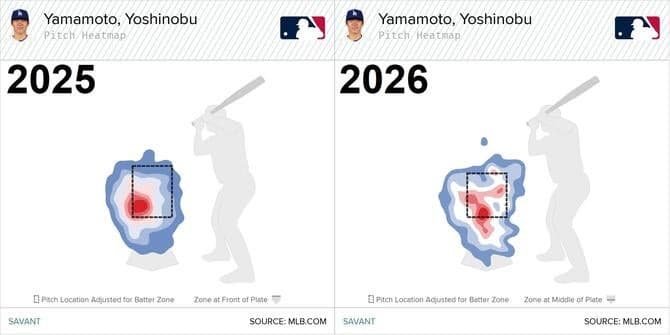
Yamamoto is pitching lefties inside a bit more this season. MLB.com/CBS Sports
The catch here is that Yamamoto has performed worse against lefties this year (.671 OPS) than last (.486), but it's not the sinker's fault. Lefties have yet to put a sinker in play. Blame his other pitches. Yamamoto has given up three homers to lefties on his splitter and four-seamer already in 2026. He gave up three total on those two pitches from 2024-25.
This is a minor tweak more than a complete overhaul, because why would Yamamoto overhaul things? He's already one of the best pitchers in baseball. Using the sinker more against lefties is just one way to improve on the margins because that's about all you can do when you're as good as Yamamoto: make minor improvements where you can and get a little better each year.

TB • CF • #14
BA0.309
R14
HR0
RBI6
SB9
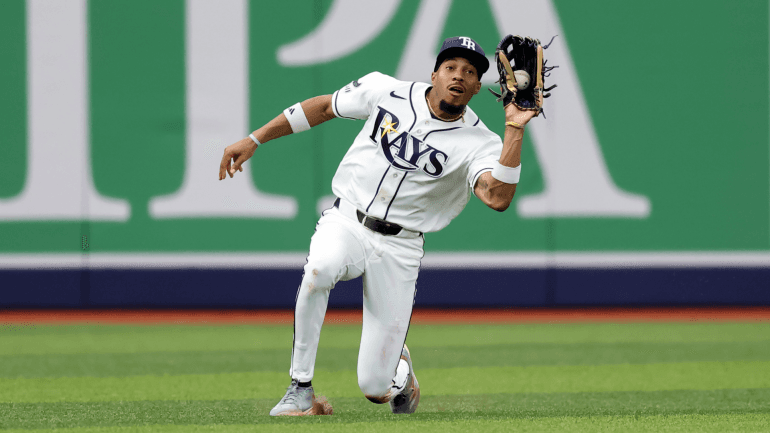
In an era of big power, Rays left fielder Chandler Simpson is a throwback. The fastest man in baseball has hit one home run out of the ballpark in more than 400 professional games, and it didn't count because it was in spring training. He puts the ball in play and runs like hell, although he has been oddly inefficient stealing bases this year (75% success rate going into Tuesday).
Fast guys tend to be strong outfield defenders who run everything down, but that wasn't the case for Simpson in the minors or last year in the big leagues. He finished with minus-4 defensive runs saved and minus-1 outs above average in 46 games worth of innings in left field in 2025, and he was much worse in center (minus-5 DRS and minus-4 OAA in 51 games worth of innings).
This year, Simpson has played strong left field defense according to both the eye test and the numbers (plus-3 DRS and plus-4 OAA). Statcast calculates a defender's expected success rate based on the exit velocity and direction of the batted balls he sees. Last year, Simpson's actual success rate was two percentage points below expected in left. This year, it's six points above.
It is early in the season and defensive stats are unreliable in small samples, though Simpson looks more confident in the field, and it is something he worked on over the winter. Aiding him was former Rays center fielder Kevin Kiermaier, one of the very best defensive outfielders of his generation. Kiermaier also spent time with the team as an outfield coach in spring training.
"He cares about the product he puts out there on the field, and those are the guys that I want to be around," Kiermaier told MLB.com about Simpson in spring training. "I'm a lucky man to have a situation like this where I can think out loud to these guys and see what they can accomplish."
Simpson's defensive trouble mostly boiled down to poor jumps and inefficient routes. Last year, his "reaction," which is the distance an outfielder covers in the first 1.5 seconds after a ball is hit, was 0.5 feet above average. This year it's 5.3 feet above average, the best in baseball. He's getting going quicker and covering more ground off the bat. Add in his speed, and you have a top defender.
The offensive bar is pretty high in left field, and if you play below-average defense, it's even higher. Simpson is a fun player but his offensive ceiling is only so great given the complete lack of power. Add in poor defense, and it wasn't clear he was an MLB-caliber player at this time last year. Now that he's showing improvement in the field, Simpson suddenly looks like a long-term piece for the Rays.
This is already Year 4 of the pitch clock era and, even with ABS challenges upping the time of game a bit this season, it has been a smashing success. Games are shorter and, more importantly, pace is up. There is less standing around, adjusting batting gloves, catching your breath between pitches, etc. That was always the goal: reduce downtime and keep the action moving.
Although the pitch clock had been used at some level of the minors since 2014, many MLB players had no experience with it, so there was an adjustment period when it arrived in 2023. That's understandable. Now that we are four years into the pitch clock era, hitters and pitchers know what they're doing and pitch clock violations are way down. Here are the numbers:
| Violations per game | Total violations | |
|---|---|---|
| 2023 | 0.44 | 1,068 |
| 2024 | 0.25 | 608 |
| 2025 | 0.20 | 470 |
| 2026 | 0.19 | 470 (pace) |
The decline is steady across pitchers and hitters. Violations are coming down for both groups at more or less the same rate. I'm not sure we can realistically expect the violation rate to come down any further. The decline has plateaued at around one violation every five games. How much lower could it possibly go? One mistake every five games seems almost negligible.
This was always going to happen. Players needed time to get familiar with the pitch clock, something that was completely new to a great many of them. Four years into it, they've got it down. Pitchers and hitters alike have found a comfortable rhythm and we don't see as many disciplinary balls and strikes handed out. Fewer violations equal fewer interruptions, and that's a good thing overall.