
Sports
Sixers' Embiid undergoes surgery for appendicitis
ESPN News
Shai Gilgeous-Alexander's MVP stats include impressive performance metrics updated through games played on April 8.
Shai Gilgeous-Alexander and Nikola Jokić are both strong MVP candidates, with each having unique arguments for their candidacy.
Luka Dončić's hamstring injury may render him ineligible for MVP consideration, impacting the overall dynamics of the race.
The top MVP candidates this season include Shai Gilgeous-Alexander, Nikola Jokić, and Victor Wembanyama.
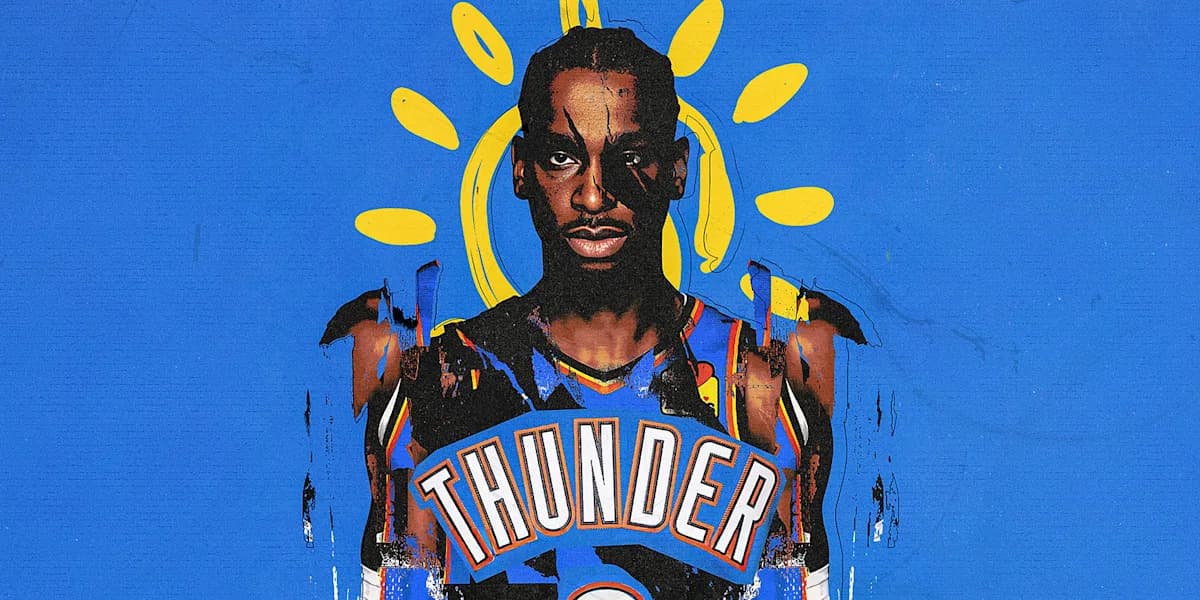
Shai Gilgeous-Alexander is a top MVP candidate this season, alongside Nikola Jokić and Victor Wembanyama. Luka Dončić's hamstring injury may affect his eligibility for awards.
This week we’re breaking down the top MVP candidates — reigning winner Shai Gilgeous-Alexander, multi-time winner Nikola Jokić, and megastar Victor Wembanyama. Luka Dončić was in the plans until he suffered a hamstring injury that may make him ineligible for any awards.
This series is less about who I think should win — I’ll reveal that on Friday’s episode of The Dunker Spot — and more about helping others either bolster their arguments for their favorite candidate, or understand the legitimacy of the other cases.
After examining the Jokić case on Tuesday, let’s talk SGA.
All stats are updated through games played on April 8.
OKC record: 56-12 (82.4% win rate, 68-win pace); 8-4 without him (55-win pace)
Notable per-game rankings (min. 50 games): 2nd in scoring, 17th in assists
Notable advanced stats: 1st in Win Shares per 48, 1st in estimated plus-minus (EPM), 2nd in offensive estimated plus-minus (O-EPM), 3rd in LEBRON
There’s a level of inevitability with all of the major candidates. Jokić will diagnose your defense and create advantages at a historic level. Wemby will warp the court on both ends in a way no other player has.
I’ve been struggling with a way to simplify SGA’s case in this way, aside from invoking the name of the (arguable) GOAT — so I’m just going to stop struggling.
SGA’s blend of interior scoring dominance, coverage-bending due to that dominance and context-proof winning is the closest thing we’ve seen to Michael Jordan.
Full stop.
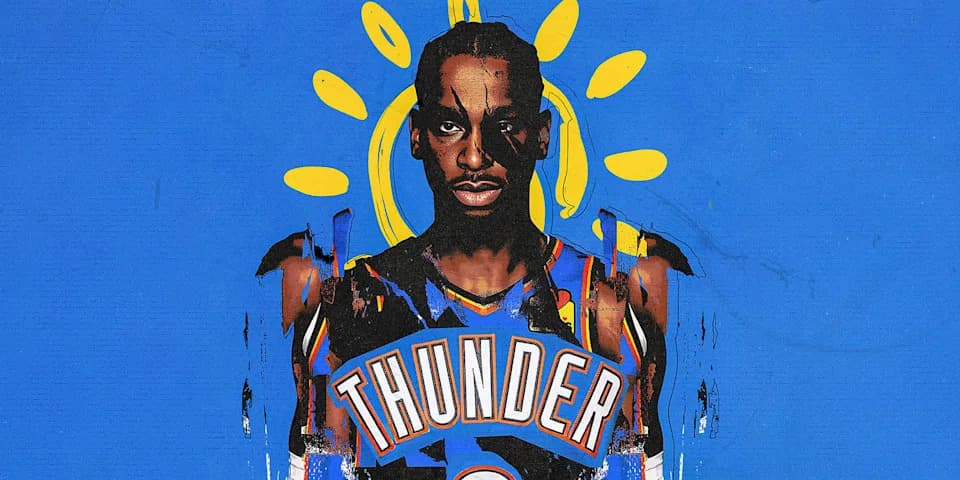
(Hayden Hodge/Yahoo Sports illustration)
There have been 21 seasons where a player has averaged 30 or more points on 60% true shooting or better, while his team wins 60% or more of their games. SGA, Jordan and James Harden are the only players to do so three times; SGA and Harden are the only ones to do it three times in a row.
Modestly increase the marks to more closely resemble what SGA is doing this year — let’s call it 65% true shooting (he’s at 66.5%, a whopping 8.6 percentage points above league average) and 70% win rate (he’s at 82.4%; the Thunder overall are 80%, best in the NBA) –— and the list shrinks to SGA and the historic 2015-16 campaign of Stephen Curry.
Of course, the shot profile is what separates the two; Curry famously bombed away from deep (45.4% on 11.2 attempts), while SGA has been otherworldly inside the arc (60.2% on 15 attempts).
That’s really where it starts for me: guards are not supposed to drive as much as SGA does, operate in the mid-range to this volume and still score this efficiently.
Teams know what’s coming, but the handle, footwork, arrhythmic pacing, understanding of angles and, yes, a preternatural ability to use his limbs against you make him darn-near impossible to guard.
The guy broke, and is extending, freaking Wilt Chamberlain’s record for consecutive games of 20 points or more, for crying out loud!
To lay it plain:
Per Second Spectrum, among 31 players to log at least 750 drives, SGA’s 1.2 points per possession on those trips lead the NBA. This is with him seeing at least one help defender on 75.3% of his drives (league average: 71.9%). Oh, and if you filter for drives against top-10 defenses, SGA is 2nd in volume (411) and first in points per possession (1.18 PPP, min. 200).
Among 33 players to attempt at least 150 mid-range shots, SGA’s 54.9% clip leads the NBA. T.J. McConnell (54.1%) is the only other player above 50%, but SGA trumps him in volume (355 attempts vs 159 attempts). For giggles, please look at what MJ did in 1996-97 and 1997-98.
To broaden the scope, there have been 58 instances in NBA history where a player has logged at least 50 games while converting at least 60% of their 2s on 10 or more attempts per game, including this season from SGA. The kicker: He is the only guard on the list. If you bump up the requirements to 15 attempts (to match SGA), the list shrinks to 12 seasons, seven on-one-name-basis stars: Giannis (x4), Kareem (2x), Shaq (2x), Barkley, McHale, Zion and SGA (which I guess is an acronym, whatever).
More play-type data sells the case. He’s been the league’s best high-volume (min. 300 attempts, 36 players) isolation player (1.22 PPP). At 1.11 PPP, SGA narrowly trails Dončić (1.114 PPP) as the league’s most effective pick-and-roll maestro among high-volume options (min. 1000, 47 players) .
He gets to the rim and finishes at a high clip. The mid-range scoring is sublime. As if that wasn’t enough, he has the audacity to shoot over 38% on off-the-dribble threes, too.
The scoring dominance enhances his improved playmaking; that improvement has been necessary in light of how teams have worked to defend him.
Teams working to “load the box” against SGA drives isn’t a new phenomenon, though it ramps up against top-tier competition. I still have this end-of-half Boston possession burned in my brain. He’s drawn a second defender (or more) on roughly 21% of his touches, the fifth-highest mark in the league among players to log at least 2,000 touches so far.
It simply hasn’t mattered.
The Thunder have generated over 1.1 points per possession when SGA has drawn two, an elite figure. The stars that match or exceed SGA’s volume (Deni Avdija, Jaylen Brown, Cade Cunningham, Dončić) don’t match that efficiency; the stars that match or exceed the efficiency (Giannis, Jokić, Jamal Murray) are at least 200 touches below SGA’s volume.
His ability to diagnose help or ball-screen aggression has both grown and popped all year. Load up against his isolation (or post-switch) attacks and he can manipulate that help to generate looks for others.
Ramp up your aggression when defending him in ball screens, and he’ll sprinkle in slips, make relief passes to the wing to keep the machine more fluid, or simply reject or split the ball screen altogether and turn things into a downhill affair. Dump-off passes and corner kicks are unlocked and accessed; of course, he could also just drain more pull-ups.
Averaging 31.1 points on 60/39/88 splits, plus 6.6 assists (only 2.2 turnovers) is not supposed to happen. When you consider how much of this damage has been done through three quarters — he’s sat out 26 fourth quarters this year — his campaign becomes even more absurd.
When he’s actually been needed for the final frame (or overtime), he’s been sensational.
You could build an ironclad Clutch Player of the Year case with just his basic numbers. To the easy stuff:
He leads the NBA in clutch points (156) while doing so on 61/35/85 splits.
He’s made a league-best 22 shots to tie or take the lead in clutch situations this year, including an insane 18-of-27 (66.7%) clip on shots inside the arc.
The Thunder are 20-7 in the clutch games he’s appeared in (74.1% win rate), and they’ve outscored opponents by a league-best 93 points in the 125 minutes he’s played.
SGA, Jokić, and Cade Cunningham (welcome back!) are the only players with 100 clutch points, 20 clutch assists, and 10 or fewer turnovers; SGA has been more efficient and has won at a higher clip than both of them.
But then you have to look at what he’s faced during those clutch moments. Most notably, teams send two on the ball on nearly 17% of SGA’s pick-and-rolls during clutch time — the fourth-highest clip among players who’ve run at least 50, and a massive shift from what he sees through the first three quarters (6.4%).
Again, it has not mattered.
That he’s been able to handle this offensive workload and the ramping up of defensive attention/aggression with this level of ball security — among 36 players with a usage rate above 25%, none takes care of the ball like SGA — adds another cherry on top.
Quietly baked into all of this absurdity: the “it doesn’t matter” bit extends to his own teammates.
Eight of SGA’s in-the-rotation teammates have missed at least 10 games this season: Jalen Williams (47), Isaiah Hartenstein (33), Alex Caruso (24), Ajay Mitchell (23), Aaron Wiggins (17), Jaylin Williams (15), Lu Dort (13) and Chet Holmgren (11).
Nine if you include fan (and personal) favorite, Kenrich Williams (26).
(I specify the rotation piece because I don’t love including guys like Thomas Sorber or Nikola Topić into the games missed bit, but you technically could.)
That is not supposed to be the recipe for a 60-win team.
While credit is obviously due to the culture of accountability and execution (especially defensively) head coach Mark Daigneault has established during his tenure, the floor- and ceiling-raising of SGA deserves a ton of praise.
The Thunder perform as a very good basketball team (+6.7 net rating) with SGA off the floor; they become world-beaters (+16.5) with him on the floor.
It’s hard to overstate just how much he unlocks for this offense; its rating jumps from 112.9 (would rank 26th league-wide) to 123.5 (would rank 1st). Only four players – Jokić, LaMelo Ball (underrated All-NBA case), Murray and Harden — impact their team’s offense to that degree or higher.
If there’s one parallel to draw between SGA and 2015-16 Curry, it’s that teams attempt(ed) to poke at them defensively because they’re often the only sub-elite option to go at, not because they’re actually bad at defense.
Some of the play-type data is very kind to SGA. Of note:
Among 102 players to defend at least 500 pick-and-rolls as the screen navigator, SGA’s 0.83 PPP allowed mark is only bested by Ausar Thompson (0.79).
Among 121 players to defend at least 300 off-ball screens as the screen navigator, only Rui Hachimura (0.79) has allowed a lower mark than SGA (0.81).
Among 69 players to defend at least 400 drives, SGA’s 0.949 mark ranks 12th — in a virtual tie with 11th-ranked Dyson Daniels, and ahead of other notables like Thompson, Jaden McDaniels and Cason Wallace.
Those numbers scream, “SGA should have a DPOY case, too” — but the film and accompanying matchup context does not agree with that claim.
Things like his isolation (0.99 PPP; 72nd of 103 players, min. 150) and closeout numbers (1.02 PPP; 44th of 109 players, min. 350) paint him closer to average, if not slightly below.
I’d say he’s been firmly above-average in my watching; not just a capable cog in OKC’s elite machinery, but one that can add legitimate value when locked in.
He’s once again racking up steals, though not to last year’s standard. Smartly deployed on weak links, he’s able to get theoretical breathers with those assignments while also affording him the freedom to use his length and instincts to muck things up.
At his best, he utilizes that blend to affect real change as a secondary rim protector. After opponents converted 64% of their shots at the rim against him last season, that mark has improved drastically to 58.8%. To put that into perspective, that puts him behind a guy like Derrick White (55.6%, -3.2), but ahead of a guy like Thompson (61.2%). I think the Thunder will take that middle ground.
Teams still try to poke at SGA with post-ups when matched up against 4s, but they haven’t had much success (0.74 PPP). There’s obvious context to add — OKC likes sending late help/doubles, and those have turned potential attempts at the rim into swing-swing 3s that have missed — but SGA has also created his own mayhem with late swipe-downs.
There’s also the matter of the post-up attempts that haven’t been logged because he’s been adept at deflecting or outright stealing entry passes.
If you’re of the “MVPs must provide value on both ends” class of argumentation, SGA certainly crosses that threshold.
Share this article


See every story in Sports — including breaking news and analysis.