NFLPreview
Colts' Josh Downs ready to go 'head-to-head' with Cowboys' Caleb Downs
Josh Downs of the Colts is ready to compete against his brother Caleb Downs of the Cowboys this season!
Yahoo Sports1 min read

Iga Świątek has fired coach Wim Fissette and hired Francisco Roig, previously with Rafael Nadal's team. Emma Raducanu remains without a permanent coach, while Amanda Anisimova is trialing with Sebastian Sachs after parting ways with Henrik Vleeshouwers.
Mentioned in this story
For participants and lovers of the tennis coaching carousel, it’s been quite a month or so.
At the end of March, Iga Świątek fired Wim Fissette, the coach who helped her to the Wimbledon title last year. Fissette and Świątek had evolved parts of the six-time Grand Slam champion’s game, but not to the extent that they both wanted.
Świątek needed a new coach. So she hired Francisco Roig, a longtime member of Rafael Nadal’s team. Roig, who had recently split with Emma Raducanu, was not a free agent. He was working with Giovanni Mpetshi Perricard, the Frenchman with the biggest serve in the men’s game. No matter. Roig left Mpetshi Perricard and his agent to find someone else, so Mpetshi Perricard teamed up with Greg Rusedski, a big server himself, out of little more than thin air.
Raducanu? She has so far chosen not to hire anyone permanent, most recently having a brief, one-off training camp in Spain with Andrew Richardson — who coached her to the U.S. Open title in 2021.
Fissette is still waiting for his next gig, and may not be in a hurry, after a lot of weeks on the road with Świątek the past 18 months. He might have been a possible get for Amanda Anisimova, who split with Henrik Vleeshouwers around the same time as Świątek and Fissette parted ways. Instead, according to her agent, Anisimova is now on a trial with Sebastian Sachs, a former coach of Raducanu and Belinda Bencic, through the end of her time at the French Open.
That’s a lot of spinning. Especially for clay-court season.
This sort of swirl usually occurs at the end of the tennis season, in October and November. In plenty of other sports, there are systems and networks in place to manage these sorts of untimely crises, and in team sports especially, the firing and hiring process has become professionalized.
Owners and chief executives engage search firms with specialized practices in sports. Headhunters screen candidates, who may be asked to compile presentations outlining a short and long-term plan for improvement. That can happen quickly or slowly, depending on how fast a franchise wants or needs to move. Teams will sign managers to five-year contracts even if they might not be in the same league before the first year is out. Soccer coaches of the biggest clubs are expected to come in with a grand vision for success, in keeping with that club’s philosophy and financial means. The constant wild card, across tennis and everywhere else, is availability.
Iga Świątek fired Wim Fissette because they did not evolve her game to the extent they both wanted.
Francisco Roig is a longtime member of Rafael Nadal's team, and Świątek hired him to help improve her game after parting ways with Fissette.
Emma Raducanu has chosen not to hire a permanent coach and recently had a brief training camp with Andrew Richardson.
Amanda Anisimova is currently trialing with Sebastian Sachs, a former coach of Emma Raducanu and Belinda Bencic.
Josh Downs of the Colts is ready to compete against his brother Caleb Downs of the Cowboys this season!
Toby Collyer, 22, looks up to Casemiro as he aims for a first-team role at Manchester United.
Fabio Wardley reacts to 'email champion' jibes ahead of Dubois fight
Kris Srikkanth believes RCB needs Devdutt Padikkal at the top order.
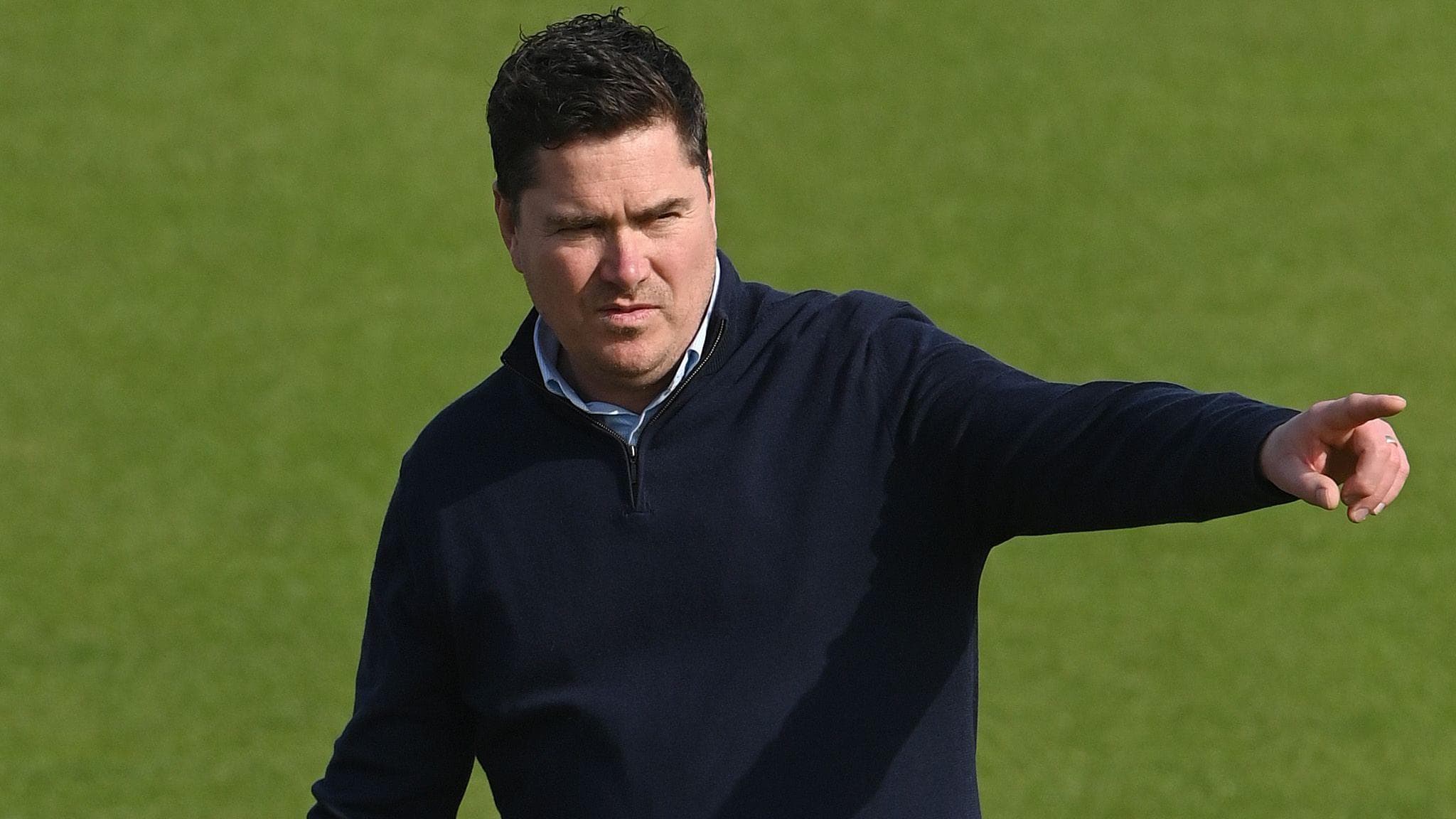
England likely to appoint Marcus North as national selector, a historic first.
Tonali and Fagioli's gambling scandal concludes with final punishments.
See every story in Sports — including breaking news and analysis.
Still, as in most realms, tennis does the other things a little differently. The reasons tennis players choose coaches — technical expertise, motivational style, Grand Slam experience — can vary wildly and they will seek different things as their careers evolve. But the ways that they end up with them tend not to change all that much.
Happenstance. Word-of-mouth. Familiarity. Convenience. And the usual terms over compensation and time commitment that pertain to every job in the history of market capitalism.
Most coaches receive a base salary and a percentage of a player’s winnings. Those numbers can fluctuate depending on the renown of the coach and the player. A top coach of a quality player might receive a base salary in the low-mid six figures and between 5 and 15 percent of a player’s prize money.
Players cover the travel expenses, though some tournaments provide additional hotel rooms and subsidized travel for team members, especially for top players.
Some coaches also might receive a percentage of a player’s sponsorship income. Everything is up for negotiation. Jannik Sinner and Carlos Alcaraz would be foolish to sign away a high percentage of their winnings to a coach.
Alcaraz collected $21 million in 2025. Juan Carlos Ferrero and Samuel López are excellent coaches. Are either worth more than $3 million? There might be differing opinions on that, depending on whether one is a player (or a player’s agent) or a coach (or a coach’s agent).
Ferrero started coaching Alcaraz when he was 14. The Murcian wonderkid joined his academy and Ferrero essentially dumped a young Alexander Zverev, who was far more established at the time, to take on Alcaraz. He and Alcaraz won six Grand Slam titles together and were a unit until last December, when the two camps could not come to terms on a new deal.
By then, López was serving as a second coach for Alcaraz. He had been working with Alcaraz’s close friend and mentor, Pablo Carreño Busta, for years before joining team Alcaraz. Sliding him into the first position after the split with Ferrero made for a simple and orderly transition.
In plenty of other cases, randomness rules, even with someone like 24-time Grand Slam champion Novak Djokovic. Since his experiment with Andy Murray, Djokovic basically just grabs a veteran of Serbian tennis and brings him along for a swing.
Consider some of these anecdotes.
In October 2022, Pam Shriver, the longtime commentator, former world No. 3 and 22-time Grand Slam doubles champion, drove from her home in Los Angeles to San Diego for the WTA tournament there. Shriver said she wanted to speak with veteran Donna Vekić, who was a member of the WTA Player Council, about getting support for a new player safeguarding program.
That conversation evolved into a talk about tennis and Vekić’s game and potential. Very quickly, Vekić asked Shriver to join her coaching team. Shriver coached Vekić for the next three years, serving mostly as a second coach for roughly a third of each season, especially at the biggest tournaments.
In 2023, Coco Gauff decided she needed a new voice after she lost to Sofia Kenin in the first round of Wimbledon. After that loss, Brad Gilbert, the longtime coach and television commentator, was talking with Mary Jo Fernandez about what Gauff could do to join the sport’s elite.
Fernandez told her husband, Tony Godsick, who was then Gauff’s lead agent. Godsick floated the idea of appointing Gilbert to the Gauffs and had his lieutenant, Alessandro Barel di Sant Albano, reach out to Gilbert. There was an interview during Wimbledon, then a trial tournament at the Citi Open in Washington, D.C., where Gilbert had a corporate gig. Six weeks later, Gauff was the U.S. Open champion, with Gilbert in her box. A year later, after a slumping loss at the same event to Emma Navarro, Gilbert was out.
Last spring, coach Tom Hill and Greece’s women’s No. 1 Maria Sakkari began talking about reuniting. That was news to Peyton Stearns, who was employing Hill at the time, and soon learned that Hill was dumping her. Stearns went on social media and announced she was taking DMs and other forms of applications.
A friend reached out and suggested Blaž Kavčič, a Slovenian who had been working with Max Purcell, who was serving an anti-doping suspension. It was mid-season. She figured she’d give it a shot. They lasted for much of the rest of the season.
Last fall, Alex Michelsen, the 21-year-old American, needed a coach. His agent, Mats Merkel, was on the lookout. He ran into Tallon Griekspoor at the Shanghai Masters. Griekspoor told him he was no longer working with his longtime coach, Kristof Vliegen, who had taken Griekspoor from an unranked 17-year-old to the edge of the top 20 during their many years together.
That was all Merkel needed to hear. He called Vliegen to set up a trial. They hit it off, and have been together since.
“He’s young and he’s new,” Vliegien said of Michelsen during a recent interview. “I like to work with young guys.”
That’s often how the hiring process starts, with a call from an agent to a coach to gauge interest, though sometimes the idea comes from the player. David Witt is pretty sure that is how he ended up with Aleksandar Kovacevic this past off-season.
Witt spent the previous year coaching Frances Tiafoe. Tiafoe and Kovacevic are part of the same practice cohort based around Boca Raton, Fla., where many of the top American men live and train. He and Kovacevic knew of one another.
Shortly after Witt and Tiafoe parted on good terms after last season, he got a call from Kovacevic’s agent asking if he would consider coaching the 27-year-old American who has never been ranked higher than No. 54. Witt, who previously coached Venus Williams, Jessica Pegula and Sakkari, said he had gotten a few other calls from the agents of female players.
He decided to do a trial run with Kovacevic during the off-season.
“We liked each other,” he said during a recent interview. He thinks they are headed in the right direction after some tough three-set losses to Novak Djokovic, Tiafoe, and Rei Sakamoto, the 19-year-old, from Japan. “Building blocks,” he said of the defeats.
Those can be valuable. Just ask Simone Vagnozzi, who had some lean months early in his tenure with Jannik Sinner after Sinner dumped Ricardo Piatti in 2022. Vagnozzi and Sinner came together through another tried and true route: the national federation coaching tree.
Vagnozzi had a solid reputation with Italy’s tennis federation for working with some middling Italian men. He’d never coached a big star. Then again, Sinner wasn’t a big star in early 2022. He also wasn’t a middling Italian. But he had done time with Piatti, a super coach who is a brand unto himself, and he wanted something different. Sinner liked the idea that Vagnozzi is the opposite of Piatti. Darren Cahill fulfils the big-name role in what has become a wildly successful partnership.
Then there are the players who end up with coaches they are assigned.
Ethan Quinn, a rising American, is a native of Fresno, Calif., the home of Brad Stine, who has coached just about everyone from Jim Courier to Tommy Paul. Stine has overseen Quinn’s development throughout his childhood, but is busy coaching Paul.
Stine tapped Brian Garber, who has mainly coached on the ATP Challenger Tour, the second tier of men’s tennis. Stine believes Garber and Quinn can develop the same kind of bond Stine has with Paul and previously with Courier, a former world No. 1.
“I feel like Ethan can be the guy that can really make Brian’s career,” Stine said during an interview last year. Quinn, the 2023 NCAA champion, was outside the top 100 then. He’s the world No. 54 now. If he keeps climbing the rankings, his place in the coaching carousel will likely change. But as its top stars and rising talents well know, no matter their fortunes, it will keep on spinning in its own, singular way.
This article originally appeared in The Athletic.
Sports Business, Tennis, Women's Tennis
2026 The Athletic Media Company