NFL
Fantasy Football Video: Should managers be concerned at all over 'crowded' Eagles' offense?
Eagles' Offense: Concerns Over Crowded Receiving Room?
Yahoo Sports1 min read

The 2027 NFL mock draft predicts six quarterbacks will be selected in Round 1, with Dante Moore projected as the No. 1 overall pick. Arch Manning, despite his high profile, is not currently ranked as QB1.
Mentioned in this story
Getty Images
Whether it's a "way-too-early" mock draft, or the final mock draft in late April … it's always about the quarterbacks. The last two years, we've seen four total quarterbacks go in Round 1 after six went in the first 12 picks in 2024. If the 2027 class plays out like we all expect (and let's be honest, that almost never happens), we could see four or five quarterbacks find their way into the first round some 350 days from now.
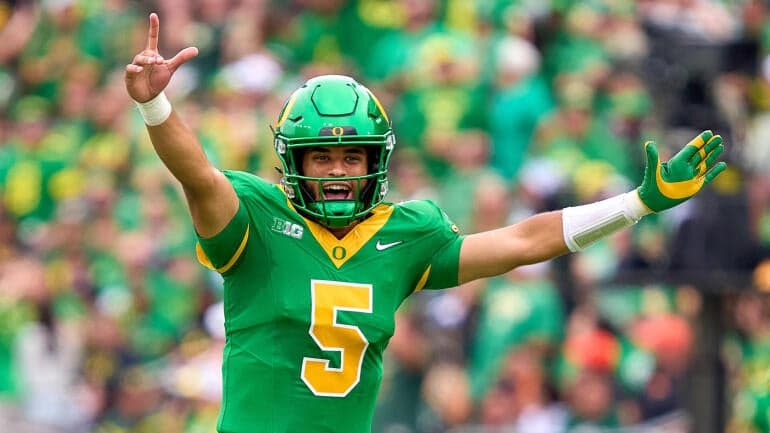
Let's start at the top. I have Dante Moore going No. 1 overall in this exercise and it shouldn't be hard to see why (though I suspect some folks will take it as a personal affront). At points last fall, Moore was in the QB1 conversation, and he would've almost certainly been the No. 2 overall pick for the Jets had he not returned to Oregon.
Meanwhile, the inertia for Arch Manning as QB1 feels all but unstoppable -- fueled in part by the nonstop media momentum, as well as an NFL that sees bloodlines as a buffer against the inherent uncertainty that comes with identifying a franchise quarterback.
Then there's Jayden Maiava, who I thought might have been a first-rounder in '26 had he declared. Add names like Darien Mensah, CJ Carr and Drew Mestemaker (not to mention Julian Sayin, Trinidad Chambliss, John Mateer, Josh Hoover and Nico Iamaleava, among others) and suddenly this class looks impossibly deep. (Of course, what looks "impossibly deep" in May often turns out to be "slim pickins' 10 months later…)
But before you go too far, it's worth reframing what this actually is. Less a true mock draft and more a living watchlist -- a snapshot of where things stand heading into the 2026 college football season. It's a collection of names, traits and possible trajectories to track as the fall reshapes everything.
So just a friendly reminder: It's early. A lot will change. But if this snapshot holds, the 2027 draft, like the 2024 version, won't just feature quarterbacks, it'll be defined by them.
(And in case you're wondering, in looking back at my way-too-early 2024 mock draft, I had five QBs going in Round 1 -- , , , . … and , who ended up being a seventh-rounder. The two I missed on: and , which is also a good reminder that we'll have 1-2 QBs come out of nowhere to make a first-round push by the time it's all said and done.)
Dante Moore is projected to be the No. 1 overall pick in the 2027 NFL draft.
The mock draft anticipates that four to six quarterbacks could be selected in the first round of the 2027 NFL draft.
Arch Manning is not currently ranked as QB1 due to the strong performance and expectations surrounding other quarterbacks like Dante Moore.
Factors include performance metrics, media momentum, and the perception of a player's potential as a franchise quarterback, often influenced by their family background.
Eagles' Offense: Concerns Over Crowded Receiving Room?
Ez Abde is excelling at Real Betis, raising questions about a Barcelona return.
Philadelphia Eagles trade up with Cowboys to select Makai Lemon in the 2026 NFL Draft.

2026 Rookie Mock Draft: Surprises and Tight End Premium Picks

Top NBA player prop picks for May 4, 2026 playoffs
See every story in Sports — including breaking news and analysis.
Alright, let's get to it!
Note: The draft order was determined using FanDuel Sportsbook's reverse Super Bowl odds. The Jets have three first-round picks: their own, the Cowboys' from the Quinnen Williams trade and the Colts' from the Sauce Gardner trade. The Cowboys have the Packers' selection from the Micah Parsons trade.
[Ranking each team's 2026 NFL Draft class: Chiefs, Browns, Jets crush it; Steelers, Rams, 49ers raise questions
Ryan Wilson

Moore would have been the No. 2 pick in the 2026 NFL Draft had he not decided to return to Oregon. He plays with high-end pocket composure, handles pressure well -- and once the play breaks down, is elite out of structure. He showed up in big moments throughout the '25 season (until they ran into the Hoosiers in the CFP) and he's my QB1 because he outplayed Arch Manning -- and every other QB -- in the '26 class.
Manning got off to a sluggish start in 2025 but finished strong. If he picks up where he left off late last fall, he'll be in the No. 1-overall-pick conversation. Again.
Maiava was one of my favorite players to watch last season; he's a well built, big-armed QB who shows good touch on layered throws, but needs to play with more consistency from start to finish.
Smith is better than Marvin Harrison Jr. coming out of Ohio State. And I'm guessing we'll be comparing him more to the likes of Julio Jones or Megatron by next spring.
Simmons can win with power, speed and twitch -- he was unstoppable for much of '25 and I only expect him to get better this season.
Goosby, who would've likely been a first-rounder had he declared for the '26 draft, has a huge frame and high-end athletic traits that allow him to anchor effectively against power, though he remains a raw prospect who can struggle with quicker pass rushers.
Stewart uses his long frame, tenacity and overpowering strength to set the edge against the run. He's also surprisingly twitched up as a pass rusher, consistently collapsing the pocket with an explosive blend of length and suddenness.
Mensah is a sturdy, big-armed passer who has both touch and accuracy on deep throws, consistently layers the ball on second-level throws, can rip intermediate and deep throws out of structure and with accuracy, but he can also get himself into trouble when he tries to extend plays instead of taking what the defense gives him. He has a chance to be the latest Miami QB transfer to be in the Round 1 conversation, following Cam Ward and Carson Beck.
Moore is a fluid athlete who stays in phase and uses his length to be consistently disruptive downfield. His smooth change of direction allows him to play both outside and in the slot, which will make his transition to the next level even smoother.
A high-motor D-lineman with quick feet who can get off blocks early in the rep to be a consistent disruptive presence in the backfield. Stone can line up anywhere along the D-line and often finds himself around the ball vs. the run.
Uiagalelei has an NFL frame who wins with power and a high motor, particularly when aligning wide. That said, he lacks bend and needs to add to his pass-rush arsenal. His 2025 tape wasn't nearly as far along as Tuli Tuipulotu coming out of college and he was a second-round pick (54th overall) of similar age and with similar tools. Looking for a big leap in '26.
Carr is a Bo Nix-style game manager and I mean that in the most laudatory terms possible. He's a steady-as-she-goes QB, who doesn't make mistakes, shows consistently good touch on deep balls, can throw with anticipation on intermediate throws, has the athleticism to play out of structure and finds ways to make plays -- and that's all just from one year of starting experience.
Coleman is a physically imposing wideout who pairs elite contact balance with the suddenness to make defenders miss in the open field. He runs routes with the nuance of a much smaller receiver and possesses the play strength to consistently punish DBs after the catch.
Mestemaker is a big-armed QB who layers the ball well on downfield throws but can also step on it when he needs to fit it in a tight window. He shows the ability to get through his reads while standing tall in the pocket, though he'll need to limit his interceptions (he had 11 in '25), some of which came on poor decisions, or throws in which he didn't set his feet. He'll see a step up in competition going from North Texas to Oklahoma State, and if he makes that jump, he'll be a name to watch in the fall.
Washington is a powerful, athletic defensive lineman who can collapse the pocket or blow up a run play when he fires off low and plays with leverage. He's at his best attacking gaps, where his burst, strength, and motor let him disrupt plays before they develop. When he's locked in, he looks like a true difference-maker who can overwhelm blockers with both quickness and power.
Daley wins through superior hand usage and a diverse pass-rush arsenal that includes an impressive spin move that often leaves OTs flat-footed. He also plays with the leverage and strength necessary to reset the line of scrimmage against the run.
Green plays with a sturdy anchor against power rushers, and while he needs to play with lower pads in the run game, his high-level awareness makes him a reliable blindside protector whose NFL future could be inside at guard.
A powerful edge rusher who leverages a low center of gravity to collapse the pocket and physically overwhelm blockers. Ross displays impressive lateral agility to redirect in space; inline TEs will struggle to block him in the run game.
Becker didn't see the field consistently unitl midway through the 2025 season when an injury to Elijah Sarratt led to more playing time. And he took full advantage; he's a huge target who can win with speed and contested-catch ability -- and he can also contort his body in ways to make the impossible catch look routine.
Rhodes offers a rare physical profile, combining massive size with the athleticism to serve as a versatile chess piece across the defensive front. He is immovable at the point of attack and generates significant power as a pass rusher.
Smith is a high-level athlete at LT who shows natural talent for moving defenders in the run game and anchoring against power. While he needs to sharpen his technique against nuanced speed rushers, his physical tools provide a high floor for development.
An explosive straight-line rusher who can close quickly on the QB because of his downhill juice. Though Wilson isn't bendy around the edge, he wins through pure power and leverage.
Pieper is an athletic interior lineman who shines in pass protection and in zone schemes. As he continues to improve functional strength, he has the potential to become one of the best interior OL in the class.
Coleman-Williams' tape in 2025 looked nothing like what we all witnessed during his freshman season in '24. If he can return to that player, he'll have a chance to be a top-10 pick and battle Jeremiah Smith for WR1.
Lubin marries high-end power-rush capabilities with the discipline to shut down the run. His rare ability to drop into zone coverage makes him an ideal hybrid player in the ever-evolving defensive schemes that rely more and more on "positionless" play.
Carter Jr. is a long-striding playmaker who threatens all three levels of the field and runs like a power back after the catch. While he struggles with focus drops at times, his combination of vertical speed and high-effort blocking makes him a dynamic weapon as offenses continue to use more multiple TE sets.
The Colorado transfer has an enormous frame with a thick build yet he plays light on his feet, has high-end lateral mobility and anchors well vs. bull rushers. Seaton plays with heavy hands and once he locks on, edge rushers struggle to disengage. Don't be fooled by his size -- his high-end athleticism shines, especially in space, where he can excel as a second-level blocker, and on the perimeter as a lead blocker.
Robinson is a physical corner who excels at reading the QB and being consistently disruptive at the catch point. He plays with the confidence and technical traits to thrive on an island, whether in man or off-coverage.
Echoles is a disruptive interior bulldozer who plays with a low center of gravity and also has surprising twitch that often finds him in the backfield making plays on the ball.
A physically imposing cornerback who consistently puts himself in a position to make plays at the catch point, Brown's ability to mirror receivers in man or react in off-coverage makes him a highly reliable presence in the secondary.
Marsh transferred from Michigan State where he was targeted 102 times in 2025. At 6-foot-3, 200 pounds, he looks like the natural replacement for Elijah Sarratt (and like Sarratt, he lined up outside about 95% of the time). Despite his size, Marsh can put his foot in the ground and get in and out of breaks, creating separation at the route stem. Like Sarratt, he won't consistently create separation on vertical routes, but he has legit contested-catch and YAC ability, and he uses his frame to shield defenders.
Hardy is built low to the ground, runs with a low center of gravity, is incredibly difficult to get on the ground as a result, and has home run ability once he gets to the second level. He excels in outside/wide zone schemes that allow him to one-cut-and-go once he sees daylight. He didn't give Mizzou much in the pass game last season -- he was targeted just seven times and had six catches.