News
Family 'utterly devastated' after boy, 13, killed in crash as two charged
BBC News
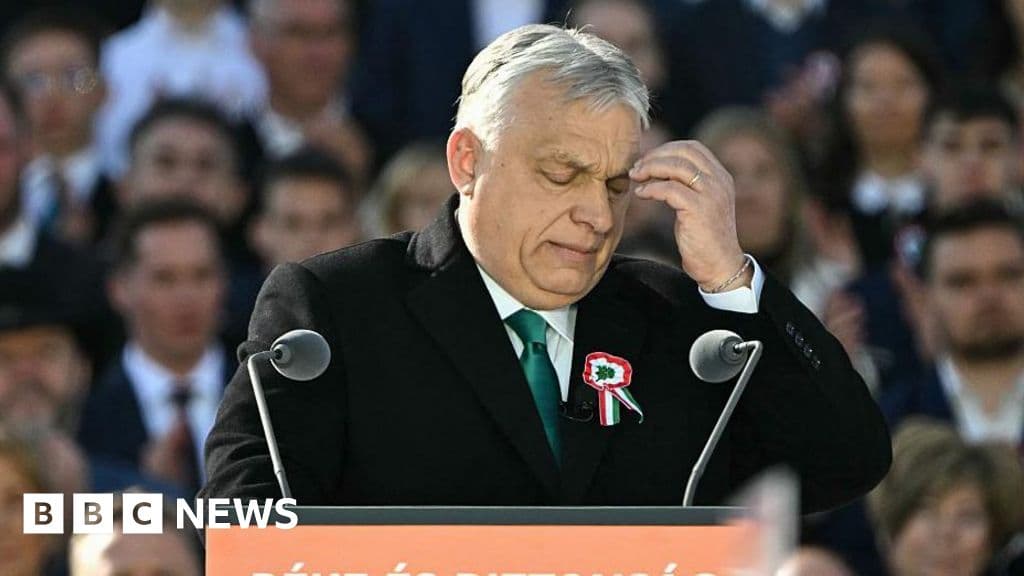
No serving leader in the European Union has led their country for as long as Viktor Orbán. But after 16 years he faces his strongest challenge yet in 12 April elections, where most opinion polls suggest he is heading for defeat at the hands of former party insider, Péter Magyar.
Since 2010, Orbán has transformed Hungary into what the European Parliament has denounced as a "hybrid regime of electoral autocracy". He appears uncertain how to describe his own invention. He has tried both "illiberal democracy", and "Christian liberty". His allies in the US Maga movement call it "national conservatism".
Orbán has repeatedly clashed with European Union colleagues on the war in Ukraine, blocking vital funding for Kyiv, which he accuses of trying to force Hungary into war with Russia.
And yet he has powerful international allies.
He is considered Vladimir Putin's strongest partner in the EU, and he has been endorsed by US President Donald Trump in his bid for a fifth consecutive term in office. His closest allies within the EU come from the radical and hard right.
His antagonism towards Brussels still pays off with many Hungarians, but Orbán has cut an increasingly lonely figure among EU leaders looking for European unity in response to the war in Ukraine.
His Foreign Minister, Péter Szijjártó, recently admitted personally sharing details of EU meetings with his Russian counterpart Sergei Lavrov, but called those conversations "everyday diplomacy".
"Orbán and his foreign minister left Europe long ago," Poland's Prime Minister Donald Tusk observed.
His personal charisma has been an unquestionable ingredient of his success, but polls suggest many of his supporters have tired of him and the corruption allegations that have swirled around his party.
Orbán appeared rattled when he was booed during a March campaign speech in the north-western town of Győr.
This was a very different Orbán from the man whose ex-football trainer once highlighted his ability to "think on the ball".
This was a leader who rolled up his sleeves and stacked sandbags alongside firemen and volunteers, when toxic red sludge from a bauxite mine engulfed a Hungarian valley and threatened the Danube shore in 2010.
Now 62, Orbán first made his mark while still a law student in Budapest in the late 1980s as the Soviet Union began to fall apart, setting up a political movement called Fidesz, or Alliance of Young Democrats.
"If we believe in our own power, we are able to finish the communist dictatorship," he told an estimated quarter of a million Hungarians during an audacious seven-minute speech. They were gathered in the city's Heroes' Square for the reburial of the man behind Hungary's failed uprising in 1956, Imre Nagy.
Reflecting on his words 10 years later, he said he had "exposed everyone's silent desire for free elections, and an independent and democratic Hungary".
The democracy that replaced authoritarian Soviet rule has changed dramatically under Orbán, who according to Hungarian-born journalist Paul Lendvai has moved "from one of the most promising defenders of Hungarian democracy into the chief author of its demise".
Prof Andras Bozoki, a former culture minister, describes Hungary since 2010 as being "the only one former consolidated liberal democracy in the EU that has reached the level of a non-democratic system as a hybrid regime".
Viktor Orbán was born in 1963 an hour to the west of Budapest, the eldest of three sons whose father was an agricultural engineer and Communist Party member and whose mother was a special needs teacher.
They had no running water at the family home in Felcsut, a village of about 2,000 people where he still owns a house.
In an 1989 interview, he recalled being beaten twice a year by his father, Gyozo, whom he described as a violent man: "When he beat me, he also shouted. I remember all this as a bad experience."
Nothing about his childhood suggested that he would go on to challenge the communist regime. He attended a grammar school and was involved in the Young Communist League.
His main interest was football, playing for his local club, FC Felcsut, and he remains highly enthusiastic about his childhood sport. In 2014 he inaugurated a controversial new stadium there called the Pancho Arena, where top-flight team Puskás Akadémia plays to small crowds.
In the months before he went to university, he carried out his military service, where he says he turned down an approach from the communist secret services to become an informer.
He was 23 when he married fellow student Anikó Lévai, whom he met at university. They have five children, four daughters and a son, Gáspár, who was trained by the British Army at Sandhurst and served as an officer in the Hungarian army in Chad.
After his 1989 speech to a large crowd in Heroes' Square, he went on to study liberal political philosophy briefly at Oxford. His scholarship was funded by Hungarian-born billionaire philanthropist George Soros, a benefactor he would turn against years later.
Within months he had abandoned his studies early to campaign in 1990 elections, when Fidesz won 22 seats, with Viktor Orbán top of the party list.
Friends from his student days became key members of Fidesz, and his college director Istvan Stumpf went on to take up the role of his chief of staff during the first Orban premiership from 1998-2002.
As a young MP, Viktor Orbán and his party joined the global Liberal International movement in 1992.
Political scientist Zoltan Lakner believes he shifted ideology during the second half of the 1990s. As Hungary was governed by a liberal-socialist coalition, he realised "to gain political success he had to turn his back on liberalism and transform his party into a nationalist, anti-liberal political force".
Perhaps the seeds of his reversal were already sown at Oxford. In his few months at Pembroke College, he befriended the conservative philosopher Roger Scruton.
Or perhaps it was more political opportunism.
Orbán became Fidesz leader in 1993, and was already pushing it to the centre right by the time the conservative MDF lost power in 1994. Fidesz filled the gap left by the weakened conservatives.
Peter Rona, an Oxford-based economist and former candidate for president of Hungary, describes a meeting in the early 1990s, at which Orbán said he wanted to create a "modern conservative party".
When Peter Rona warned him that earlier politicians who had attempted the same thing had quickly dropped the "modern" when circumstances demanded, Orbán replied: "Then so be it."
In 1998, Orbán led Fidesz to election victory, and at 35 became Europe's youngest prime minister, taking Hungary into Nato in 1999.
He then suffered two defeats at the ballot box, in 2002 and 2006, and on both occasions the Fidesz leader learned his lessons.
The defeat in 2002 changed him. "The nation cannot be defeated," he told his supporters, as he tried to digest what had just happened.
After 2002, Orbán befriended Árpád Habony, a martial arts instructor and businessman, as his personal guru. Habony became a trusted ally and component in the business empire that underpinned Fidesz.
Orbán was swept back into office in the turbulence of the global economic crisis in 2010 and has not lost since.
He has since transformed Hungary with a host of changes to its laws and constitution, winning four consecutive elections with four straight "super-majorities", controlling two-thirds of parliament.
In an attempt to secure his legacy, more than 40 "cardinal laws" were passed, reshaping state institutions, the economy, election laws and the media.
The economy was stabilised, public finances were secured and EU funds came in.
However, expensive state projects were placed in the hands of Orbán's inner circle, including a childhood friend and a son-in-law.
Fidesz and its supporters gradually took control of Hungary's media landscape, replacing foreign investors, says Hungarian media monitor Mertek.
In 2018, almost all "Orban-friendly media" transferred ownership rights to a foundation called Kesma, whose board was made up of Fidesz MPs and the head of a Fidesz-friendly think tank, according to Mertek.
For several years, Hungary has been labelled the EU's most corrupt country by Transparency International.
The European Parliament, both in 2018 and 2025, has warned of persistent threats to rule of law. Billions of euros in EU funds for Hungary has since been frozen.
The EU is one of several targets that Orbán has set his sights on in recent years.
His latest stand-off with EU leaders means €90bn in funds for Ukraine has been put on hold because of a Hungarian veto.
Sandor Csintalan, both a former ally and critic of Orbán, has spoken of "a constant need to radicalise himself", which places him apart from other European conservatives.
Ukraine has become another core issue for the long-time Hungarian leader, while for years he focused on George Soros and migrants.
In 2013 political consultants George Birnbaum and Arthur Finkelstein gave him the idea of creating Soros as an enemy.
"Soros was a good target," Birnbaum explained, "because enough people in Hungary didn't like the idea of this billionaire… like the Wizard of Oz, controlling politics and policy, from behind the curtain".
Orbán accused George Soros's civil society groups of "trying secretly and with foreign money to influence Hungarian politics". A poster-campaign condemned by critics as antisemitic targeted the philanthropist, although Orbán has been able to point to his support for Israel and Prime Minister Benjamin Netanyahu to reject the accusations.
The Soros-founded Central European University, set up in 1991 as Hungary embraced democracy, was forced to move most of its activity to Vienna in 2019.
In July 2015, as refugees and irregular migrants entered the EU over Hungary's borders in increasing numbers, Orbán drew a "clear link between illegal immigrants coming to Europe and the spread of terrorism".
The solution was clear, he said: "We would like to keep Europe for Europeans... also we want... to preserve Hungary for Hungarians."
A fence was built on the Serbian border and new laws were introduced criminalising migrants. A "Stop Soros" law in 2018 criminalised those who helped irregular migrants, and the EU's top court ruled that Budapest had failed to fulfil its obligations under EU law.
Going into the 12 April vote, Ukraine has become Orbán's main campaign focus, as he accuses Volodymyr Zelensky of blocking Hungary's oil supply and his opponents of wanting to hand Hungarian money to Kyiv.
Although he has been able to rely on Trump and Putin for political support, his claim to be protecting Hungary from leaders who wage war has become increasingly shaky.
He has not experienced electoral defeat since 2006. Despite the support of both Vladimir Putin and Donald Trump, he is now facing the biggest test of his political career.
Share this article

See every story in News — including breaking news and analysis.