
Crypto
Bittensor (TAO) Collapses 20% Daily: Here’s What Happened
CryptoPotato
Japan's Cabinet approved a bill reclassifying cryptocurrencies as financial assets, allowing banks to use XRP for cross-border settlements. Meanwhile, $343.1 million flowed into Bitcoin ETFs as BTC stabilizes above $72,000, and Binance's CEO urged a shift to passkeys to enhance security.
TL;DR
Japan, by the end of the week, made a fundamental step toward becoming one of the world’s key crypto hubs, as its Cabinet officially approved amendments to the Financial Instruments and Exchange Act, which will finally move cryptocurrencies from the category of “payment methods” to full-fledged financial assets regulated alongside stocks.
While the bill covers 105 assets, XRP stands at the forefront due to its unique position in Japan. This is not least because of SBI Holdings and its head Yoshitaka Kitao — a long-time supporter of Ripple — who have systematically integrated XRP into the country’s financial system through SBI Ripple Asia.
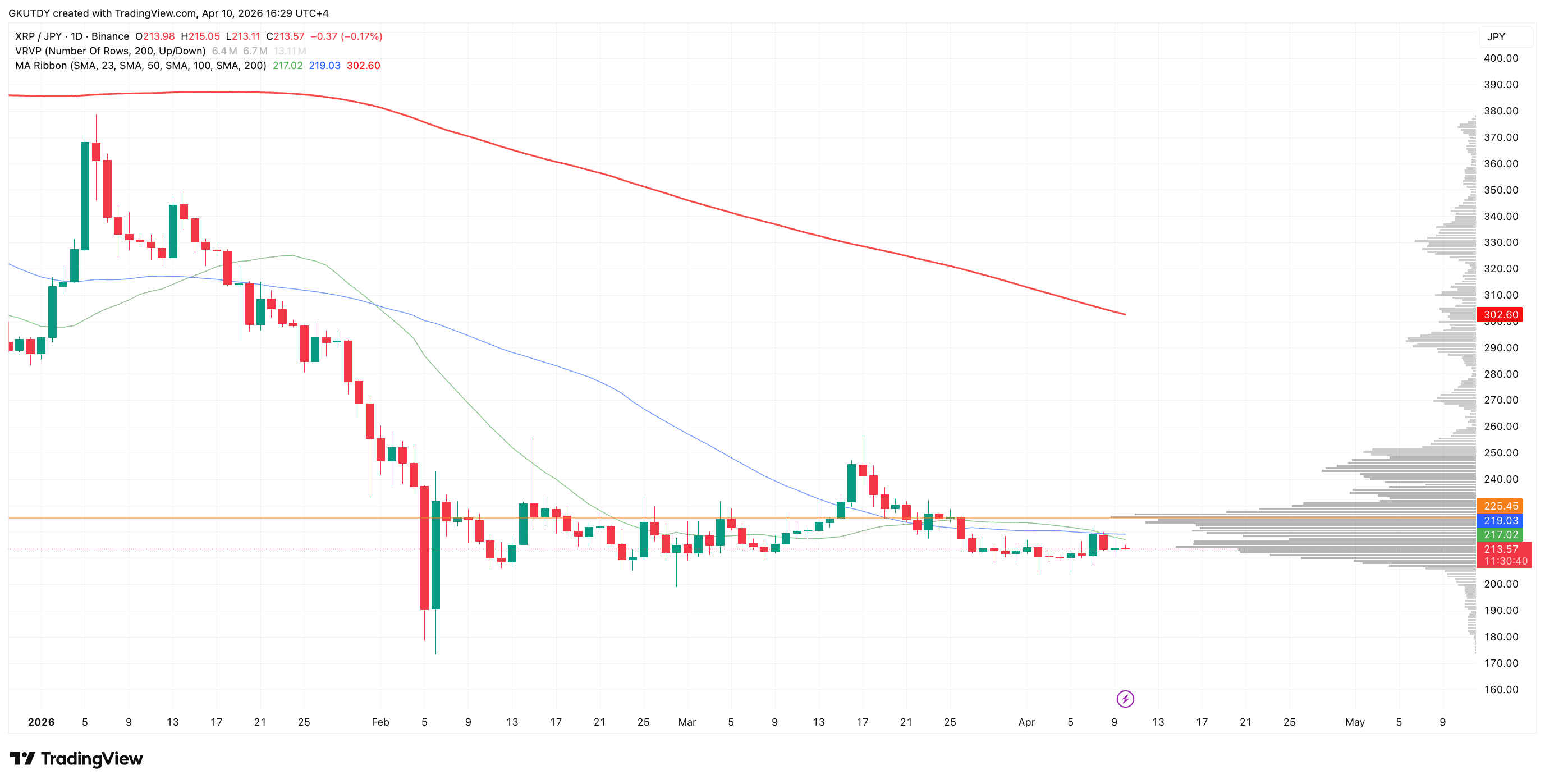
XRP against Japanese Yen in 2026, Source: TradingView
The new classification of assets as “securities or financial products” potentially removes the legal uncertainty that previously prevented major Japanese banks from fully using XRP for cross-border settlements — the token’s primary purpose.
Meanwhile, for those connected to the crypto market and Japan, the new framework implies:
The reform is part of a broader plan to reduce crypto taxes to a fixed 20% rate, similar to equities, aiming to attract part of the $34 billion held by 12 million local users.
For XRP in Japan, this bill marks a transition from an “experimental technology,” widely endorsed by events like XRPL Japan this week, to a regulated banking standard.
The end of the week has been positive for the U.S. spot Bitcoin ETF market. Despite cautious forecasts earlier in the month, capital inflows reached $343.1 million recently, as per SoSoValue, confirming sustained institutional demand above the $72,000 price range, and being the second major inflow this week after $471 million on April 6.
The bulk of it went to BlackRock’s iShares Bitcoin Trust, which recorded $269.3 million in net inflows. Second was Fidelity Investments with $53.3 million.
Notably, none of the 12 active funds recorded outflows during the period. Morgan Stanley entered successfully, too. On its second trading day, April 9, its fund attracted $14.9 million, offering the lowest fee in the market at 0.14%.
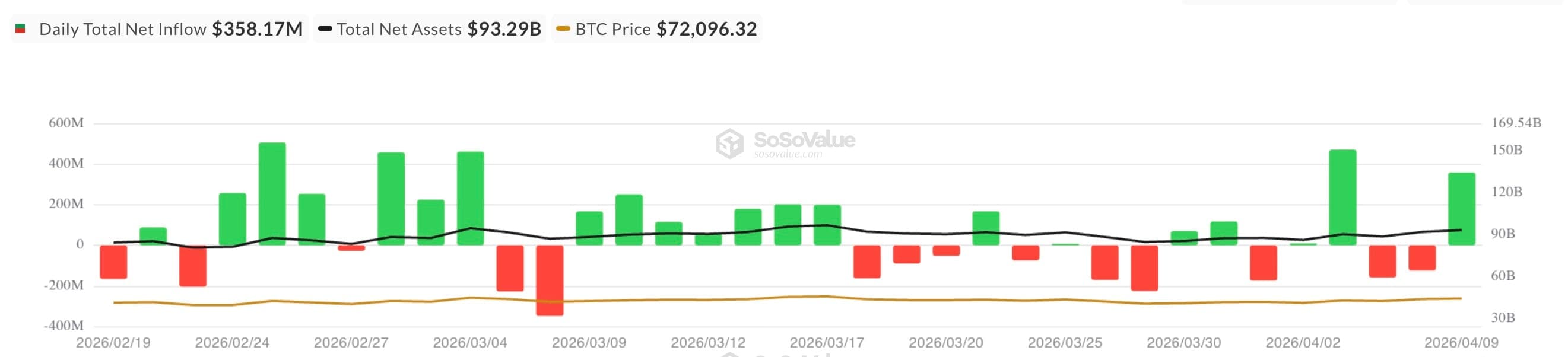
Total Bitcoin Spot ETF Net Inflow, Source: SoSoValue
The current rise is supported by markets reacting positively to news of a two-week ceasefire and negotiations in the Middle East, reducing fears of an inflation shock from potential disruptions in key shipping routes.
Additionally, the options market saw a surge in interest for $80,000 per BTC call options totaling $1.6 billion, indicating expectations of a continued rally into June. Despite concerns of a correction after a 6% gain in April, the absence of outflows and the entry of new banking products provide a strong foundation for holding local highs.
Amid record crypto fraud losses, Binance CEO Richard Teng issued a critical reminder that traditional security methods like passwords and SMS text messages are no longer sufficient in 2026. His key method to protect deposits is a full transition to passkeys.
According to the FBI’s IC3 report, crypto theft rose 22% in 2025, reaching an all-time high. Attack vectors have shifted toward more complex schemes. Social engineering using deepfakes generated nearly $900 million in losses.
About 40% of total losses came from older users, who are more likely to trust fake “investment advisors.” Standard two-factor authentication via cloud backups or intercepted codes has become a major vulnerability in 2025-2026.
Enable Passkeys on your Binance account 🔐
Each passkey is unique and encrypted
It cannot be reused, intercepted, or phished— Richard Teng (@_RichardTeng) April 10, 2026
Teng emphasizes that passkeys solve the fundamental human factor problem. Unlike passwords, which can be stolen or guessed, passkeys provide three layers of protection:
While many users still rely on the “password plus SMS” model, the industry in 2026 recognizes it as outdated. Passkeys effectively turn a smartphone or biometric data into a hardware-grade lock for a hot wallet.
Ahead of the weekend, the focus shifts from global events to the U.S. inflation report, which will determine short-term liquidity and risk appetite.
Key points:
Share this article
Japan's Cabinet has approved a bill that reclassifies cryptocurrencies as financial assets, enabling banks to potentially use XRP for cross-border transactions.
$343.1 million has flowed into spot Bitcoin ETFs, indicating strong institutional demand as Bitcoin stabilizes above $72,000.
Binance CEO Richard Teng recommended a complete transition to passkeys, deeming passwords and SMS-2FA obsolete to combat significant fraud losses.
The approval of the cryptocurrency bill is expected to position Japan as a key crypto hub, enhancing the regulatory framework for digital assets and attracting more institutional investment.




See every story in Crypto — including breaking news and analysis.