
Crypto
Ex-SEC, Coinbase staffer becomes Securitize president
Cointelegraph

CoreWeave secured an $8.5 billion loan backed by AI, signaling a shift from crypto mining finance to AI-driven data center funding. This transition highlights the challenges faced by traditional Bitcoin mining financing models.
CoreWeave’s recent $8.5 billion AI-backed loan highlights a major transition in how Wall Street finances digital infrastructure, marking a shift from “MinerFi” to “ComputeFi,” according to TheEnergyMag.
In its latest Miner Weekly newsletter, TheEnergyMag examined CoreWeave’s multibillion-dollar raise from a group of banks and investors, backed by Mark Zuckerberg’s Meta Platforms. As Bloomberg reported, the financing underscores how companies are finding new ways to fund data center construction and expand GPU capacity.
Although CoreWeave has pivoted away from the digital asset sector toward AI-focused data center compute, the move offers a broader lesson on the shortcomings of Bitcoin (BTC) mining finance.
Historically, lenders funded Bitcoin mining operations using application-specific integrated circuits, or ASICs, as collateral. However, these models proved fragile due to crypto price volatility and rapid hardware depreciation. When markets declined, both revenues and collateral values fell sharply.
CoreWeave’s financing structure is “what MinerFi tried — and failed — to become,” TheEnergyMag said.
Unlike prior models, CoreWeave’s deal ties financing to active AI infrastructure with contracted customers and predictable cash flows. GPUs must be deployed, operational and revenue-generating before capital is extended, which reduces lender risk.
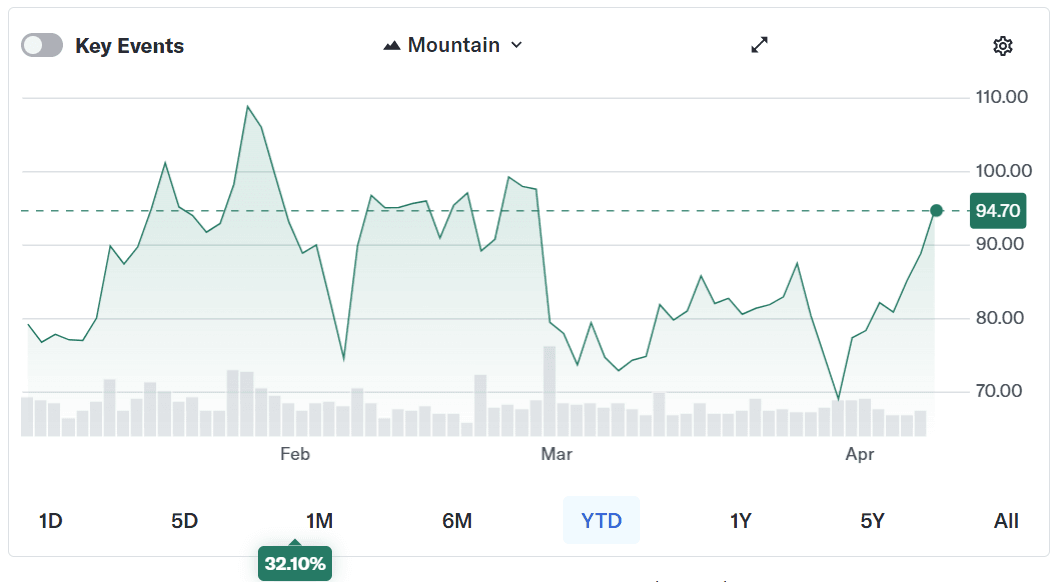
CoreWeave (CRWV) stock. Source: Yahoo Finance
Related: Bitcoin mining’s 2026 reckoning: AI pivots, margin pressure and a fight to survive
CoreWeave’s early pivot away from crypto mining has helped position it as a leading “neocloud” provider, a term used to describe companies offering GPU-based cloud infrastructure for artificial intelligence workloads, according to a recent analyst note by Bernstein.
The report compared CoreWeave with peers IREN and Nebius, highlighting differences in scale, infrastructure and financing strategies.
CoreWeave’s head start has translated into a significantly larger backlog of roughly $67 billion, compared with about $9.7 billion for IREN and $47 billion for Nebius.
While all three companies are expanding into AI infrastructure, IREN still generates most of its revenue from Bitcoin mining as it continues its transition.
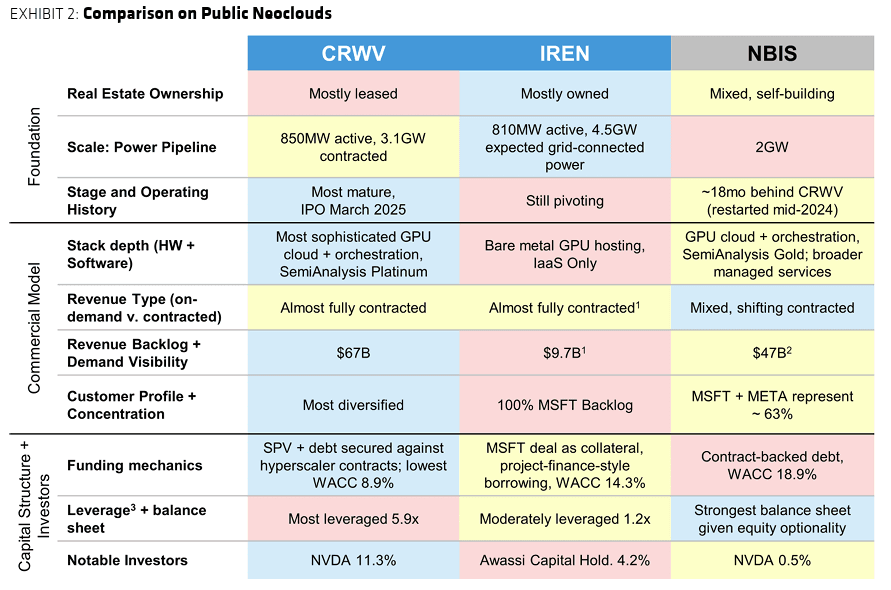
A comparison of CoreWeave, IREN and Nebius across capital structure, commercial model and infrastructure. Source: Bernstein
The Bernstein analysts gave CoreWeave top marks for its “commercial model,” thanks to the “depth in the software stack, a mix of contracted and on-demand revenue, strong backlog and an increasingly diversified customer base.”
However, they said IREN has an advantage in infrastructure, citing its sizable real estate footprint rather than its reliance on leased data center capacity.
Related: Crypto Biz: Mining weakness tests Bitcoin’s market cycle
Share this article
CoreWeave's loan signifies a major shift in Wall Street's approach to financing digital infrastructure, moving from crypto mining to AI-focused data centers.
Unlike traditional Bitcoin mining finance, which relied on volatile crypto assets as collateral, CoreWeave's financing is backed by AI capabilities, reducing risks associated with crypto price fluctuations.
CoreWeave's loan was backed by a group of banks and investors, including support from Mark Zuckerberg's Meta Platforms.





See every story in Crypto — including breaking news and analysis.