
Crypto
David Bailey’s bitcoin holder Nakamoto is trying to stay on Nasdaq with a reverse stock split
CoinDesk

Japan has amended the Financial Instruments and Exchange Act to classify crypto assets as financial instruments, enhancing regulatory oversight. The changes include a ban on insider trading and annual transparency requirements for cryptocurrency issuers.
The Japanese government amended the Financial Instruments and Exchange Act on Friday to classify crypto assets as financial instruments.
The amendment also bans insider trading and other activities that involve buying and selling based on undisclosed information, Nikkei reported.
The amended act will also now require cryptocurrency “issuers” to be more transparent and disclose information once a year.
Japan’s Financial Services Agency has previously regulated crypto assets under the Payment and Settlement Act, citing their potential use as a means of payment. However, the regulations and classifications have been updated to reflect increasing institutional investment in the asset class.
By reclassifying crypto as a financial instrument rather than just a payment method, Japan is moving crypto out of the experimental payments category and into the same league as its stock market.
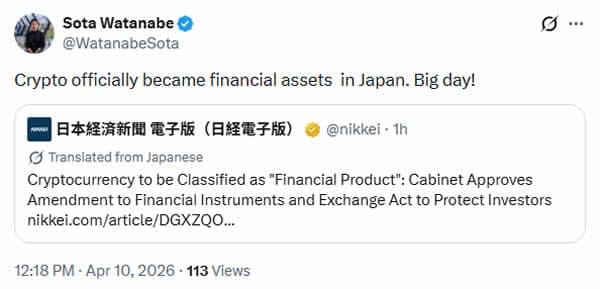
Source: Startale Group CEO Sota Watanabe
“We will expand the supply of growth capital in response to changes in financial and capital markets, and ensure market fairness, transparency, and investor protection,” said Finance Minister Satsuki Katayama at a press conference after the Cabinet meeting.
Fines and sentences for unregistered crypto exchanges have also increased under the amendment.
Related: Prediction markets are testing legal limits in strict Asian markets
Japan signaled that it was bringing crypto under the same umbrella as traditional finance in January when Katayama said, “To ensure citizens benefit from digital and blockchain-based assets, the role of exchanges and market infrastructure will be essential.”
The government backed plans in December to significantly reduce Japan’s maximum tax rate on crypto profits, with a flat rate of 20% across the board.
Japan is also planning to legalize crypto exchange-traded funds (ETFs) by 2028, marking a major shift toward mainstream crypto adoption, according to a January report.
Major financial groups, including Nomura Holdings and SBI Holdings, are among the first companies expected to develop crypto-linked exchange-traded products.
Asia Express: Phantom Bitcoin checks, China tracks tax on blockchain
Share this article
The new bill classifies crypto assets as financial instruments, imposes a ban on insider trading, and requires issuers to disclose information annually.
Reclassifying crypto as a financial instrument aligns it with stock market regulations, moving it beyond just a payment method and increasing institutional investment oversight.
Banning insider trading aims to create a fairer trading environment in the crypto market, enhancing investor protection and market integrity.





See every story in Crypto — including breaking news and analysis.