Crypto
Bitcoin may hit $110K as Strategy absorbs nearly 3x new BTC supply
Cointelegraph

A US appellate court has ruled against New Jersey gaming authorities for bringing an enforcement action against prediction market platform Kalshi over sports event contracts.
In a Monday-issued opinion, a panel of judges in the US Court of Appeals for the Third Circuit ruled 2-1 in favor of Kalshi’s argument that the company had a ”reasonable chance of success” claiming that the Commodity Exchange Act preempted state law, setting the stage for a potential battle over gaming laws in the US Supreme Court.
"This is a big win for the industry and millions of users," Kalshi CEO Tarek Mansour said in a social media post on X.
The appellate court’s opinion affirmed a lower court ruling, in which Kalshi argued that the US Commodity Futures Trading Commission (CFTC) had “exclusive jurisdiction” in regulating sports-related event contracts as swaps that fall under its purview.
“Allowing New Jersey to enforce its gambling laws and state constitution would create an obstacle to executing the Act because such state enforcement would prohibit Kalshi, which operates a licensed [designated contract market] under the exclusive jurisdiction of the CFTC, from offering its sports-related event contracts in New Jersey,” wrote Circuit Judge David J. Porter. “This state regulation is exactly the patchwork that Congress replaced wholecloth by creating the CFTC.”
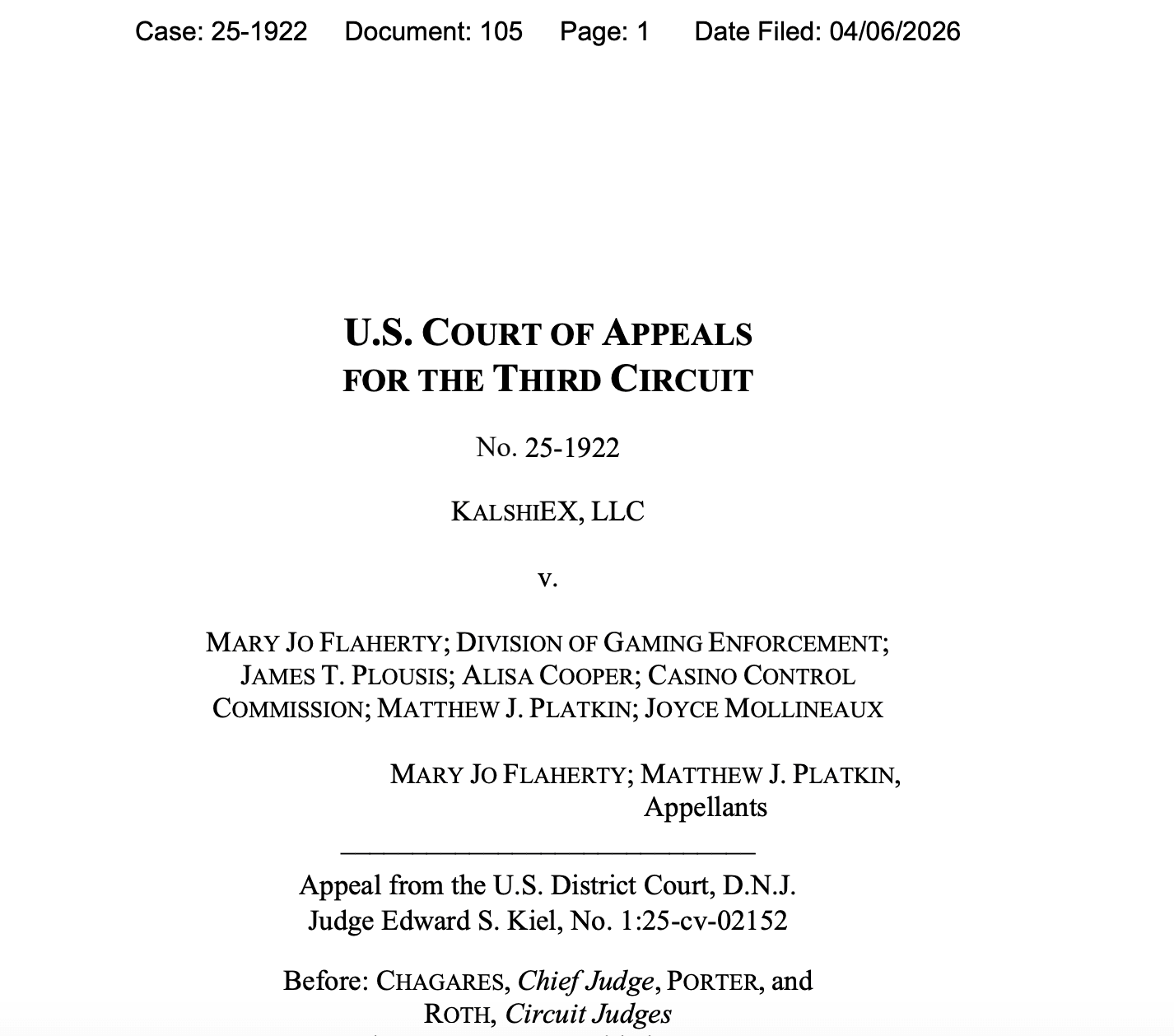
Monday’s Third Circuit opinion affirming lower court ruling. Source: PACER
The circuit court ruling came just days after a Nevada judge extended a ban on Kalshi offering event-based contracts, following several other state authorities cracking down on sports betting on prediction markets. The patchwork of state-level rulings could lead to the US Supreme Court taking up one of the cases, potentially changing its 2018 decision giving states the authority to regulate sports gambling.
Related: Texas Lt. Gov. calls for study of crypto, prediction markets
In her dissent, Circuit Judge Jane Roth said the prediction markets platform’s actions were a “performative sleight meant to obscure the reality that Kalshi’s products are sports gambling,” adding that the company’s event contracts were “virtually indistinguishable” from those on betting websites:
“[T]he question of whether sports-event contracts are swaps is a thorny issue with the potential to radically upend the legal landscape governing the gambling industry, and I am not convinced the Majority’s analysis does this issue justice.”
CFTC Chair Michael Selig, the sole commissioner at the financial agency following the departure of acting chair Caroline Pham in December, has made prediction markets one of the commission’s central issues since taking office. In the last four months, Selig has claimed that the CFTC has “exclusive jurisdiction” in regulating event contracts on prediction markets, opened a proposed rule to public comment and filed an amicus brief supporting its position in the Ninth Circuit Court of Appeals in a case involving Nevada’s gaming authorities.
The regulator last week sued Arizona, Connecticut and Illinois to block them from pursuing what it said were unlawful efforts to regulate prediction markets.
“Our definition of commodity and statute is very broad,” Selig said at the Digital Assets and Emerging Tech Policy Summit at Vanderbilt University on Monday. “It includes events on sports, it includes events in politics, it includes corn and grains and all sorts of things. It doesn't really distinguish between if you're offering an event contract on grains, you're regulating that differently than an event contract on sports.”
The CFTC chair added that there were exceptions for event contracts that were “readily susceptible to manipulation.”
Magazine: AI agents will kill the web as we know it: Animoca’s Yat Siu
Share this article
The Third Circuit ruled in Kalshi’s favor because the judges said the company had a reasonable chance of showing that the Commodity Exchange Act preempts New Jersey law. The court agreed that Kalshi could argue the CFTC has exclusive jurisdiction over sports-related event contracts as swaps. That made the state enforcement action harder to sustain.
The decision supports Kalshi’s argument that New Jersey cannot enforce its gambling laws to stop the platform from offering sports-related event contracts there. The appellate court affirmed a lower court ruling that had already favored Kalshi. It does not end the broader legal fight, but it is a major win for the company.
Yes, the ruling could help set up a Supreme Court fight over prediction markets and state gambling laws. The article says the patchwork of state-level rulings may lead the Supreme Court to take up one of the cases. Such a case could affect the Court’s 2018 decision that gave states authority to regulate sports gambling.
The dissenting judge said Kalshi’s event contracts were a “performative sleight” meant to hide the reality that they are sports gambling. She also said the contracts were “virtually indistinguishable” from products offered on betting websites. Her view was that the majority did not fully address whether sports-event contracts should be treated as swaps.
The CFTC says it has exclusive jurisdiction over prediction market event contracts, including those tied to sports. Chair Michael Selig said the agency’s definition of commodity and statute is broad and can include events in sports, politics, and other areas. He also said there are exceptions for contracts that are readily susceptible to manipulation.





See every story in Crypto — including breaking news and analysis.