
News
The Papers: 'Harry sued' and Vance warns Iran 'don't try to play us'
BBC News
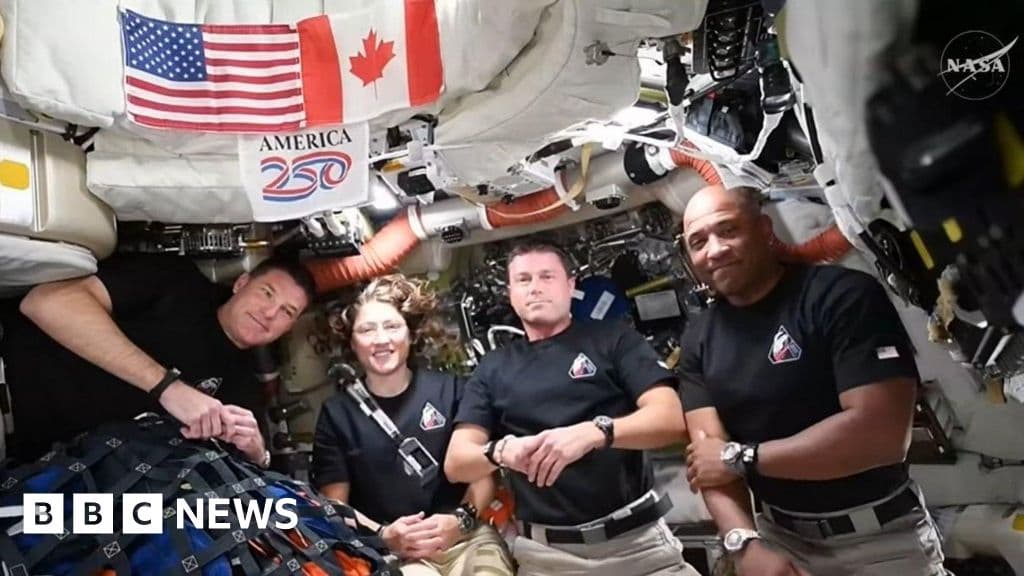
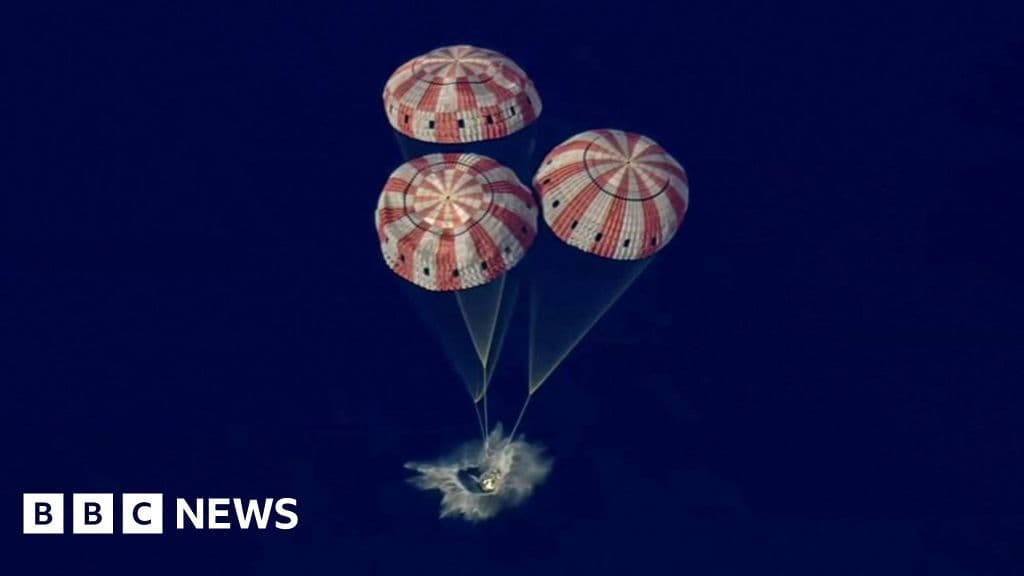
The Artemis II crew has successfully returned to Earth after a historic mission, traveling deeper into space than any humans before them. They splashed down off the coast of California after reaching speeds of 25,000mph (40,000km/h).
The Artemis II crew have safely returned home after re-entering Earth's atmosphere at 25,000mph (40,000km/h), splashing down off the coast of California.
They have travelled deeper into space than any humans before them - just over 4,000 miles more than the record of 248,655 set by Apollo 13 in 1970.
Astronauts are highly trained to cope with the physical and mental strain of space.
Although it might seem like it would be a difficult experience to endure, astronauts talk about being in space as the highlight of their lives and say they would return in an instant.
In a press conference before landing, Christina Koch said the inconveniences, such as freeze-dried food or a toilet without much privacy, were worth it.
Nasa does not release details about the crew members' health or private lives, but here's what's likely to happen to Reid Wiseman, Christina Koch, Victor Glover and Jeremy Hansen now they're back.
On arrival they will be immediately examined by doctors on the US warship sent to retrieve them. Then they will be flown ashore by helicopter before being taken by plane to Nasa's Johnson Space Center in Houston.
Spending time in space will have been physically gruelling for the Artemis II crew**.**
Without the tug of gravity, muscle and bone mass shrinks in space. The most affected muscles are those that help maintain posture in the back, neck and calves.
Astronauts have strict exercise requirements but it can't stop all wastage.
After just two weeks, muscle mass can fall by as much as 20%.
But remember, around 700 people have been into space before, including low Earth orbit. The time the Artemis II crew have spent up there will be amongst the shortest.
During the space shuttle era in 1981 to 2011, astronauts spent two to three weeks in space. A typical stay on the International Space Station is now five to six months.
So the impacts on the Artemis II astronauts' health is likely to be minimal compared with their predecessors.
And what's it like to return to Earth after being in space?
Astronauts are level-headed by temperament and training, so don't expect revelations of any "space come-downs".
Koch has already said she will miss the "teamwork and camaraderie" and the "common sense of purpose on the mission".
Many astronauts talk about a profound appreciation of the uniqueness of Earth and that all humans share the planet together.
Seeing our planet surrounded by the blackness of space "truly emphasised how alike we are, how the same thing keeps every single person on planet Earth alive," Koch said from space.
Most astronauts, including the first British astronaut Helen Sharman, have described how they don't want to come home because the work in space is so exciting.
The Artemis crew will of course be excited to be reunited with their families.
Commander Reid Wiseman, who lost his wife to cancer in 2020 and has raised their two teenage daughters alone, talked to them before the mission about what would happen if he died and showed them where his will was kept.
Splashdown was a dangerous moment for the crew, so the families will be delighted to see them home safe.
Dr Catherine Hansen, who is married to astronaut Jeremy Hansen, told BBC World Service's Newsday programme that their two daughters and son were "so, so excited to see their dad living his dream".
"We certainly will have a celebration... When Jeremy is back safely, we will absolutely come together. First just the five of us in a quiet environment to hear some of those private stories, and then we will absolutely celebrate with the world," she said.
Nasa won't release details about what the astronauts will be doing when they get back to Earth.
The three Nasa astronauts remain on the agency's books. There are more Artemis spaceflights to come: Artemis III is billed for 2027 and Artemis IV for 2028.
That will be the big one. It aims to land humans on the Moon again, although the date is likely to slip.
We don't yet know who will fly those missions. All members of Nasa's astronaut corps, including the four on Artemis II, are eligible.
But one big engagement is on the cards.
US President Donald Trump, who established the Artemis programme during his first presidency in 2017, called the crew while in space to invite them to the White House for an Oval Office reception.
"I'll ask for your autograph, because I don't really ask for autographs much, but you deserve that," he told them.
He promised to give them "a big salute on behalf of the American people and beyond that".
It is not clear if Hansen, who's Canadian, will join the trip.
Post-Moon, the biggest change these astronauts can probably expect is fame.
Compared to many recent astronauts, these four have captured the imagination of millions.
Round-the-clock news coverage and viral memes mean they are coming back to Earth significantly more famous than they were when they left. That will likely require some adjustment.
Share this article
The Artemis II crew traveled over 4,000 miles deeper into space than the previous record of 248,655 miles set by Apollo 13 in 1970.
The Artemis II astronauts re-entered Earth's atmosphere at a speed of 25,000mph (40,000km/h).
Christina Koch described the inconveniences of space travel as worth it, stating that being in space is the highlight of their lives and they would return in an instant.
The Artemis II crew splashed down off the coast of California after their mission.



See every story in News — including breaking news and analysis.