
Sports
Transfer rankings for 2026-27 season
ESPN News

Here's a list of the players who have more assists in a Premier League season than Bruno Fernandes has right now:
If someone asked you to come up with a list of the best creative players in Premier League history, it would look something like those six. Eric Cantona never bested Fernandes' current mark, while the likes of David Beckham, David Silva, Eden Hazard, Steven Gerrard, Trent Alexander-Arnold, and literally any other name you might think belongs in this conversation have never assisted as many Premier League goals as Manchester United's captain has in this campaign.
The difference between Fernandes and anyone we've already mentioned, of course, is that he still has seven games left to play. If he keeps up his current pace of about 0.6 assists per 90 minutes, he'll match the record of 20 set by Henry in 2002-03 and equaled by De Bruyne in 2019-20. He could easily break it, too.
In other words, Fernandes is putting together what might go down as the greatest creative season in Premier League history. And it's driving Manchester United to what's likely to be a third-place finish, just a year after the club finished 15th. They have a plus-17 goal differential when he's on the field and have been outscored by a goal when he's not.
**More from Ryan O'Hanlon:
At the end of the season, there will be only a year left on Fernandes' contract, but the decision is obvious: You do whatever you can to keep an all-time Premier League great at your club ... right? To see why the answer isn't so obvious, all United need to do is to look about 35 miles due west to the club that's now tied with them atop the list of the most first-division titles in English soccer history.
It's not an exaggeration to say that Manchester United might be playing in the Championship if it weren't for Fernandes. OK, fine, maybe it is; if they didn't have him, it's not like they would just have all of their same players sans Bruno. They would've signed other players who might have replicated some of his production. But it's highly doubtful that anyone else could've done any of this.
Since January of 2020 in the Premier League, Fernandes has:
Pick any aspect of the sport of soccer, outside of maybe winning headers or saving shots, and Fernandes has been the most important United player across the current decade.
While I've wondered at times if their Brunodependencia has put a lid on United's potential, that all becomes irrelevant once you start finishing in the bottom half of the table. For his time at the club, United average a plus-0.38 goal differential per 90 minutes when he's on the field; they get outscored by 0.11 goals per 90 minutes when he's not out there.
So, it's easy to look at all of that and conclude that it will fall apart without Fernandes. Who else is going to do, well, everything? But here's the thing: whether or not they re-sign him, Manchester United won't have this version of Bruno for long -- and they might not ever have him again.
This chart shows what we mean when we talk about the "age curve." It shows every minute played by what Opta identified as attacking midfielders since the start of the 2008-09 Premier League season, sorted by age:
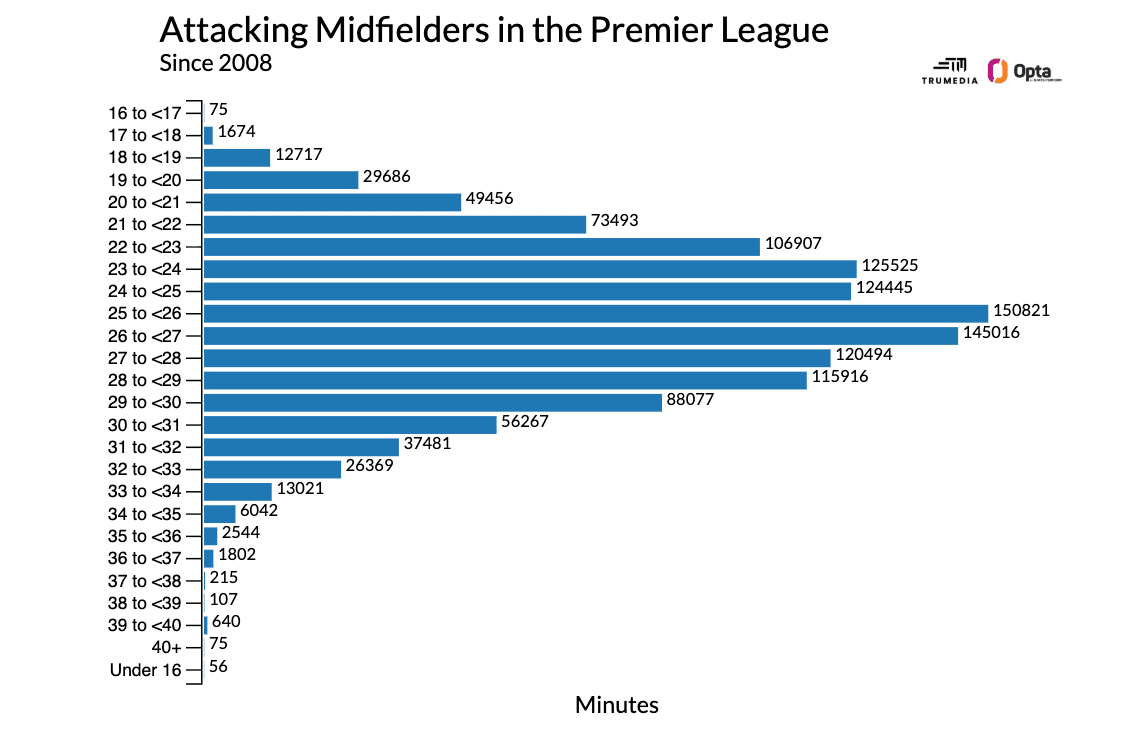
The bulk of a Premier League career at the position occurs at the ages between 22 and 29. From then on, there's essentially a massive step down at every age. Most players eventually start to get worse as they age, and Fernandes turns 32 in September.
He might be the best player in the Premier League right now, but here's something I wrote about the best player in the Premier League last season:
To re-sign Salah, Liverpool would have to take the risk that they'd be paying him like one of the best players in the world -- right when he stops being one of the best players in the world. But Salah is an outlier already, so perhaps it makes sense to compare him to the other players of his age and level -- rather than the general Premier League population.
You can replace most of those proper nouns with "Bruno Fernandes" and "Manchester United," and it's close to the same situation.
When I compared Salah to the only players who were still producing like he was at his age, then the age curve looked a lot better: Lionel Messi, Cristiano Ronaldo, Zlatan Ibrahimovic and Robert Lewandowski kept scoring goals and winning games at the highest level as they stretched into their 30s. Given that Salah stayed in incredible shape and almost never got injured, it seemed right to give him a much higher likelihood of extending his elite performance beyond what the age curve suggested might happen.
Fernandes has provided a similar, possibly even greater, level of consistency and durability as the Liverpool legend. In fact, across the entire Stats Perform database, Fernandes has played more competitive minutes, at the international and club level combined since the start of 2020, than all but one player: Brazilian goalkeeper Weverton.
If we remove keepers and defenders, who are all less likely to be substituted in a given match, here's the top 15:
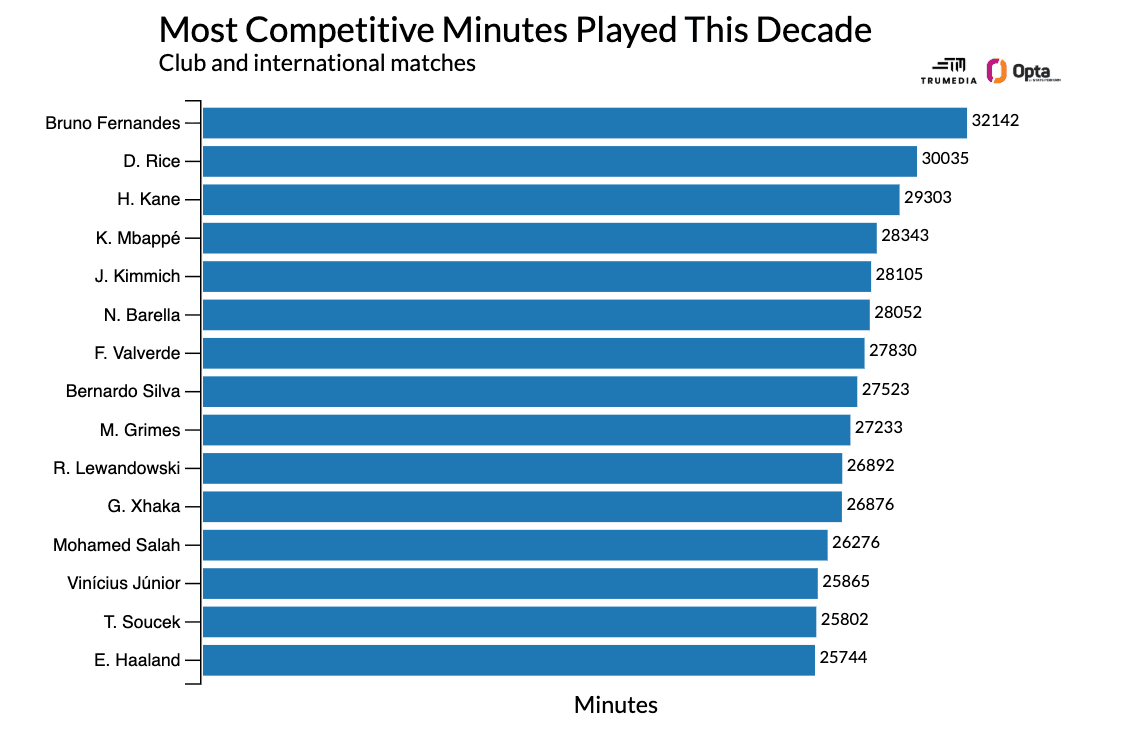
So, to review: Fernandes has played over 2,000 more competitive minutes than any other midfielder or attacker since 2020 -- that's nearly a full extra season of game time compared to second-place Declan Rice.
There are two ways to look at that: the best predictor of future injuries are past injuries, so Fernandes is more likely to stay healthy than anyone else. Or: Those minutes are going to catch up with him real soon.
You could've projected those same two paths for Salah at the end of last season -- and it turns out that your legs can give out even when your body looks like something that Medicis would've commissioned a sculpture for. While Salah's numbers died off in the second half of last season, I'm not sure it's good analysis to look at that with anything but a skeptical eye: Liverpool basically had nothing to play for come the middle of March, and the team and coaching staff were partying for the last month of the season. But there's no question that he has fallen off a cliff this season.
Salah put up 47 goals+assists in the Premier League last season, and that number is down to 11 this year. He has never been below 26 in his Liverpool career. Liverpool took the risk of paying Salah like one of the best players in the world right as he stopped being one of the best players in the world -- and that's exactly what happened. (You could say the same thing about Virgil van Dijk, too.)
Part of the problem, too, might be the current state of the Premier League. While Lewandowski, Harry Kane and Luka Modric are all still playing at really high levels into their mid-30s and beyond, they're all doing it in leagues that are way less physical and competitively demanding than England's top flight is on a weekly basis. Perhaps that explains why Salah's performances and production in the Champions League this season have been much closer to what we're used to seeing.
We haven't seen Fernandes in the Champions League this season, and that's one of the hidden drivers of Manchester United's success. Research has shown that Premier League teams lose, on average, a point for every two extra games they play in Europe, compared to the previous season. And with United completely out of Europe this year -- in addition to being knocked out of both domestic cups early on -- Bruno will end the season with, at most, 36 starts across all competitions. Last season, he started 55 matches; his full-season low at United is 43.
Is it a coincidence that he has been his most efficient, in terms of goals+assists per 90 minutes, in the season when he has played the fewest games? He'll have the World Cup this summer, and barring a collapse, United will be back in the Champions League the following season.
Now, Fernandes still has another season left on his contract, which has a £57 million release clause, and he won't turn 33 until September 2027. His situation doesn't exactly line up with Salah's, but broadly, it's the same story and the same decision: an incredibly consistent superstar player is still performing at an elite level in his 30s, and if you could guarantee that he'd stay the same for a few more seasons, you'd give him whatever he wants. But that's not how the human body -- or anything else -- works.
Salah and Fernandes have both proved that world-class players can still be world-class players once they enter their third decade. Except, as Liverpool have learned this season, you're an outlier right up until you're not, and that's what United need to figure out.
Is their captain going to be the rare player who fights off decline, year after year? Or is time going to come for him, like it does for almost every other 30-something professional soccer player, sooner rather than later?
Share this article
Bruno Fernandes is central to almost everything United do in attack and buildup. Since January 2020 in the Premier League, he leads the club in goals, assists, shots, chances created, through balls, passes into the final third, and possession wins by wide margins. The article also notes United's goal difference is much better when he plays than when he does not.
Bruno Fernandes is having one of the best creative seasons in Premier League history. He is among the league leaders in assists and could still match or even break the single-season Premier League assist record if he keeps his current pace. The article says his output is helping drive Manchester United toward a likely third-place finish.
Manchester United should be careful because Fernandes is entering the age range when most attacking midfielders decline. He turns 32 in September, and the article argues that even elite players can drop off quickly once they pass their peak years. The risk is paying him like a superstar just as his performance starts to fade.
The article uses Mohamed Salah as the main example. Liverpool re-signed Salah at a huge level, but his production has fallen sharply this season after an elite year, showing how quickly an older star can decline. The point is that even durable, world-class players are not guaranteed to stay elite forever.
No, the article does not say Fernandes is already declining. In fact, it describes him as one of the Premier League's best players right now and highlights his remarkable consistency and durability. The concern is about what might happen next as age and workload begin to catch up with him.


See every story in Sports — including breaking news and analysis.