Crypto
Ethereum Price Analysis: Can ETH Finally Break Out of This Bearish Channel?
CryptoPotato
Several lesser-known altcoins experienced significant price drops after Binance announced a delisting. This move reflects Binance's ongoing commitment to maintaining high standards for listed cryptocurrencies.
There isn’t a single top-100 cryptocurrency today (April 9) that has posted a double-digit daily decline.
However, the same can’t be said for some lesser-known altcoins, whose prices collapsed sharply following a recent announcement from the world’s largest crypto exchange.
The company periodically reviews each digital asset listed on its platform to ensure it complies with high standards and industry requirements.
“When a coin or token no longer meets these standards or the industry landscape changes, we conduct a more in-depth review and potentially delist it. Our priority is to ensure the best services and protections for our users while continuing to adapt to evolving market dynamics,” Binance explained.
Some of the factors that the exchange monitors include team commitment, level and quality of development activity, trading volume, liquidity, and more. Based on the latest results, Binance decided to terminate all services with Beefy.Finance (BIFI), FunToken (FUN), FIO Protocol (FIO), Orchid (OXT), Measurable Data Token (MDT), and Wanchain (WAN).
The delisting will take place on April 23, but the prices of the affected tokens have already declined following the disclosure. This is a fairly normal reaction because Binance is an industry heavyweight, and withdrawing support typically leads to reduced liquidity, reputational damage, and potential panic among investors.
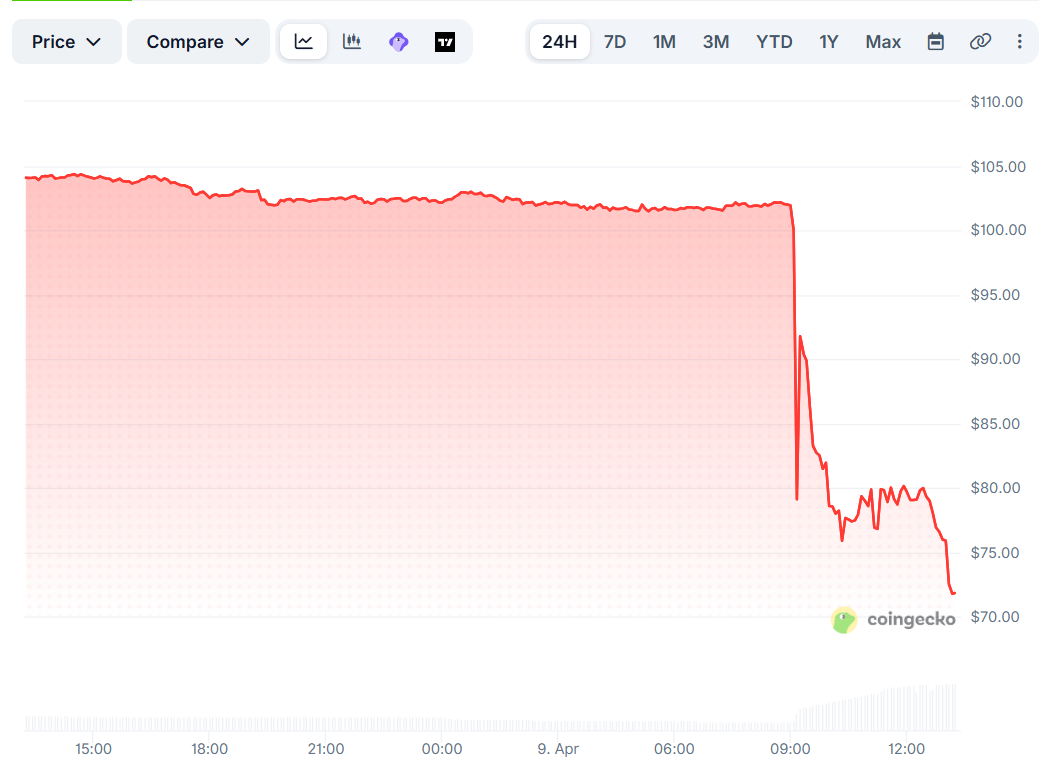
BIFI took the biggest blow, with its valuation crashing by 32% over the past 24 hours, whereas the other involved coins dropped by 20-25% during the same period.
BIFI Price, Source: CoinGecko
A similar thing was observed last month when Binance delisted the altcoins Arena-Z (A2Z), Ampleforth Governance Token (FORTH), Hooked Protocol (HOOK), Loopring (LRC), IDEX (IDEX), Neutron (NTRN), Solar (SXP), and Radiant Capital (RDNT). Back then, IDEX was the biggest loser after posting a daily plunge of roughly 33%.
In addition to the frequent listings and delistings, Binance has also announced other developments aimed at improving the exchange and making it more competitive.
Perhaps the most important is its intention to launch a prediction market feature by aggregating data from third-party platforms. The product will let users place bets on a wide range of categories, including sports, politics, economics, crypto, and more. Such markets have surged in popularity, and some of Binance’s main competitors, such as Coinbase and Crypto.com, have already dipped their toes in the field.
Meanwhile, the company performed wallet maintenance on the Ethereum network on April 7, briefly suspending deposits and withdrawals on that blockchain, which was completed quickly. Operations on the TON Network (TON) were also temporarily disrupted due to an upgrade.
Share this article
The article does not specify the names of the altcoins that were affected by the Binance delisting.
Binance reviews digital assets based on compliance with high standards and industry requirements, and may delist coins that no longer meet these criteria.
The delisting can lead to sharp price declines for affected altcoins, as seen in the recent market reaction following the announcement.



See every story in Crypto — including breaking news and analysis.