
Sports
Flick furious over bizarre 'clear red' in Barça loss
ESPN News

The Chicago Bulls have fired their top basketball executives and are looking for a new GM who will retain head coach Billy Donovan. The team is appealing due to potential draft picks and cap space, but the insistence on keeping Donovan may limit their candidate pool.
Getty Images
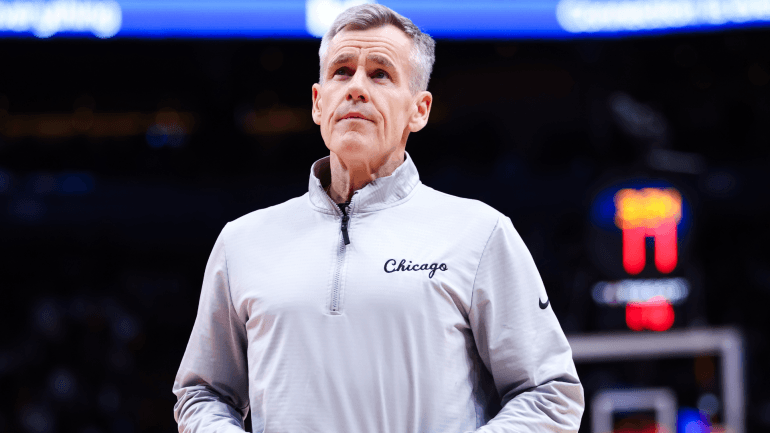
The Chicago Bulls cleaned out their front office on Monday by firing top basketball executives Arturas Karnisovas and Marc Eversley. Now, they begin the process of replacing them. The job holds real appeal. The Bulls could have two first-round picks in this year's draft. They'll have max cap space this offseason, they play in the NBA's third-biggest market, and of course, they come with all of the history Michael Jordan made for them in the 1990s. On paper, it's the sort of gig that should be able to attract top front office talent. There's just one hangup: the Bulls seem to have their heart set on retaining head coach Billy Donovan.
"If I interview someone and they're not sold on Billy, they're not sold on a Hall of Fame coach," Bulls CEO Michael Reinsdorf said during a video call Tuesday, "they're not sold on a person who's won championships in college, who's gone deep in the playoffs with Oklahoma City. ... If Billy wants to be our coach and someone's not interested in that, then they're probably not the right candidate for us."
Though it hasn't come with such public support from ownership, something similar appears to be happening in Dallas. The Mavericks are seeking a full-time replacement for Nico Harrison, and they're even seemingly planning to go big-game hunting for proven, winning general managers in that effort. But according to Marc Stein, they'd also like whoever they hire to keep Jason Kidd as their head coach.
This has left fans of both teams feeling somewhat uneasy with their searches. Wouldn't the best executives want to hire their own coach? Are the Bulls and Mavericks therefore limiting the pool of interested general managers by trying to handcuff them to an existing coach? Can an organization really be aligned when a head coach and general manager were hired by different people?
The theoretical answers to these questions are "yes," "probably" and "usually not," but why limit ourselves to conventional wisdom? Let's look at NBA history and try to figure out whether or not teams tend to be more successful when general managers hire their own coaches or when they inherit them.
[Bulls vs. Mavericks: Which open front office job is better? The choice involves more than just Cooper Flagg
Jasmyn Wimbish
The Bulls and Mavericks do not currently have general managers, so we'll put them aside for the time being. That leaves 28 teams in the NBA that currently have front office leadership in place. Let's talk about where the coaches they started this season came from.
Of those 28 teams, 20 followed the traditional path of hiring a general manager before their coach. Those teams are the Pistons, Celtics, Knicks, Cavaliers, 76ers, Hornets, Magic, Heat, Bucks, Nets, Pacers, Wizards, Thunder, Spurs, Lakers, Rockets, Clippers, Grizzlies and Jazz.
You will notice right away that most of the NBA's best teams occupy this list, including eight of the nine teams who have clinched playoff spots as of this writing. The timing of those partnerships varies wildly. Some general managers have been in their post for more than a decade and hired multiple coaches. On other occasions, the general manager and head coach were hired in the same offseason. Take Detroit as an example here. The Pistons hired Trajan Langdon one year in the historic six-year, $70 million deal they gave Monty Williams to be their head coach and they still allowed him to make a change. His subsequent hire of JB Bickerstaff has worked out quite well thus far.
So who are the other eight teams here? Let's go through them one by one:
Of these eight partnerships, only the one between Finch and Connelly has proven sustainably successful. The jury is still out on Denver, Toronto and Atlanta, but there is some degree of promise for each. Golden State's circumstances aren't really fair to judge. Kerr's success with Bob Myers made him virtually untouchable and their aging roster has made it mostly impossible for Dunleavy to really put his stamp on the team. Billups and Cronin didn't exactly fail, but they didn't have any success, either. The Pelicans and Kings were outright disasters this season. Notably, the two were the runaway losers of my bi-annual front office rankings, coming in at No. 29 and No. 30, respectively. The Bulls were No. 28 and the Mavericks were No. 27.
We're dealing with small samples here, though. There are only 30 head-coaching jobs. Most of them are hired by an existing general manager. It does seem notable, though, that the teams we associate with sustained winning (like the Thunder, Celtics, Spurs and Heat) never handcuffed a head coach to a general manager while the teams that are widely regarded as poorly-run (like the Kings, Pelicans and Bulls) went with the arranged marriage approach. Let's not draw any conclusions yet, though. We need to broaden our horizons a bit.
Let's wind the clocks back a decade. Since 2016, there have been a total of 43 instances in which a team has changed top basketball decision-makers, though this includes Brian Wright becoming San Antonio's general manager while Gregg Popovich remained atop the organizational hierarchy as coach and team president. We will therefore ignore Wright inheriting Popovich. Otherwise, the split over this time period is much more balanced. There were 21 instances of a general manager inheriting a coach and keeping him going into his first full season on a job. So let's look at how those partnerships played out:
We're 15 duos through our list of 21 and thus far, nobody has lasted even three full years. That would broadly qualify the next six situations as the "successes" of this organization-building style, though I would argue that even if some came with meaningful winning, none of the six worked out in the end.
So with a decade of history now examined, the picture looks a lot clearer.
Is it possible to win when your general manager didn't get to hire his own coach? Yes. There are examples of winning teams getting built that way. Malone's Nuggets, Kidd's Mavericks and those Rivers teams are the best examples of that. But when a team is hiring a front office, they may envision the success that those teams had, but not the dysfunction and disappointment that came with it. When an owner hires a lead basketball executive, he usually does so hoping for organizational harmony, that he can have trustworthy leadership in place for the long haul.
And there just aren't many examples of that happening in recent history. Even if you expand our time horizon a bit, you can see a handful of similar cases. Dwane Casey (with the Raptors), George Karl, Mike Brown (with the Cavaliers), Byron Scott and Sam Mitchell all won Coach of the Year awards within the past 20 seasons while working for general managers who didn't hire them, but none of those unions yielded championships and eventually ended badly. Notably, the Raptors won a championship immediately after replacing Casey with a coach Masai Ujiri hired himself, Nick Nurse.
None of this is to suggest that the traditional way is infallible, either. Owners sometimes hire the wrong general managers, which ruins the coaching hire before the interviews even begin. The right general manager can hire the wrong coach. The right general manager's wishes can be superseded by a meddling owner. There are countless ways any organizational structure can go wrong.
But think about what Reinsdorf said he wants for Chicago's future. "We want to win, but we don't want to win if it's not sustainable," Reinsdorf said. "I don't want to be just good for one or two years. I want it to be year in, year out, we have a chance to be competitive and win. And maybe some of those years, we can go all the way."
Think about the ways that the NBA's actual, sustained winners operate. Can you imagine Micky Arison telling Pat Riley who should coach his team? Or Clay Bennett interfering with Sam Presti's long-term designs? Peter Holt was well-known for trusting Gregg Popovich to do his job. The Celtics have new ownership now, but Wyc Grousbeck was never known for issuing mandates to Danny Ainge or Brad Stevens.
If recent NBA history is any indication, the key to building a sustainable winner is finding an executive you trust and getting out of their way. This is in no way a critique of Donovan (or Kidd for that matter). Plenty of the coaches we've covered here succeeded in other jobs or even the ones that didn't work out in the way. But the healthiest organizations are run from the top down by a single executive with the authority to do whatever it takes to put a winning team on the floor. If the Bulls are serious about sustained winning, finding that executive and granting him the authority he needs to build the organization he wants is where they have to start.
Share this article
The Bulls fired their top basketball executives, Arturas Karnisovas and Marc Eversley, as part of a front office overhaul aimed at improving the team's performance.
The Bulls have two potential first-round draft picks, max cap space, and the appeal of being in the NBA's third-largest market, along with a rich history.
The Bulls' CEO, Michael Reinsdorf, stated that any new GM must be supportive of retaining Billy Donovan as head coach, emphasizing his successful track record.
Similar to the Bulls, the Mavericks are also seeking a new GM but want the new hire to retain head coach Jason Kidd, indicating a trend in prioritizing existing coaching staff.


See every story in Sports — including breaking news and analysis.