
News
Plan 2 student loan interest rates capped at 6% in England
BBC News
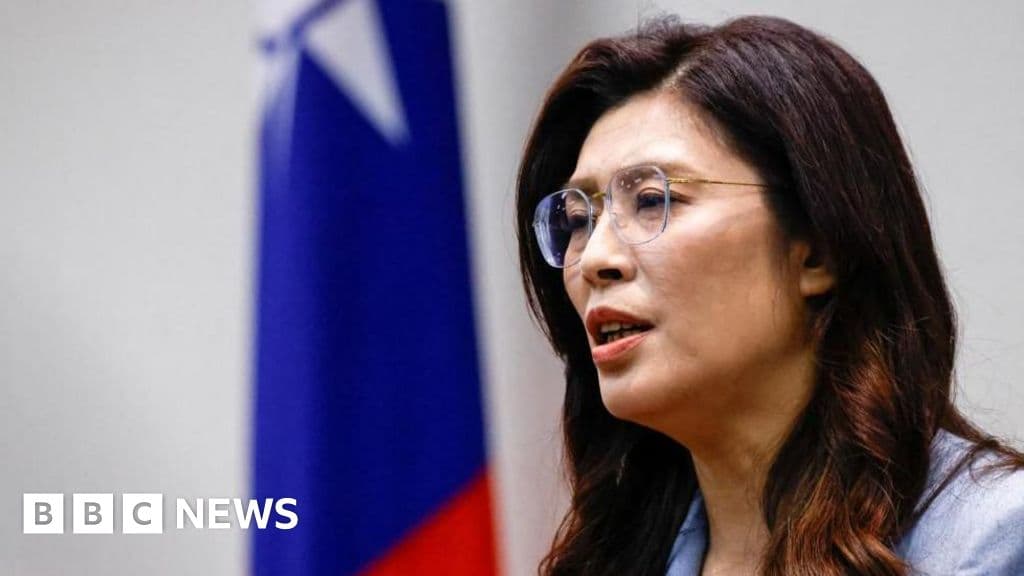
The leader of Taiwan's main opposition party has arrived in China and is expected to meet President Xi Jinping, in a closely-watched visit.
Cheng Li-wun, who took over as Kuomintang (KMT) chairperson last year, said she "gladly accepted" President Xi Jinping's invitation to visit and hopes to be a "bridge for peace".
She is expected to meet Xi later in her six-day trip which will span Shanghai, Nanjing and Beijing. Cheng is the KMT's first incumbent chief to visit China in a decade.
Beijing cut off some communications with Taiwan after the Democratic Progressive Party's (DPP) Tsai Ing-wen became president in May 2016, citing Tsai's refusal to endorse the concept of a single Chinese nation.
China sees self-governed Taiwan as a breakaway province that will eventually be part of the country, and has not ruled out the use of force to achieve this.
Many in Taiwan consider themselves to be a sovereign nation. At the same time, most favour "the status quo", meaning they do not want to formally declare independence nor unification with China.
On Tuesday Taiwan's ruling party, the DPP, criticised Cheng for being "subservient" to Beijing, noting that her trip would be "completely controlled" by the Communist Party.
The DPP accused Beijing of being the "main culprit in disrupting regional peace", adding that China has continued to dispatch war planes and naval vessels around Taiwan.
Premier Cho Jung-tai said the government would closely monitor Cheng's trip.
Although the KMT has traditionally maintained warm ties with China, Cheng's eagerness to visit contrasts with her predecessors' more cautious approach towards cross-strait relations, some analysts say.
Her trip comes amid growing scepticism about the US in Taiwan "largely stemming from [Donald] Trump's mixed signals on his Taiwan policy and the Middle East conflict", says William Yang, North East Asia analyst at the non-profit think tank International Crisis Group.
"Cheng sees this as an opportunity for her to present herself as the political leader capable of maintaining cross-strait exchange and potentially reducing cross-strait tension," Yang says.
Although the US has formal ties with Beijing rather than Taiwan, it has for decades remained the island's biggest arms supplier. In recent years Trump has said that Taiwan should pay the US for defending it against China.
Last week, a bipartisan US delegation visited Taipei to urge parliament to pass a $40bn (£30bn) special defence spending budget. The proposal is currently stalled in the opposition-dominated parliament.
Xi's invitation to Cheng comes weeks before he is due to meet Trump, who is scheduled to visit Beijing on 14 and 15 May.
"Beijing wants a cordial meeting with Taiwan's opposition to undermine the argument for US-Taiwan defence cooperation," says Wen-ti Sung, a political scientist with the Australian National University's Taiwan Centre.
This will then allow China to focus on "cutting business deals" with the US during Trump's visit, rather than addressing cross-strait issues, Sung explains.
For Cheng and the KMT, this could be politically beneficial ahead of Taiwan's local elections later this year.
Despite having started her political career as a pro-independence advocate, Cheng has in recent years tried to cultivate a reputation as a peace builder.
She is "trying to thread a needle between the US and China... to strengthen her leadership stature while highlighting Taiwan President Lai Ching-te's failure to resume engagement with the Chinese side", says Yang.
Within Taiwan, however, Cheng's position of accommodating Beijing has proven unpopular, says political scientist Chong Ja-Ian of the National University of Singapore.
"Many do read Cheng as a fair-weather politician, an opportunist with little principle, and a politician that cares about her own position more than anything else," Chong says.
"That is a reason why the polls show little confidence in her.
"That also means that she is willing to wheel and deal," Chong adds. "Who this benefits, and how much, are the bigger questions."
Share this article
Cheng Li-wun is visiting China after accepting President Xi Jinping’s invitation and says she wants to be a “bridge for peace.” Her trip comes at a sensitive time in cross-strait relations and ahead of Xi’s planned meeting with Donald Trump. Analysts say the visit could also help Cheng and the KMT politically before Taiwan’s local elections.
Yes, Cheng is expected to meet President Xi Jinping later during her six-day visit. The trip includes stops in Shanghai, Nanjing and Beijing. It is her first visit to China as incumbent KMT chairperson in a decade.
The DPP has sharply criticized Cheng’s trip, calling her “subservient” to Beijing. It said the visit would be “completely controlled” by the Communist Party and accused China of being the main disruptor of regional peace. Premier Cho Jung-tai said the government would closely monitor the trip.
Cross-strait tensions remain high because China sees Taiwan as a breakaway province and has not ruled out force to bring it under its control. Beijing also cut off some communications with Taiwan after Tsai Ing-wen became president in 2016, citing her refusal to endorse the idea of a single Chinese nation. Taiwan’s government and many of its people continue to reject unification.
The visit could benefit the KMT politically by allowing Cheng to present herself as a leader who can maintain cross-strait exchange and reduce tension. But within Taiwan, her accommodating stance toward Beijing is unpopular and has drawn criticism that she is opportunistic. Analysts say her approach is partly aimed at strengthening her leadership ahead of local elections.





See every story in News — including breaking news and analysis.