
Sports
Sources: Top PG Wright boosts BYU with return
ESPN News

Alabama wide receiver Germie Bernard is considered a top prospect for the 2026 NFL Draft due to his technical skills and reliability on the field. With a 4.45 40-yard dash and a low drop rate, he excels in route running and separation, making him a valuable asset for NFL teams.
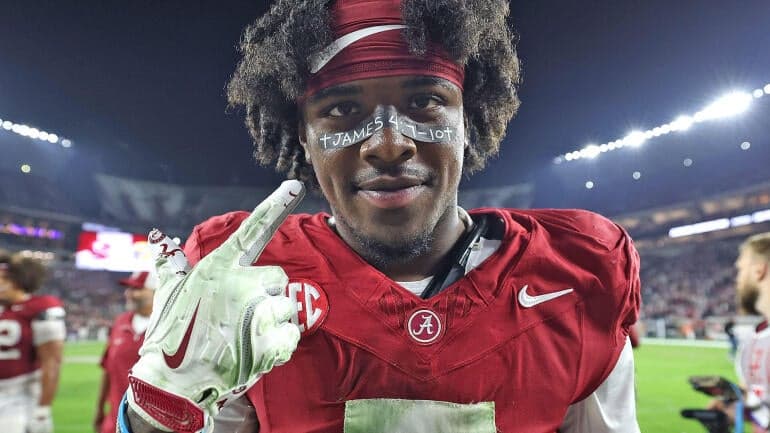
Route running is one of those things that gets talked about constantly and understood very little. It's easy to say a receiver "runs good routes." It's much harder to explain what that actually means -- or why it translates to the next level. Bernard explains it in the simplest way possible: repetition and detail. "It just takes a lot of reps," he said. "Perfecting running routes since I was a freshman, sophomore in high school." That sounds basic, but it's not -- Bernard just makes it look easy. NFL separation is built on tiny margins -- a half-step created at the top of a route, a subtle lean that forces a defender to flip his hips, consistent pad level that prevents DBs from keying in on breaks. That's where Bernard lives, in those margins. He talks about mastering "releases," "speed cuts," and "little nuances." He emphasizes film study -- not just watching, but studying and stealing. "I'm always trying to take things from guys and see what they do," he said. "At the next level, it's challenging … those DBs are so smart."
Germie Bernard (6’1 206) Alabama
- Finding the soft spots against zone coverage
- 9.03 relative athletic score
- Lines up in the slot, on the outside, and even in the backfield at times
- Very reliable target and has just a 2.5% drop rate for his entire career
- Ball security… pic.twitter.com/2clugNxW0J
— Bengals & Brews (@BengalsBrews) March 1, 2026 That's the part that matters most. Bernard isn't just running routes trying not to mess up, which is a familiar MO for just about every rookie receiver. No matter how much college experience they have, that first year in the league often involves way too much thinking -- Am I lined up correctly? What coverage am I looking at pre-snap and what is my route adjustment? What is my blocking assignment based on the formation? -- and not enough *just playing*. Bernard, meanwhile, already anticipates leverage, understands coverages, and has long played the position the way NFL offensive coordinators demand from their wide receivers. It's why Bernard's game projects so cleanly.
At Alabama, former wide receivers coach JaMarcus Shephard didn't mince words. "Germie Bernard is a technician," he said back in Sept. 2024, according to SI.com. "He really truly is. He's gonna get to the right leverages, be in the right location." Bernard wasn't even a month into his first season with the Crimson Tide when Shephard, now the coach at Oregon State, made those remarks. He had arrived in Tuscaloosa alongside head coach Kalon DeBoer, after two seasons at the University of Washington. But Bernard, who had caught passes from Michael Penix Jr. and played alongside Rome Odunze, Ja'Lynn Polk, and Jalen McMillan, was already a grizzled vet, savvy beyond his years by the time he arrived at Alabama. One of the most important lessons he learned along the way: sometimes it's about being exactly where the quarterback expects you to be when the window opens. That's where Bernard's value is truly realized. Carthon, who spent nearly two decades in NFL front offices, framed it in the way people in the league think about the position. "A reliable and quarterback-friendly wide receiver." Just seven words but the underlying meaning is worth taking such a player a round or two higher than you might otherwise. It's a well-earned compliment, for sure, but it's also NFL currency. Quarterbacks love guys who excel at contested catches, or can high-point the ball but more than anything else, they want receivers who eliminate uncertainty. Who run the same route the same way every time, who adjust to coverages, who can be trusted on third down to be exactly where they're supposed to. No one in this draft class' game is built to just that more than Bernard. Part of what makes Bernard so polished is the path he took to get here. He didn't arrive at Alabama as a finished product. He wasn't handed a WR1 role early in his career. Instead, he moved from Michigan State to Washington to Alabama, and along the way, absorbed everything he could, learned from a lot of current NFL players, and above all else, just kept evolving. At Michigan State, he says, the growth started off the field. "Learning how to balance life … how to balance football and school," he said. "Growing up … getting out of my childish ways." He credits veterans like Keon Coleman and Jayden Reed for showing him how to approach the game. Then came Washington, where he watched a loaded receiver room featuring the aforementioned Odunze, Polk, and McMillan -- along with Penix Jr. "I was just being a sponge," Bernard explained. "Seeing how those guys work … how they take care of their bodies … things they balance off the field." In Lansing and later Seattle, Bernard knew he wasn't the guy … yet. But he also knew something else. "When my time comes, I'm gonna be more than ready." And that's exactly how it played out. By the time he got to Alabama, the understanding of what his job entailed caught up to the traits -- because of the work he put in, the discipline, the routine, just doing the mundane boring stuff over and over until it became second nature. And it kept showing up on tape.
One of the more underrated aspects of Bernard's game -- and one that NFL teams will tell you they prioritize -- is his versatility. Carthon compared him to Chris Godwin, and it's easy to see why. "He can play all three positions," Carthon explained. "He's tough … and willing to insert in the run game." Run-blocking wide receivers won't always move the needle with fans, and even some media, during the pre-draft process, but receivers who block -- really, truly block and not just occupy space -- stay on the field. And Bernard wholly embraces that part of the job. Robert Gillespie is the Crimson Tide's running backs and assistant head coach. He also played in the backfield at the University of Florida alongside Carthon in the early 2000s. And that prompted this question from Carthon: "If I call Coach G right now and I asked him, 'Tell me about Germie Bernard,'' what, what would he tell me?" "He's gonna say I'm a dog," Bernard said without missing a beat. "In the run game, in the pass game … I'm gonna do everything that I can for our teammates to have success."
Ben Johnson loves receivers with run after catch ability and that can block. Enter Germie Bernard. #Bears pic.twitter.com/Ao4WMD6p1d
— Sky Kruse (@KruseSports\_) April 5, 2026 It's not lip service. It shows up consistently in how he plays, with physicality, with effort, with a willingness to "stick his face in the fan," as Carthon put it. And it echoes what Coach Shephard said back in those Sept. 2024 remarks to SI.com: "Certainly, if you watch the tape, Germie Bernard is blocking just as well as [former Alabama WR Kendrick Law]. … I tell these guys all the time, 'Knee benders are jawbreakers'. So they're going to bend their knees to strike on contact and that's what Germie does better than anybody else is bend his knees so that he can uncoil and strike on contact." It's that combination -- route technician plus physical blocker in the run game -- that turns a role player into a core piece, that takes him from the middle of the depth chart to comparisons to Chris Godwin.
Calling Bernard "under the radar" is both unfair and untrue. It's not that the league hasn't taken notice. It's that his strengths aren't always the ones that lead the conversation; in a world of freakish athletes, Bernard can get lost in the mix. In much the same way no one disputes that Texas Tech linebacker Jacob Rodriguez is a great player and a fantastic athlete, he's never going to rank above Arvell Reese and Sonny Styles because, frankly, they're aliens. It doesn't mean Rodriguez isn't a good player -- and 3-4 years from now, he might be the best linebacker from the '26 class. And we also could be saying the same thing about Bernard compared to the other receivers in this group -- it's what makes him one of the safest bets in the draft Every draft has its share of wide receivers who look the part: bigger, faster, more explosive, etc. And every draft has a handful of receivers who just play the position better than anyone else. Guess which group you can find Bernard? "I know I'm not like anybody else," he said. And that's exactly why it works. And it's also why, when we look back on this class in a few years, we'll all collectively wonder how Bernard lasted as long as he did and wasn't selected 10-20 spots higher. I talk a lot about not "overthinking" the draft process -- trust what your eyes are telling you and don't be distracted by the shiny objects that manifest themselves in the form of ungodly measurables. Bernard is just a good football player and at the end of the day, that's all every GM, coach and quarterback are looking for.
Share this article
Germie Bernard is viewed as a safe pick due to his technical skills, reliability in route running, and a low drop rate, which suggest he can perform consistently at the NFL level.
Germie Bernard stands 6-foot-1 and weighs 206 lbs, having run a 4.45 40-yard dash and achieved a 6.71 3-cone time, placing him in the 90th percentile among wide receivers.
Germie Bernard studies and takes inspiration from NFL receivers like Davante Adams, Keenan Allen, and Justin Jefferson, focusing on route running and technical skills.
Bernard prepares for NFL competition by mastering route nuances, studying film extensively, and understanding defensive coverages, allowing him to anticipate plays effectively.



See every story in Sports — including breaking news and analysis.