
Sports
Transfer rumors, news: Man United, Liverpool fight for Monaco forward
ESPN News
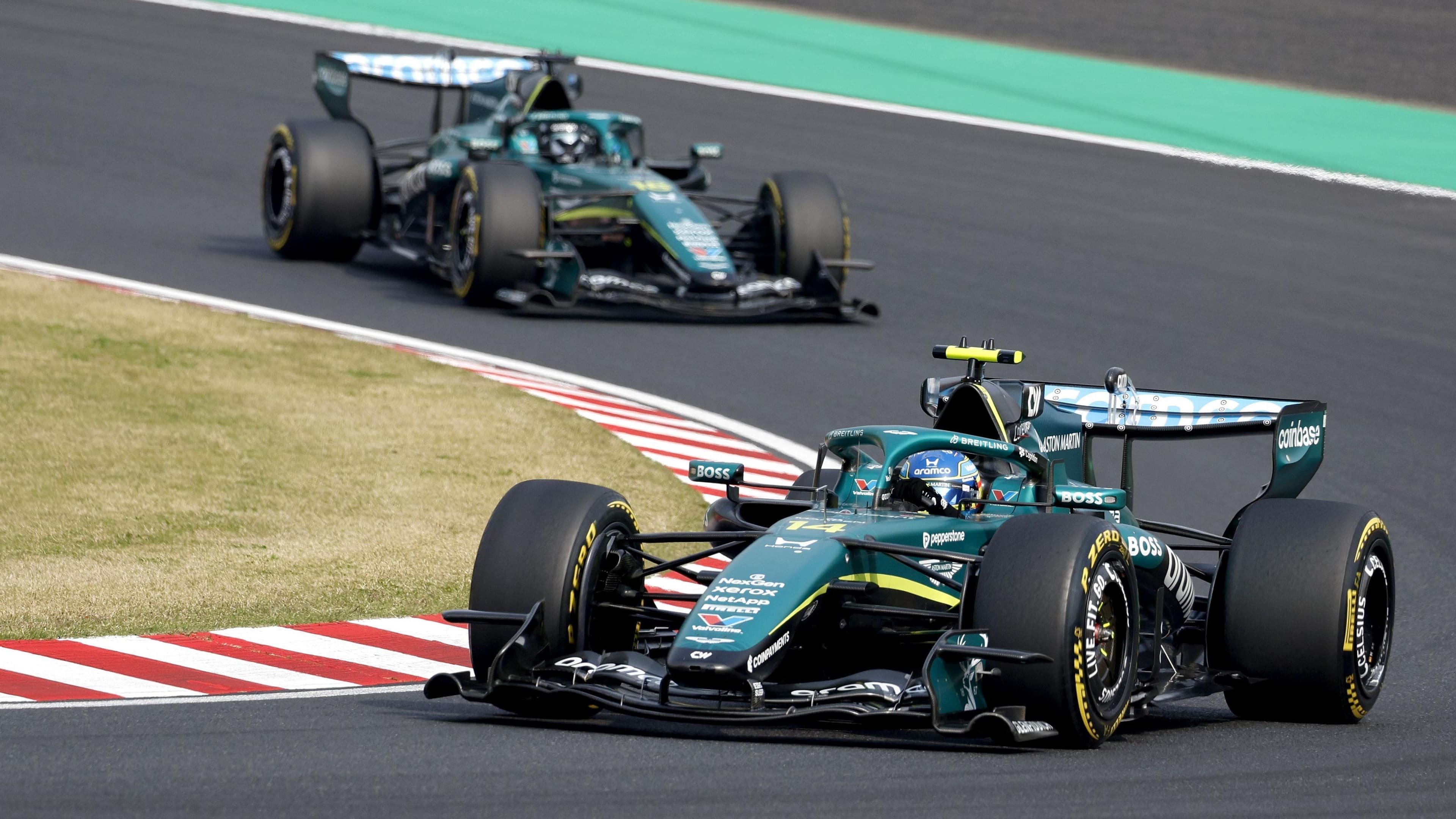
Formula 1 is taking a break from racing during April because of the cancellations of the Bahrain and Saudi Arabian Grands Prix but there is still plenty to talk about.
BBC F1 correspondent Andrew Benson has been answering your latest questions...
Andrew mentioned in his Japanese GP race report that half of Aston Martin's time deficit is down to the chassis and therefore not just the Honda engine. Please could he elaborate on exactly what he has learned because this has not been widely reported and I think deserves to be heard, as it does not seem fair to burden all of the blame on to Honda - Kevin
The race report from Suzuka actually mentioned that more than half Aston Martin's deficit to the front was caused by the chassis.
That information came from a very senior and knowledgeable figure over the course of the Japanese Grand Prix weekend.
It also tallies with what other teams are seeing on the GPS data to which all have access, in terms of the cars' speed on different parts of the track.
The exact split in terms of the losses that can be attributed to car and engine at Aston Martin-Honda is not known, and it's probably not possible to know, as of course the behaviour of the engine can also have an impact on the cornering performance of the car.
It's worth adding that, while it's true that much of the public focus has been on the Honda engine, and especially the severe vibrations that have been causing reliability problems, team principal Adrian Newey has been clear that the car is also lacking.
It's also the case that it's not clear where the vibrations are coming from - are they intrinsic to the engine, or is there something about the way the engine is mounted to the chassis that exacerbates them?
In Australia, Newey said that on the chassis side "we're maybe the fifth best team, so sort of potential Q3 qualifiers on the chassis side, but with the potential to be up front at some point in the season".
On average over the four qualifying sessions of the first three races, including for the sprint in China, the Aston Martin is 3.6 seconds off the pace.
The fifth fastest team on average are Alpine, at 1.268secs off the pace, followed by Haas at 1.567secs.
So Aston Martin are about 2.3secs off qualifying in the top 10, with the majority down to the chassis and the rest the engine.
In other words, put a Mercedes engine in the car, and it would be about where Alpine or Haas are. Exactly as Newey suggested.
Given the Aston Martin's troubled birth - effectively starting again when Newey arrived in March last year, a delayed entry into the wind tunnel until April, and a consequent compressed development programme - that sounds entirely feasible.
The car is overweight, and is especially poor in high-speed corners.
The fundamental point, though, is that it doesn't really matter where exactly the deficit lies between car and engine. Both Aston Martin and Honda are a long way from being competitive, both know that's the case, and both have a lot of work to do.
Allowing drivers a 'free' stop during a safety car period just seems to bring an unnecessary element of luck to races. It certainly made a huge impact at Suzuka. Why not just change the rules and prevent stops? - Alan
There have been a variety of rules governing the safety car since it was introduced into F1 30-odd years ago and the current ones have been arrived at organically.
It's true that an element of luck can enter into the equation, but the same would inevitably be true whatever the rules were.
And at the moment, while drivers who are on the wrong end of a safety car intervention inevitably bemoan their luck at the time, I've not heard anyone suggest the rules should be changed to prevent it.
As for the specific incident in question, it is debatable whether the safety car in Japan changed the outcome of the race.
It certainly looked like it did, as it gave Kimi Antonelli a chance to have a stop under the safety car when Oscar Piastri and George Russell, who were leading the first part of the race, had pitted under green-flag conditions.
However, Mercedes believe that the safety car effectively made no difference, that Antonelli would have won anyway.
They based that on the fact that once Charles Leclerc's Ferrari had pitted and Antonelli was in clear air, the Italian was lapping faster than Piastri and Russell.
Their plan was to leave him out as long as possible on his medium tyres to enable him to make up the lost time.
Remember, too, that Russell was still stuck behind Piastri.
It's impossible to be definitive, because there was only one lap after Russell stopped before the safety car was called.
But assuming Antonelli's tyres had stayed in good enough condition for his pace to continue for a few more laps, he would have 'over-cut' both Piastri and Russell and returned to the track from his pit stop in the lead.
Media caption,
'Antonelli had the luck, but sometimes you need it'
During the race in Japan we heard that the McLaren pit wall had lost power and they had to move to the garage. What benefit is there of having the pit wall vs garage - is it a space thing? - Alice
Teams have their senior management on the pit wall for historic reasons as much as anything.
Before digital timing, it was a necessity for timing purposes to be on the pit wall, as it gave the best view of the track, and it was the best way to time laps and lap chart the race by hand.
It continues today out of convention as much as anything else.
No team have to have their senior management on the pit wall during the race. There is no benefit to it - all the data that is accessible to them there is also accessible in the garage.
And, with the odd exception, they tend to communicate by radio when they're on the pit wall, even if they are sitting next to each other.
Having said that, if a team are set up that way, then obviously it is a disruption to have the pit wall gantry go down.
Much has been said about the new regulations affecting racing, so how much slower have lap times been during qualifying and races so far? - Chris
In Australia, pole position this year was 3.422 seconds slower than than last year. In China, it was 1.423secs and in Japan 1.793secs.
In the races, the fastest laps this year in Australia and China were actually quicker than last year - by 0.076secs and 0.179secs.
That was not the case in Japan, where last year the fastest lap was 1.467secs faster than this.
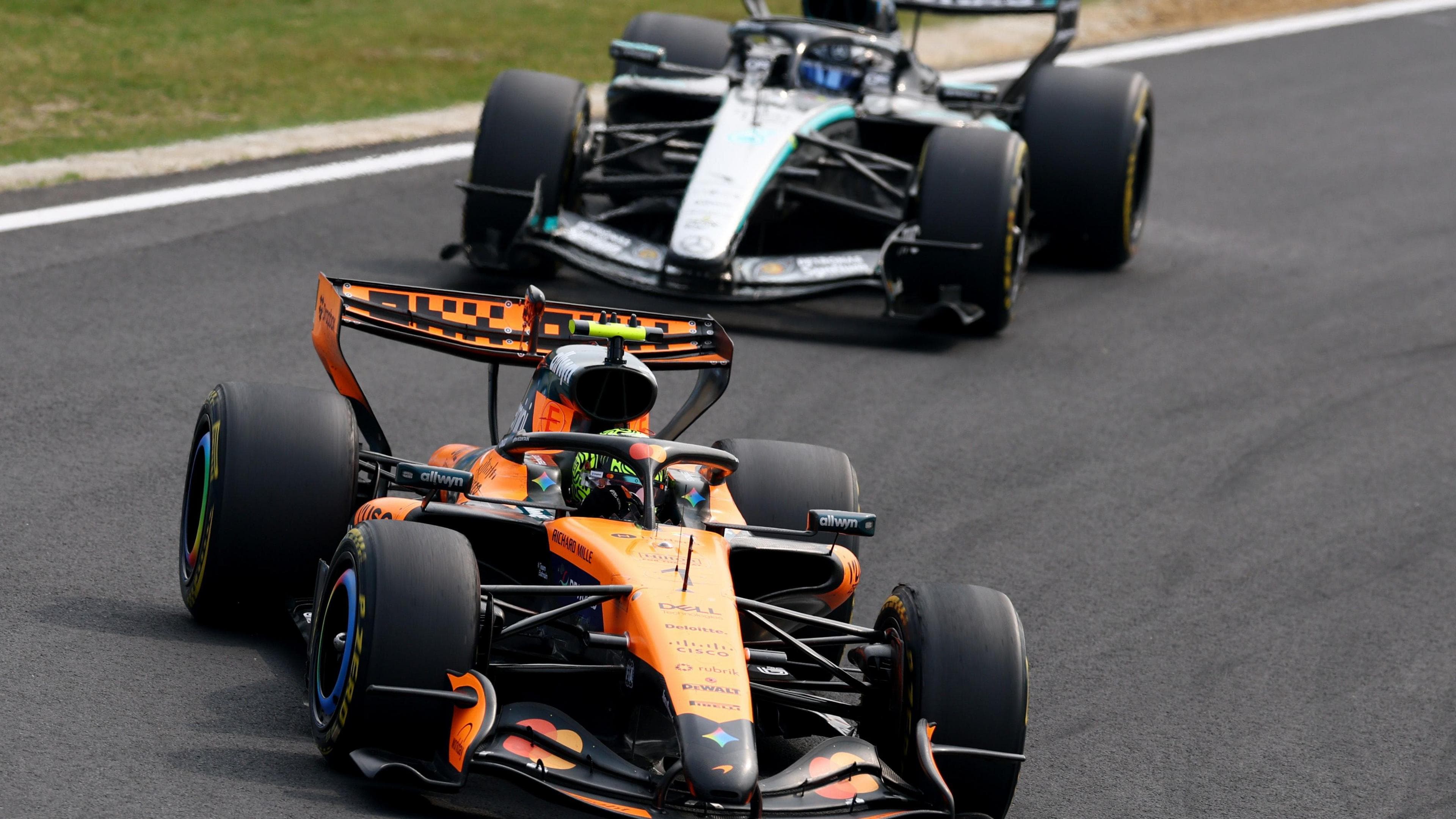
Image caption,
McLaren's Oscar Piastri with Mercedes' George Russell behind him during the Japanese Grand Prix
How much do the power-unit suppliers share with their customers compared with the works team? Does the deal include software, ancillary components, operating procedures etc? Do they get updates at the same time and are they privy to development information? - Freddie
The rules dictate that power-unit manufacturers must supply to their customers engines of exactly the same specification as those used by the works team.
That includes everything that the engine needs to operate to its maximum capacity.
The theory that a team needs to have a works engine relationship to win the championship was founded on the fact that if a chassis team has input into an engine design from the beginning, then the way the car and engine operate together can be optimised.
Choices can be made with regard to engine architecture that could have a positive influence on aspects such as weight distribution and even aerodynamics.
In contrast, a customer team have to take the engine they are given and design the car around it.
That is not necessarily a disadvantage, but it does mean the design timelines are changed.
McLaren proved in 2025 and 2026 that this does not necessarily prevent a team from winning a championship as a customer, especially in a situation where a set of engine regulations had been in existence for a long time and the power-units were well understood.
The issue for McLaren this year is that in a new power-unit regulation, and one in which the operation of the engine was complex because of the degree of energy-management required and the intricacies of the rules that have been imposed, they were behind in terms of operating the engine.
That gap has narrowed rapidly, thanks to work McLaren has done alongside Mercedes, to the extent that team principal Andrea Stella said in Japan that he "didn't think that we have left much unexploited".
It remains the case, however, that the Mercedes car is better than the McLaren one - or was until Japan.
McLaren have upgrades coming for the next races in Miami and Canada.
Share this article
No, the Honda engine is not the only issue. The article says more than half of Aston Martin's deficit to the front is down to the chassis, with the rest attributed to the engine. It also notes the car is overweight and especially weak in high-speed corners.
Aston Martin is about 2.3 seconds off qualifying in the top 10 on average, and most of that gap is said to come from the chassis. The article says the car's troubled development, delayed wind tunnel entry, and compressed programme have left it underdeveloped. A Mercedes engine would likely only move it up to around Alpine or Haas level.
It may have changed the outcome, but the article says it is impossible to be definitive. Mercedes believe Kimi Antonelli would have won anyway because he was faster in clear air and could have over-cut Oscar Piastri and George Russell. The safety car did give Antonelli a key advantage by allowing a stop under caution.
They use the pit wall mostly for historical and practical reasons rather than because it gives unique data. Before digital timing, it was the best place to watch the track and time the race by hand. Today, the same information is available in the garage, so being on the pit wall is not essential.
Yes, the rules require manufacturers to supply customer teams with engines of exactly the same specification as the works team. That includes everything needed for the engine to operate at maximum capacity. The difference is that works teams can help shape the engine and car concept together from the start, while customer teams must design around the engine they receive.





See every story in Sports — including breaking news and analysis.