Sports
Brewers place Brandon Woodruff on IL with shoulder inflammation following Thursday’s early exit
Brandon Woodruff placed on 15-day IL due to shoulder inflammation.
Yahoo Sports1 min read

World Athletics president Sebastian Coe affirms the organization will not restrict innovation, particularly regarding 'super shoes' that aided athletes like Sabastian Sawe in breaking marathon records.
Mentioned in this story
World Athletics president Sebastian Coe says the organisation will not "strangle innovation", following the debate around the so-called 'super shoe' which helped Sabastian Sawe become the first person to run a competitive marathon in under two hours.
The 31-year-old Kenyan won Sunday's London Marathon in one hour 59 minutes 30 seconds, writing himself into history and breaking a barrier once thought by many to be impossible.
"I don't think any society, any civilisation, any sector of the economy has been served well if you try to strangle innovation," Coe told BBC Sport Africa on a visit to Botswana before the World Relays.
"The role of World Athletics is very clear - we want to enable, but we also have a regulatory responsibility."
Sawe, Ethiopia's Yomif Kejelcha - who also ran under two hours as he finished 10 seconds behind Sawe - and Tigst Assefa, who set a new world record time as the winner of the women's race, all wore the Adidas Adios Pro 3 shoes in London.
Sawe thanked Adidas for making what he said were the best shoes he had worn, particularly highlighting how "very light" and stable they are.
The first super shoe to weigh under 100 grams, Adidas claim their technology improves running economy by 1.6%.
But any runner wanting to benefit will have to pay about $500 (£450) to road test the product themselves.
"Yes, shoes play a part, but not the biggest part," Coe said.
"The biggest part is the mentality of the athlete, the physicality of the athlete, the world-class coaching, the world-class programmes that are now being run through federations to support their athletes. That's all a part of the improved performances."
Sawe shaved more than two minutes off his personal best in London, attributing his improvement to running about 200km a week at altitude.
His progress was also aided by developments in fuelling. The Kenyan reportedly took on 115g of carbohydrates per hour during the race, following a breakfast consisting only of two slices of bread with honey and tea.
Sebastian Coe stated that World Athletics will not 'strangle innovation' related to super shoes, emphasizing the importance of enabling advancements.
Sabastian Sawe is a Kenyan athlete who became the first person to run a competitive marathon in under two hours, finishing the London Marathon in 1 hour 59 minutes 30 seconds.
The Adidas Adios Pro 3 shoes are high-performance running shoes that were worn by Sawe and other top finishers during the London Marathon.
World Athletics aims to enable innovation while maintaining a regulatory responsibility to ensure fair competition in athletics.
Brandon Woodruff placed on 15-day IL due to shoulder inflammation.
Inoue vs Nakatani: Who will win the super bantamweight title on May 2?
Analyzing the Giants' disappointing start to the 2026 MLB season.
This weekend, four European football leagues could crown their champions. The excitement builds as teams approach the final stretch of the season.
Milan's Youssouf Fofana could be heading to the Premier League after a strong season.
Chicago Bears have big plans for sixth-round pick Jordan van den Berg.
See every story in Sports — including breaking news and analysis.
Image caption,
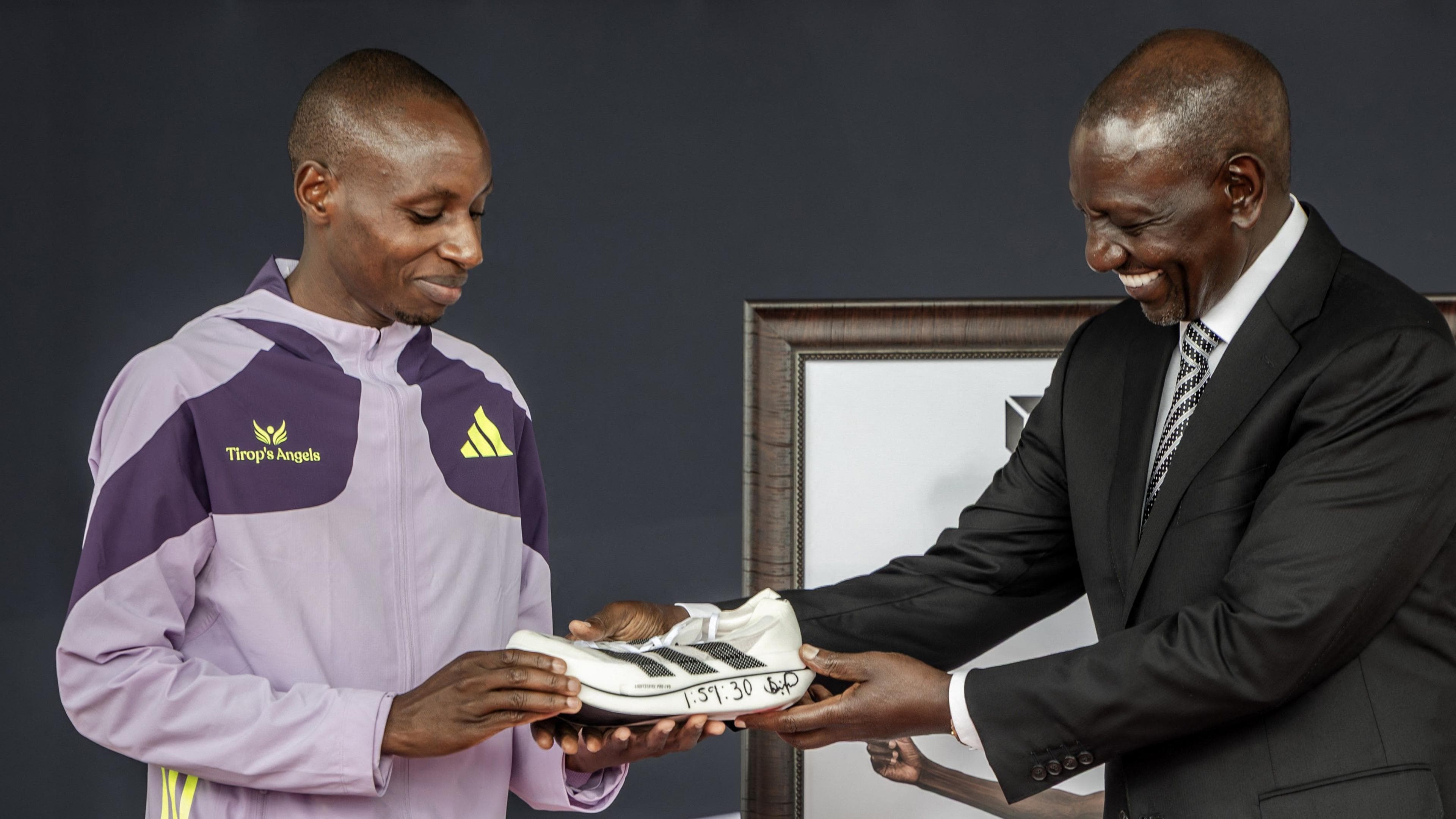
Sabastian Sawe gifted one of his shoes from the London Marathon to Kenya president William Ruto on his homecoming in Nairobi
Still, the rise of super shoes over the past decade, particularly when it comes the marathon, has prompted World Athletics into a more active regulatory role.
At the 2016 Olympics in Rio de Janeiro, all three medallists in the men's race wore prototypes of the Nike Vaporfly 4%, which promised a 4% increase in performance.
By 2020, the governing body had introduced limits on sole thickness, the design of carbon-fibre plates designed to propel the body forward as well as commercial availability to prevent excessive technological advantage.
Sportswear brands continue to innovate, pushing the boundaries of the rules, with Coe making it clear regulations could change.
"This is inevitably an evolutionary process," he said. "It's only been relatively recently that we've had a system of evaluation.
"We work closely with the athletes, the coaches, the shoe companies. We don't want them to go off and spend hundreds of millions of dollars on shoes that we're going to find illegal. So there is a balance."
He also highlighted another benefit of innovation.
"We often overlook that with the design to improve performance goes a lot of biomechanical work around injury prevention," explained the 59-year-old.
"The athletes are able to train for longer, they're able to race longer, they're able to be in our sport for longer, and that has to be a good thing."
Reflecting on his own career, the 1980 and 1984 Olympic 1500m champion added: "I don't think I'd have run under two hours for the marathon with the shoes, but I might have run a little bit quicker for 800m."
But for critics, the concern goes beyond regulation. The fear is that technology could erode the essence of distance running and that performances could reflect engineering rather than human endurance.
Coe accepts the concern but believes the sport remains on the right track.
"Life is always about balances," he said.
"I think at World Athletics we have technical teams that are always going to be conscious of where that balance is. At the moment, I think we're the right side of it."