
Crypto
Bitcoin ETF inflows hit highest level since February
CoinDesk

The challenge to solving the quantum threat to Bitcoin could be more social than technical, according to Grayscale’s head of research, especially if the community fails to come to an agreement on certain contentious issues.
Google released a paper that shook the crypto industry on March 30, suggesting that a quantum computer could potentially crack the cryptography protecting Bitcoin (BTC) using far fewer resources than previously thought.
Grayscale head of research Zach Pandl, however, suggested the problem for Bitcoin doesn’t come from its technical solution, as “bitcoin has lower risk than other cryptocurrencies” because it uses a UTXO model and proof-of-work consensus, does not have native smart contracts and certain address types are not quantum vulnerable.
Instead, the challenge would be for the community to reach a decision on the way forward, said Pandl.
The Bitcoin community has been fiercely debating what to do about old dormant coins, particularly the roughly 1.7 million BTC locked in early P2PK addresses, including Satoshi’s estimated 1 million BTC stash, currently worth about $68 billion.
The Bitcoin community needs to decide what to do about coins where the private key has been lost or is otherwise inaccessible, wrote Pandl.
They have three main options: burning the coins, deliberately slowing their release by limiting the rate of spending from vulnerable addresses or doing nothing.
“All are conceptually doable, but the challenge is reaching a decision, and the Bitcoin community has a history of contentious debates over protocol changes, including last year’s dispute around image data stored in blocks.”
Pandl was referring to a big fracas that erupted in 2023 over the use of blockspace for Bitcoin Ordinals, technology that enables inscribing data such as text and images to a satoshi, the smallest unit of Bitcoin.
Two years later, the debate may have quietened down, but the two sides continue to hold opposing views.
Related: Researchers say quantum computers could, in theory, be ready by 2030
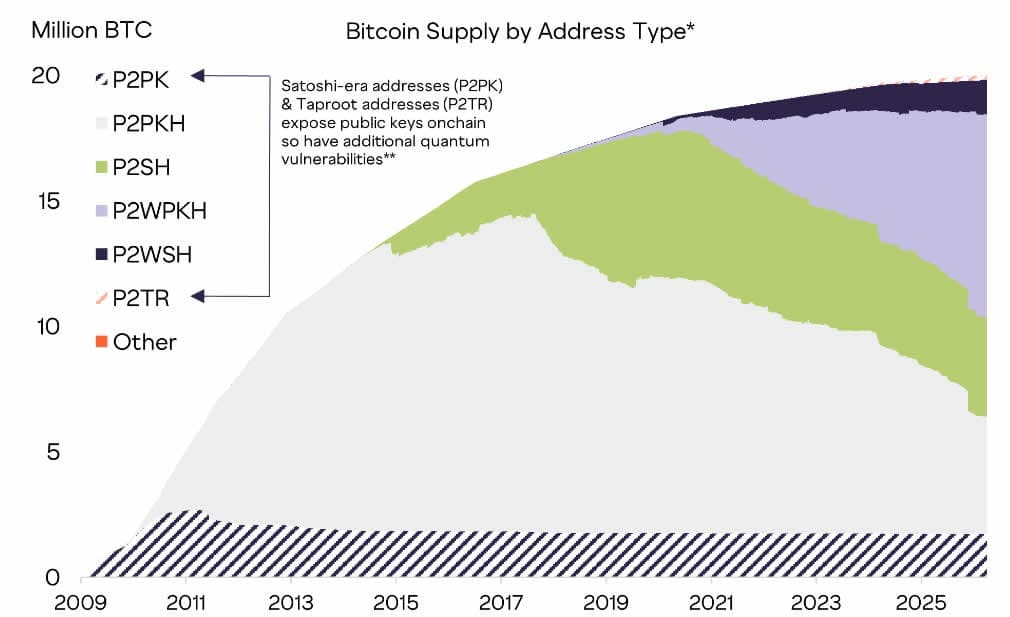
About 1.7 million BTC is vulnerable to the quantum threat. Source: Grayscale
Pandl cautioned that it was “time to get started” and that blockchains need to adopt post-quantum cryptography, echoing the sentiment from Google.
Both Solana and the XRP Ledger are already experimenting with post-quantum cryptography, wrote Pandl. Meanwhile, the Ethereum Foundation released its post-quantum roadmap in February.
Pandl concluded that investors “should not fret” for now, but it is time to accelerate efforts to prepare for our post-quantum future.
“In our view, there is no security threat to public blockchains from quantum computers today.”
Magazine: Nobody knows if quantum secure cryptography will even work
Share this article
Grayscale says the biggest challenge is getting the Bitcoin community to agree on what to do, not building the technical fix. Zach Pandl argued that Bitcoin already has some structural advantages, but reaching consensus on protocol changes could be the hardest part.
About 1.7 million BTC is considered vulnerable, according to Grayscale. That includes coins locked in early P2PK addresses, among them Satoshi’s estimated 1 million BTC stash, which is worth about $68 billion at current prices.
The community has three main options: burn the coins, slow their release by limiting spending from vulnerable addresses, or do nothing. Pandl said all three are conceptually possible, but the real difficulty is agreeing on one approach.
No, Grayscale says there is no security threat to public blockchains from quantum computers today. Pandl said investors should not worry for now, but the industry should start preparing for a post-quantum future.
Some other networks are already taking steps toward quantum resistance. Pandl noted that Solana and the XRP Ledger are experimenting with post-quantum cryptography, and the Ethereum Foundation released a post-quantum roadmap in February.





See every story in Crypto — including breaking news and analysis.