
Crypto
Bitcoin ETF inflows hit highest level since February
CoinDesk

Onchain evidence was key to securing the conviction of three individuals for terrorism financing in Indonesia in 2024 and 2025, reflecting a clear shift in the way courts value onchain evidence.
“Indonesian courts have demonstrated that cryptocurrency evidence — wallet addresses, transaction histories, on-chain flows — is not only admissible but can anchor a terrorism financing prosecution,” TRM said in a statement Sunday.
TRM said terrorism financing networks have preferred cryptocurrency as a mechanism of choice to move money, as authorities and regulators have been slow to treat it with the same level of scrutiny as traditional fiat channels, but noted that this is now changing.
Indonesian authorities traced one defendant sending more than $49,000 worth of USDt (USDT) across 15 transactions from a local exchange to a foreign platform, with the funds later routed to an ISIS-linked terrorism fundraising campaign in Syria, according to the blockchain firm.
Indonesia’s financial intelligence team and its counterterrorism police unit, Densus 88, carried out the analysis and presented the findings to Indonesian courts, which accepted the blockchain data as key evidence in each of the three cases.
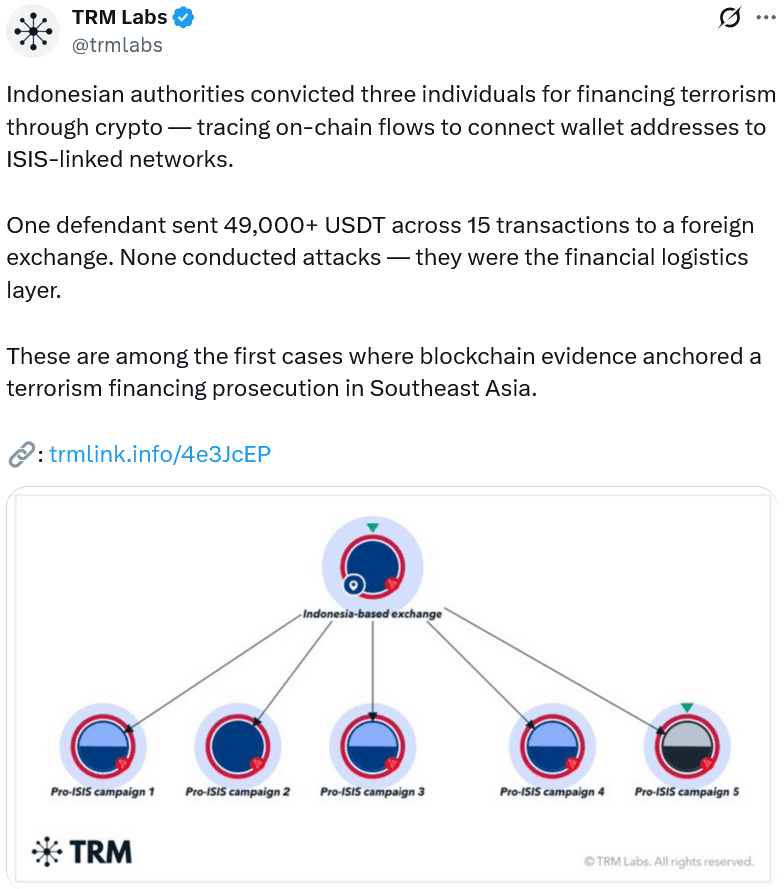
Source: TRM Labs
Indonesia is not the only country in Southeast Asia using blockchain analytics to catch criminals, TRM said.
“Similar patterns are emerging across Southeast Asia, where governments are investing in blockchain intelligence capabilities and enhancing collaboration between public and private sectors to address illicit finance risks.”
TRM Labs said that Singapore and Malaysia’s financial intelligence units and law enforcement agencies are also building the technical capacity to trace cryptocurrency flows.
Related: Drift Protocol says $280M exploit took 'months of deliberate preparation'
On April 1, Cambodian and Chinese officials captured Li Xiong, a leader of the Huione Group, an organization that served scam centers in Cambodia that carried out “pig butchering” frauds and other investment schemes to steal crypto from victims around the world.
Xiong was extradited to China, where he is set to face fraud and money-laundering charges.
His extradition came three months after the arrest of Chen Zhi, the head of Prince Group, which operates Huione Group.
TRM reported in February that illicit entities received about $141 billion worth of stablecoins in 2025, marking a five-year high.
Magazine: Are DeFi devs liable for the illegal activity of others on their platforms?
Share this article
Onchain evidence was key because Indonesian courts accepted cryptocurrency records as central proof in the prosecutions. TRM Labs said wallet addresses, transaction histories, and on-chain flows could anchor a terrorism financing case. The courts used that blockchain data as key evidence in all three convictions.
Three individuals were convicted for terrorism financing in Indonesia in 2024 and 2025. TRM Labs said the cases showed a clear shift in how courts value onchain evidence. The convictions were secured with blockchain data presented by Indonesian authorities.
Authorities traced one defendant sending more than $49,000 worth of USDT in 15 transactions. The money moved from a local exchange to a foreign platform. TRM said the funds were later routed to an ISIS-linked terrorism fundraising campaign in Syria.
Indonesia’s financial intelligence team and Densus 88, the country’s counterterrorism police unit, carried out the analysis. They presented their findings to Indonesian courts. The courts accepted the blockchain data as key evidence in each case.
Yes, TRM Labs said similar patterns are emerging across Southeast Asia. It noted that Singapore and Malaysia’s financial intelligence units and law enforcement agencies are also building the technical capacity to trace cryptocurrency flows. The firm said governments are investing in blockchain intelligence and public-private cooperation to address illicit finance risks.



See every story in Crypto — including breaking news and analysis.