
NBARecap
NBA fines Knicks' Mitchell Robinson $50K, Hawks' Dyson Daniels $25K after ejections for Game 6 altercation
NBA fines Mitchell Robinson $50K and Dyson Daniels $25K after Game 6 ejections.
Yahoo Sports1 min read
Kentucky Derby jockeys can earn significant prize money, with amounts varying based on their horse's performance. Winning jockeys and runners-up at Churchill Downs receive a share of the total purse, which is influenced by various factors.
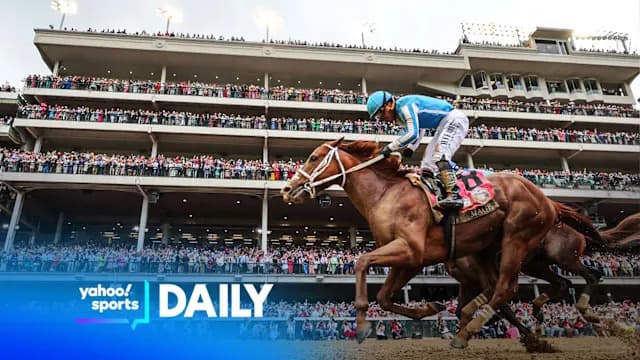
How much do Kentucky Derby jockeys make? Prize money breakdown for winners and runners-up at Churchill Downs originally appeared on The Sporting News. Add The Sporting News as a Preferred Source by clicking here.
Horse racing is distinct from most other sports because the main subject isn't even a human. The horse that wins the Kentucky Derby is credited with the win, but a horse can't take any money home for itself — can it?
In many ways, horse racing is a team sport. Between a jockey, trainer, owner or owners and everyone else who helps put a horse in the best position possible to succeed, it takes a village to win an event like the Kentucky Derby.
For jockeys, winning the iconic race can be life-changing.
Here's what you need to know about prize money at the Kentucky Derby and what jockeys can walk away with.
MORE:What is the Triple Crown of horse racing?
The total Kentucky Derby purse is currently $5 million, with $3.1 million (62 percent) going to the winner. Here's the complete breakdown:
| Place | Prize money | Percentage of purse |
| First | $3.1 million | 62 percent |
| Second | $1 million | 20 percent |
| Third | $500,000 | 10 percent |
| Fourth | $250,000 | 5 percent |
| Fifth | $150,000 | 3 percent |
Of course, horses can't do anything with money, so who gets it? Here's a look at how much jockeys earn from the Kentucky Derby purse.
MORE:When was the last Triple Crown winner?
Kentucky Derby jockeys win about 10 percent of the total earnings for the horse they ride. While the figure varies for other races, jockeys typically make 5-10 percent of a horse's winnings.
That means the jockey of a horse that wins $3.1 million could earn $310,000 for winning the two-minute race. That's exactly what happened to Brian Hernandez Jr. on 2024, as the jockey took home about $310,000 after winning the derby with Mystik Dan.
Following the 10 percent standard, here's how much each of the top-five finishing jockeys make:
| Place | Payout |
| First | $310,000 |
| Second | $100,000 |
| Third | $50,000 |
| Fourth | $25,000 |
| Fifth | $15,000 |
For jockeys who don't win, the Kentucky Derby isn't a very lucrative affair. Jockeys who don't win but still finish second, third, fourth or fifth can still expect to receive a 10 percent share of their horse's winnings. 10 percent of the second-place winnings is still $100,000, while even $50,000 for finishing third is a nice payday.
For the 15 jockeys whose horses don't finish within the top five, the payout is light. Those jockeys typically make "a couple hundred dollars apiece," CNBC reported in 2010. While that figure might depend on the owner of the horse a jockey is riding and could have risen in the years since, it's a window into how big the difference between winning and losing is for jockeys.
Jockeys also typically have to pay their agents a percentage of what they make, so that also cuts into what they bring home.
MORE:Complete list of Kentucky Derby champions
Jockeys are primarily hired on a race-to-race basis, USA Today reported, rather than signing long-term contracts. They are typically paid a fee by either the owner or trainer of the horse in addition to any winnings brought in from a win or ranked finish.
That means Churchill Downs is not paying any jockeys simply to ride during the Kentucky Derby. That business is handled by the trainer or owner of the horse.
MORE:Kentucky Derby hats at Churchill Downs, from fascinators to DIY
While it's unclear how long Kentucky Derby jockeys have received 10 percent of their horse's winnings, the total purse for the event has increased over the years — and so have the payouts for jockeys.
To get a sense of how the purses have changed over the years, here's a timeline of when the payouts reached notable landmarks at the time:
Winning jockeys currently receive 6.2 percent of the total purse (10 percent of the winning horse's payout). Using that figure, winning jockeys would have made $4,650 in 1940, $15,000 by 1982, $62,000 by 1996 and $124,000 by 2005.
MORE:Why do they euthanize horses with broken legs?
The Kentucky Derby is easily the biggest prize of the Triple Crown races. With a purse of $5 million, the derby pays out more than double the Belmont Stakes and Preakness Stakes, which each carried a $2 million purse in 2025:
| Race | Total 2025 purse |
| Kentucky Derby | $5 million |
| Preakness Stakes | $2 million |
| Belmont Stakes | $2 million |
Other races around the world do have higher purses than the Kentucky Derby, however. The Saudi Cup, launched in 2020, pays $20 million in total, while the Dubai Cup offers $12 million and two Australian races have purses north of $6 million.
On American soil, the Breeders' Cup Classic has a purse of $7 million, while the Breeders' Cup Turf matches the Kentucky Derby with a $5 million purse.
MORE:Where is Churchill Downs? Location, capacity and more Kentucky Derby track details
It can be tough for jockeys to stand out, but winning races like the Kentucky Derby can lead to endorsement deals that allow the riders to profit off of their success.
Triple Crown-winning jockey Victor Espinoza signed a sponsorship deal with Skechers before the Kentucky Derby in 2017, while horse racing network TVG has endorsement deals with jockey brothers Irad and Jose Ortiz.
Of course, many of the jockeys who have enough success to earn endorsement deals are the few making good money off of jockeying. Jockeys who don't win often aren't likely to secure sponsorships, so winning could be life-changing for riders.
The average earnings of a Kentucky Derby jockey can vary widely, but top jockeys can earn substantial sums, especially when winning or placing in the race.
Prize money is typically distributed based on the finishing positions, with winning jockeys receiving a larger share compared to those who place lower.
Earnings can be influenced by the horse's performance, the total purse for the race, and the jockey's agreement with the horse's owner regarding their cut of the winnings.
Kentucky Derby winners can receive a significant portion of the total purse, which can amount to hundreds of thousands of dollars depending on the year's total prize pool.
NBA fines Mitchell Robinson $50K and Dyson Daniels $25K after Game 6 ejections.
NBC is airing the Kentucky Oaks in primetime for the first time, highlighting the growing significance of the Kentucky Derby weekend.
Chad Brown's Always a Runner clinches victory at Kentucky Oaks 152!
Pittsburgh Steelers decline fifth-year option for Broderick Jones among others.
See every story in Sports — including breaking news and analysis.