Sports
Everything you need to know about Matias Lozano as Liverpool eye sensational midfielder
Liverpool eyes midfielder Matias Lozano as recruitment strategy shifts
Yahoo Sports1 min read
Despite facing harsh winter conditions during training, I successfully completed my best marathon at the London Marathon. The experience highlighted the importance of mental resilience and proper gear.
How I Ran My Best Marathon After Tough TrainingBruno Bobbink, @fietsbenen (center) / Sportograf / WH illustration
"Hearst Magazines and Yahoo may earn commission or revenue on some items through these links."
If you live in the Northeast, you know that the first months of 2026 were a particularly brutal time to decide to give a spring marathon a go. It meant training through the worst of the cold, snow, and ice.
Despite this, I committed to running the London Marathon with New Balance in early January. While I eventually settled into the dark frigid early morning runs (as long as I had the right gear!), it certainly made for mental gymnastics every single day. Should I go out? Could I go out? It’s so cold. Will there be sidewalks? How about the ice? Why am I running with sleet pummeling my eyeballs? Is this fun? Am I hallucinating? Etc.
Some weeks were also so busy with work and kids and life that I found myself stuffing all of my run training days into a weekend or other 3-day period. Speed/quality run on Friday, easy or mid-mileage run on Saturday, long run Sunday. Or some variation of that. (Ear muffs, coach Linda!)
But I persisted. Then about a month out from the marathon, during what was supposed to be my peak week, my son and I were both struck down by a brutal bout of flu which rendered me incapable of doing much physical activity at all. My lungs felt like I was breathing in water. I felt like I was slogging through every day, even when I was technically “better.” Next came a family vacation in a place that was virtually impossible to do extended running (mountains, jungle, no sidewalks)—it was beautiful, and just what our family needed, so hard to complain about that. But still, my training consistency suffered even more.
I found myself entering what should be close to a taper time and still trying to squeeze in a few long runs. (This is where the support of my running coach, Linda Leigh LoRe, really came into play. She adjusted my programming and continued to remind me that no build is perfect, and that I would be okay). Then, on my last long one, a 22 miler, I tripped and fell on the sidewalk at mile 14 and skinned off most of my left knee. (And all, I mean all, of my pride.)
Was this the universe telling me to just quit already?!
Thankfully, no. The lesson was still coming—and it was not that.
Hearst Owned
Anyone who asked me how I was feeling leading up to the marathon received some version of: “Oh not great, ya know, my training has been off, we’ll see what happens, no longer going for any sort of a time goal…”
Secretly, I was hoping for an official sub-4 hours, my first one. I finished the 2025 NYC Marathon in 4:00:38 and, though it was a PR, those 38 seconds have been haunting me.
Coach Linda reminded me, again, that no builds are perfect and to just go out there and enjoy the race and the city of London. And that’s just what I did.
The London course is a dream, mostly flat with downhills that pop up just when you need them. Starting in Blackheath and zooming by the Cutty Sark between miles 6 and 7, over the Tower Bridge at mile 12/13ish, and ending on Queen’s Walk with a quick turn onto the mall to finish with Buckingham Palace framing the runners as they triumphantly finish. (As one of the six Abbott World Major Marathons, London has always been a popular race, but its cache is absolutely skyrocketing; the 2026 race netted a Guinness World Record with 59,830 finishers, and the 2027 lottery application already contains more than 1.3 million applicants.)
Once I crossed over the iconic bridge, I felt pretty solid and knew that if I could hold my current pace, I could come in comfortably sub-4. I wasn’t sure how far below, but I was then determined to at least vindicate those 38 seconds.
As I crossed the finish line, with the palace behind me, I was pretty sure I’d done it, but couldn’t confirm until the texts starting coming in from friends and family around the world: 3:56!!!! OMG!!! Sub-4!!!
Holy shit. I ran it. I finished it. I did not collapse from the jet lag and the pressure of a demanding yet exhilarating career, two kids under 10, a life spanning the Hudson River and all the chaos that New Jersey Transit creates. And I achieved my goal. But HOW? Everything leading up to that race was telling me that this wasn’t going to be pretty. My self-talk involved lots of: Are you sure you can do this? You had such an imperfect training block… Maybe it’s better to bow out.
Come to find out, my imperfect training was actually the most strategic thing I could have done.
“We often think that peak performance comes from perfect preparation,” says Hillary Cauthen, PsyD, a clinical sport psychologist, certified mental performance consultant, and president of the Association for Applied Sport Psychology, when we chat the week after the marathon. “But it’s much better with adaptability, not perfection. These less-than-perfect training blocks actually create more mental flexibility, which is huge, especially for endurance athletes.”
Cauthen explains the idea of stress inoculation and it all makes sense. Stress inoculation is when you’re “inducing low levels of stress or imperfect training blocks, for example, and learning how to adapt and work through that to build tolerance when it’s uncomfortable.” So then, on race day, when you’re performing, your body knows how to respond. It’s not unfamiliar if you get a stitch or feel fatigued, because you have trained yourself to navigate through that.
“Sometimes, imperfect training allows you to have more control and be more at ease to be able to adapt your plan and work through it on race day,” says Cauthen, who’s completed nine marathons herself (before venturing into Hyrox competitions).
In fact, Cauthen believes so strongly in the power of training adaptability that she institutes what she calls a “chaos day” when she’s working with clients of all ages and expertise, from youth to collegiate and even professional athletes.
This involves “naturally creating chaos in a training block when the athletes are expecting a certain thing and then switching it up.” So, maybe that’s changing up the rules of a drill midway through. Or swapping the scoring rules of a scrimmage. Anything that forces the athletes to address and navigate their mental response to a changing environment or situation in a safe space.
There was also something strangely freeing about showing up to the start line after a less-than-stellar training block, with a mindset of “Let’s see what happens; I’ve made it here, and now it’s time to just run.”
I asked Cauthen about that feeling of lightness just before our corral made our way over the start line timing pads, and she said: “Yes, you reframed your thinking. You’re like, I’ve worked through hard things. It wasn’t perfect, but I still got here, and now I don’t have an expectation to perform amazing, so you’ve taken the pressure off. The race itself became more of a challenge than a threat.”
In essence, I’d already navigated the discomfort in the previous weeks and months so when it gets hard at, say, mile 20, I knew it was going to be hard. I don’t have to spin out. I can just work through it like I worked through coming back after the flu. I knew I could do it because I’d done it before.
My husband asked me multiple times in this training block why I was putting myself through this, especially after I returned from a long run that was so frigid that I couldn’t feel my face or when I limped into the house as blood was streaming down my leg after my knee-skinning fall.
My answer was the truth: I freaking love it so much. The joy that I’m able to extract from the simple act of running is incomparable. I solve problems on my runs. I come up with my best ideas on a run. I feel most like myself after a run. I appreciate nature in a whole new way while I’m running. I get lost in my head in the greatest of ways when I run. I get to know my community and the streets/trails so much deeper while I run. I’m a better mother/wife/person after I run. The list is endless.
That’s why running the London Marathon with New Balance meant so much. The brand had just launched their “Lose Track of Time” campaign connected to the Ellipse running shoe (the shoe I turn to when I need a little lift to get out the door while training; the look of it, with its bright colorways and wavy, textured design, signals pure happiness). The purpose? “To bring runners back to the feeling that made them fall in love with running in the first place—that moment when the miles disappear, the pressure goes away, and you’re just moving because it feels good,” Erica Tappin, New Balance Global Marketing Director, Running, tells me over email after the race.
There were reminders of this all over London for marathon weekend, with the complementary New Balance “Run Your Way” campaign slogan on windows and shirts and posters—reminding us to run our race, our own way. “It’s about giving permission for runners to define the sport in their own terms,” says Tappin. The messaging set the tone and the vibe for race day in a way that I didn’t fully appreciate until I experienced it firsthand.
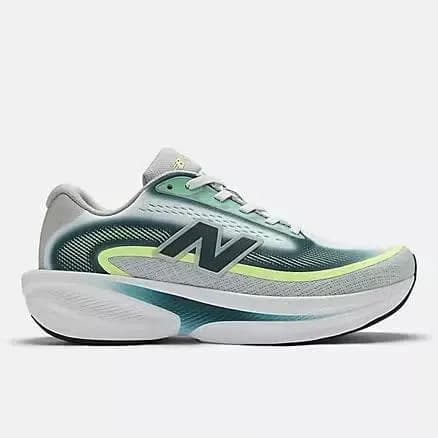
Retailer
A go-to daily training (and travel) shoe for easy miles, the color and design together = instant mood boost and kick to get out the door.
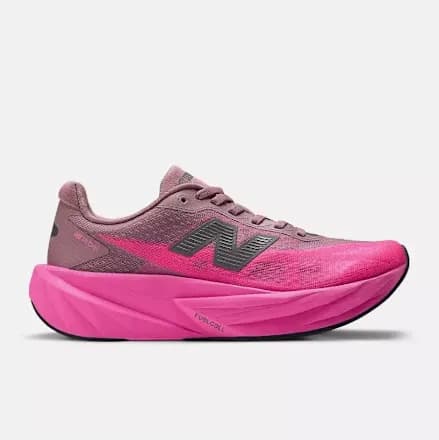
Retailer
My absolute favorite shoe for marathon training; it's a fast shoe that can go long and clocked many easy, medium, and fast pace winter miles with me over the months.
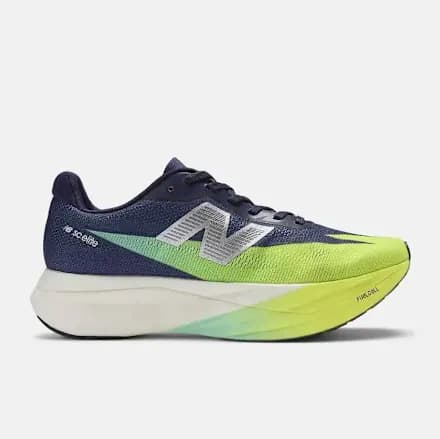
Retailer
My race day shoe! These carbon-plated lightweight super shoes helped me net a new PR on the streets of London.
“‘Run Your Way’ celebrates every kind of runner and every kind of run. ‘Lose Track of Time’zooms in on the emotional side of that: the freedom, the flow, the escape. Together, they reinforce that running isn’t about perfection—it’s about feeling good in your body and owning your experience,” Tappin says.
I couldn’t agree—and identify—more. When I asked Tappin a bit more about why New Balance decided to highlight the emotional side of running, at a time when we’re also inundated with data and tracking and performance options, her answer was a master class in running right now in 2026:
“We’ve found that so many runners are running for their mental health, and it continues to grow as the sport does. It’s why people start, why they come back, and why the sport means so much to so many. When we focus only on mileage, pace, and data, we lose the part that keeps runners connected. Will there be moments or training blocks when tracking really matters? Of course! But allowing yourself to be free of the burden or comparison or judgement allows you to reconnect to the joy running provides. Bringing emotion back means celebrating the small wins, the mindfulness, the community, the joy. It means giving runners permission to run for how it makes them feel.”
Something that I’ll always take away from the London Marathon experience, my sixth marathon, is that I built resilience. But a new form of it. Beyond the highs and the lows, the joy and the questioning, in both my training and in the race itself, I was building a more defined and personalized form of resilience.
“A lot of people get resiliency wrong where they think it's, I'm persevering when I failed or I’m getting back up again,” says Cauthen. “To me, if we're actively building resilience, you're choosing toughness. You're choosing to work in the hard and in the discomfort. And running a marathon? Let's be real. That’s discomfort, even if you're in the best shape.”
What I extracted from training for and racing the London marathon, which Cauthen says is the key to resilience, is the idea that I can do hard things—and thrive in those hard things. “I look at resiliency as an action-oriented framework of like, what are the hard things I'm choosing to do?” she says.
Cauthen would be happy if we ditched the idea that we must fail in order to work through a resilient mindset. “Every performance we do will have a hard moment. And you don't have to fail to be resilient. It's much more, can I have that cognitive flexibility to say: I'm going to push through it. I'm not going to fight the hard. I'm going to accept the hard and I'm going to choose to work through it anyway. That’s where we find resilient athletes that are mentally tough. Well, they're just choosing to work hard. They know they've accepted the hard. They've accepted the good and the easy and they're going to keep pushing.”
Personally, I’ve accepted (and now welcome) the hard—as well as the joy—and know that I’m better for it. Sub-4 or not.
Hearst Owned
You Might Also Like
I faced brutal winter conditions, including cold, snow, and ice, which made training difficult.
I focused on mental resilience and ensured I had the right gear for the harsh weather conditions.
I ran the London Marathon after enduring a particularly tough training block.
I engaged in mental gymnastics to motivate myself, questioning my decisions and pushing through the discomfort.
Liverpool eyes midfielder Matias Lozano as recruitment strategy shifts
Real Madrid president believes club legend's return will mend locker room tensions; talks ongoing.
Arsenal is reportedly considering a move for Manchester City's Tijjani Reijnders amid interest from other clubs.
FC Barcelona's Robert Lewandowski is facing a decision on his future, with an offer to stay at the club for a lower salary. Serie A teams are hesitant to pursue him despite strong interest from MLS's Chicago Fire, who have offered a lucrative contract.

El Barça puede cantar el alirón en el Clásico mientras el descenso se complica.
Arteta urges Arsenal to focus as they chase Premier League and Champions League glory.
See every story in Sports — including breaking news and analysis.