Sports
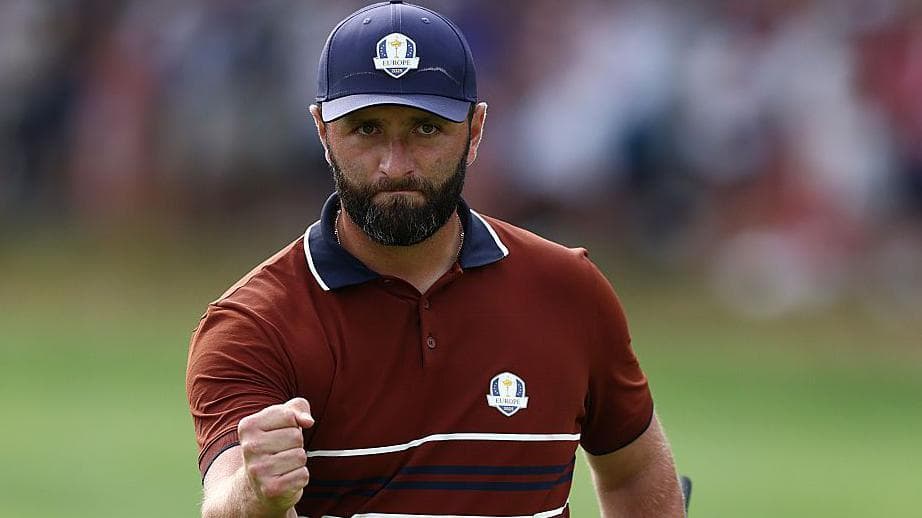
Rahm eligible for Ryder Cup after striking tour deal
BBC Sport
Alex Zanardi, the Italian Indy racer and para-cycling Olympic champion, has passed away at 59 due to injuries from a 2020 accident. He was known for his resilience after losing both legs in a 2001 Indy car crash and winning four gold medals in the Para-Olympics.
Mentioned in this story
Alessandro Zanardi of Italy in the #5 Winfield Williams Williams FW21 Supertec FB01 V10 during practice for the Formula One Australian Grand Prix on 7th March 1999 at the Melbourne Grand Prix Circuit, Albert Park, Melbourne, Australia. (Photo by Darren Heath/Getty Images)
Getty Images
Italian Alex Zanardi was a tough man to keep down. After a terrible Indy car accident in Germany in 2001 where the former F1 driver lost both legs, many folks counted him out. No such thing.
Around 2010 he took up hand-cycling, and in 2012 and 2016 at the Summer Para-Olympics, took a total of four gold medals. Sadly, earlier this month, he finally succumbed to cranial injuries suffered in 2020 he was hit by a truck while para-cycling in a charity event. He was 59 years old.
Awhile back I had the chance to meet and interview Zanardi. He was an extremely positive person, and he walked with a cane so well that if you didn’t know he had prosthetic legs, you couldn’t tell. Following are edited excerpts from that interview conducted in New York.
Jim Clash: Take us back to 2001 and your CART Indy car accident. What do you remember, if anything?
Alex Zanardi: Some of it came back. Some of the moments over the course of the entire weekend that were gone came back. Even some of the action, like me trying to regain control of the car – I can see my hands on the steering wheel, the car going sideways – and then there are no clear memories after the shunt. But luckily, we are here today.
Clash: Maybe it’s good that you don’t remember all of that.
Zanardi: Not to say that I’m special, but that’s the way I am. I just feel that this belongs to my past. So there is no reason it could hurt me more now. I was actually curious right after the accident to see the footage, try to see exactly why I ended up spinning, why I ended up losing a race that I was about to win [laughs]. A little bit for my ego, you know.
Alex Zanardi died from cranial injuries sustained in a truck accident while para-cycling in 2020.
Alex Zanardi won a total of four gold medals at the Summer Para-Olympics in 2012 and 2016.
In 2001, Alex Zanardi was involved in a severe Indy car accident in Germany that resulted in the loss of both his legs.
Alex Zanardi was 59 years old when he passed away.
Lungi Ngidi confirmed fit for today's IPL 2026 clash against CSK!
Florida baseball moves up to No. 20 in latest national rankings after series win.
Discover Bengals rookie Tacario 'Bobo' Davis and his impressive wingspan.
Jim Furyk's appointment as Ryder Cup captain raises concerns about U.S. golf leadership.
Kenneth Grant of the Dolphins is switching back to No. 78 for the 2026 season.
See every story in Sports — including breaking news and analysis.
FILED - 15 September 2001, Brandenburg, Klettwitz: Italian Alex Zanardi (M, Honda Reynard) collides with Canadian Alex Tagliani (l) at the "American Memorial" on the southern Brandenburg Lausitzring. (Photo by Matthias Hiekel/picture alliance via Getty Images)
dpa/picture alliance via Getty Images
Clash: Did you ever talk to Alex Tagliani after the accident?
Zanardi: Yes, yes, in fact I actually tried to help him get over that moment because, psychologically, I think it was harder for him than for me. He felt guilty for some reason [about hitting me]. That’s the way we are.
Sometimes you see somebody like me experiencing something so apparently devastating as losing his legs and say, “Wow, when that guy wakes up he is going to ask himself, ‘How am I going to live with no legs?’” Whereas what I really asked myself is, “How am I going to do all the things I have to do with no legs?” [laughs]. I was more concerned rather than sad or emotional over what happened.
I knew that if other people had found solutions, I could, too – it would be the same for me entering into that journey, that new challenge. As a matter of fact, the method was exactly the same as the one I developed for my sporting challenges: identify a list of priorities, put the priorities in the right order and then get on top of your problems one at a time to solve them.
Clash: Compare para-cycling to auto racing. You have been successful at both.
Zanardi: In reality, there is nothing different. You are dealing with different things, but the principles are identical. Even the way you perceive it. You go 40 kph on the cycle, and you get very similar sensations when you go 400 kph in a race car. You are chasing the limit, and that is exciting because you are risking something. You are chasing your own ability, identifying what the limit is and staying just a touch under it. That’s the name of the game.
Italy's Alessandro Zanardi after winning the men's team relay competition. The Italian team composed of Zanardi toghether with Vittorio Podestà and Luca Mazzone won the gold medal, Rio de Janeiro, Brazil on 16 September 2016. (Photo by Mauro Ujetto/NurPhoto via Getty Images)
NurPhoto via Getty Images
Never exaggerate, always keep everything under control, try to deliver your best possible performance, but never pass that line which will cause you to lose everything. Of course, sometimes you make mistakes. We are human beings, not perfect, but it’s been a lot of fun learning what I had to do in order to solve that equation in a different field like para-cycling.
Clash: Had you ever done competitive cycling?
Zanardi: I knew nothing in the beginning. It was like starting over again. It reminded me a lot of my go-kart days when I was a kid. In para-cycling I am a veteran with Olympic medals now, four of them, But there’s always something left in the bottom of the barrel. You can scratch.
So I’m very much looking forward to the para-cycling season to see whether I can regain competitiveness in a very competitive field. My last participation was in Rio and I came home with gold. At the end of the day, trying is the best part. Making it happen is even better.
This article was originally published on Forbes.com