Sports
Cárdenas vale para todo
Marca
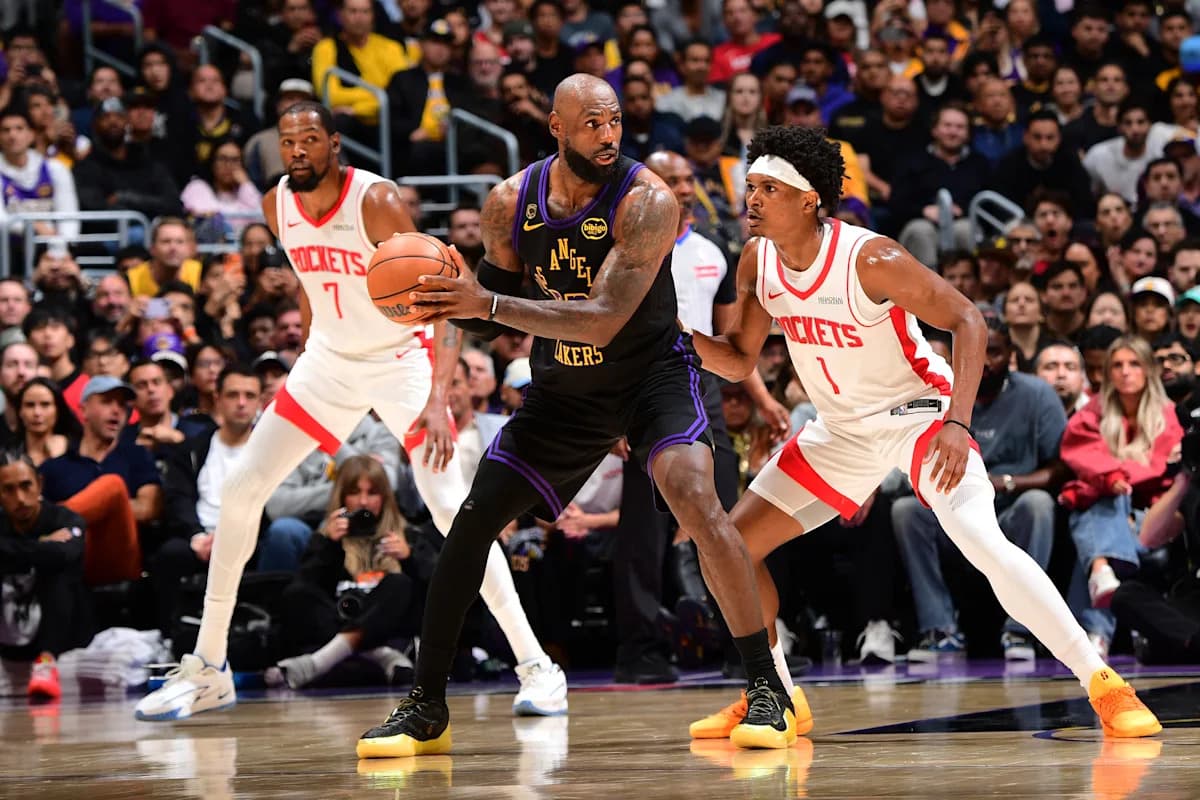
The Lakers are thriving in the playoffs despite losing Luka Dončić and Austin Reaves, winning their first two games against the Rockets. LeBron James is leading the team, adapting his play style to ensure success.
When the Los Angeles Lakers lost Luka Dončić and Austin Reaves, their top two scorers during the regular season, just two weeks before the start of the 2026 NBA playoffs, it seemed like a fatal blow to their chances of not only contending for the NBA title, but of even making it out of the opening round of the postseason. A 3-2 finish after losing Dončić and Reaves — with the wins coming over the Warriors minus Stephen Curry, the Suns minus Devin Booker, and the Jazz minus an NBA roster — did little to dispel that notion; a matchup against a tough, physical Houston Rockets team with a top-five defense and plenty of youth and athleticism on the wing seemed like one the Lakers wouldn’t survive.
They’re doing a hell of a lot more than surviving, taking the first two games of their opening-round matchup and leaving the Rockets looking overmatched and shell-shocked heading into Game 3 back in Houston on Friday. There are plenty of reasons for that: Kevin Durant and the Lakers ; , and shooting a combined 19-for-33 (57.6%) from 3-point range ; holding Alperen Şengün to just when they’ve been matched up; etc.
The Lakers finished 3-2 after losing Dončić and Reaves, winning their first two playoff games against the Rockets.
LeBron James has been instrumental in leading the Lakers, adapting his play style to ensure the team performs well despite key injuries.
The Lakers won both of their opening-round games against the Rockets, taking a 2-0 series lead.
The Lakers utilized strong shooting from players like Luke Kennard and Rui Hachimura, and effective defense against key Rockets players like Alperen Şengün.
Florida baseball falls to No. 11 in RPI after a tough losing streak.

Kyle Ivan sent to Taiwan by Senators after his song jinxed the team
Yankees won't trade Stanton to Astros because of his contract situation.
See every story in Sports — including breaking news and analysis.
One of the biggest ones, though? LeBron James, it turns out, still knows how to take the reins of a playoff series and — even at age 41 — make sure it’s played on his terms and at his pace.
“We all got to pick up our play,” James told reporters after the Lakers’ 101-94 Game 2 win. “When you’ve got two big guns out like we have, we all got to pick up our play. And that’s all it’s about. We’re all just trying to contribute, make contributions in all facets of the game, pick up our play.”
One way that LeBron’s been picking his up? By posting up.
As my colleague Tom Haberstroh noted on this week’s episode of The Big Number, through two games of Lakers-Rockets, James has finished 16 possessions out of the post with either a shot attempt or a foul drawn. According to Synergy Sports tracking data, that is not only more post-ups than any other player (nobody else is even in double-digits); it’s more than every non-Lakers team in the postseason field.
Left block, right block or at the nail; Josh Okogie, Tari Eason, Amen Thompson, Jabari Smith Jr. or Aaron Holiday; backing them all the way down to the rim, whipping a pass to a cutting big man, or turning over either shoulder for that patented baseline fadeaway jumper. LeBron’s breaking out every tool in the toolbox — I guess “every club in the bag” is more appropriate these days — in search of ways to compromise the Rockets’ defense, draw attention away from the likes of Kennard, Smart, Hachimura, Ayton and Jaxson Hayes, and create advantages that allow the Lakers to play on their terms rather than Houston’s.
Including plays where he's passed to a teammate who has shot the ball, the Lakers are scoring 1.053 points per possession on these post-ups, according to Synergy. That’s not elite efficiency; it would’ve ranked 39th among 76 players who logged at least 50 post possessions during the regular season, between Jalen Johnson and Day’Ron Sharpe. Considering the Rockets gave up 0.94 points per possession on post-ups and 0.99 points per possession on pass-outs from the post during the regular season, though, it ain’t half-bad. Especially when you factor in that a Lakers team that has struggled with ball security without Dončić and Reaves — a 19.3% turnover rate through two games, third-worst in the playoff field, including 21 cough-ups of the more damaging live-ball variety — hasn’t turned it over once on those LeBron post-ups, getting a shot on goal or drawing a foul each time.
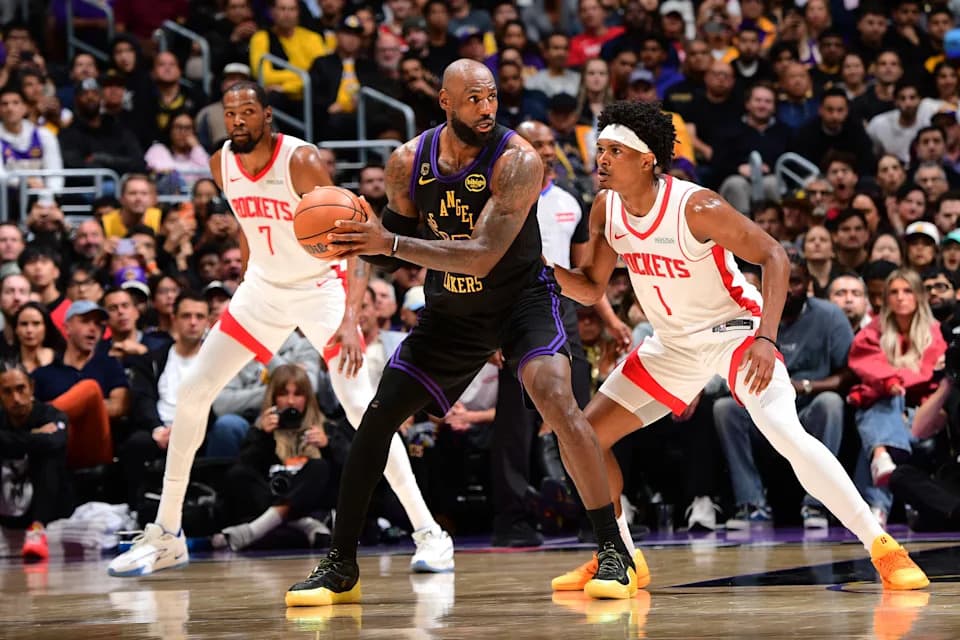
LeBron James is averaging 23.5 points, 8 rebounds and 10 assists through two playoff games. (Photo by Adam Pantozzi/NBAE via Getty Images)
(Adam Pantozzi)
Thanks partly to those methodical trips to the low post, the Lakers have the slowest average time to shot on offense (14.6 seconds, more than 60% of the shot clock) in the postseason field, according to Inpredictable, and have decelerated the pace of their series to 91.8 possessions per 48 minutes — the slowest series in Round 1 thus far. Several series in recent years have operated at a slower pace, mostly featuring teams that already played at a snail’s pace (Joe Mazzulla’s Celtics, Tom Thibodeau’s Knicks), that revolved around a low-post monster (Nikola Jokić, Joel Embiid) and/or that entered the series as an underdog and were adopting the underdog strategy of trying to take the air out of the ball — limiting the number of offensive possessions their favored opponents had, and with it their ability to build and extend a lead.
The current iteration of the Lakers check all three boxes: 22nd in pace during the regular season, built around the post game that LeBron has worked tirelessly to hone over the past 15 years, and an underdog heading into the series based on the absence of two of their three best offensive weapons. Given that, it probably shouldn’t surprise us that James has approached the start of the series by hitting the brakes and dragging the game into the post. After all, he’s been here before.
I don’t just mean that generally and metaphorically, in the sense that over the course of 23 NBA seasons and more than 1,900 games, he’s seen just about every scenario and situation that a player can experience in this league. I mean that he has, specifically, had to figure out how to make do in a playoff series against a younger, longer, more athletic, favored opponent without his two best teammates.
Harken back, if you will, to the long, long ago of June 2015. “Mad Max: Fury Road” was blowing minds at the multiplex. People were super into “See You Again” by Wiz Khalifa, partly because of its inclusion in “Furious 7,” which was blowing minds at the multiplex. There was a huge FIFA corruption scandal going on, which I realize doesn’t narrow things down all that much, but stay with me. And LeBron was nearing the end of his first season back in Cleveland, where he paired up with Kyrie Irving and Kevin Love on a Cavaliers team that won 53 games and went 12-2 in the Eastern playoffs en route to an NBA Finals matchup with the upstart Golden State Warriors.
Along the way, though, the Cavs lost Love to a dislocated shoulder against the Celtics, and then lost Irving to a fractured left kneecap in overtime of Game 1 in Oakland. The other four Cavs starters for the rest of that Finals series: Timofey Mozgov, Tristan Thompson, Iman Shumpert and Matthew Dellavedova.
Playing without another shot creator, with two plodding/mauling big men, and two only-kinda-sorta-OK 3-point shooters, James surveyed the scene and saw only one potentially feasible pathway to victory against a Warriors team that had more talent, depth, shooting and speed across the board. The objective: Keep Golden State from running by grinding the game to a glacial pace through mismatch-hunting and bulldozing his way into the post, where he could overpower the Warriors’ smaller defenders, draw defensive attention and set up shooters and cutters, or just create opportunities for Thompson and Mozgov to generate second chances.
It worked …
… for a little while, at least.
The Cavs forced the Warriors to play at their pace, though; those six games averaged just over 93 possessions per 48 minutes, which is slower than the slowest team in the NBA has played in each of the last nine seasons. And they did that, in part, through James’ control of the game from down low. In that series, including possessions where he passed out of the low block to a teammate who shot the ball, he averaged 9.8 post-ups per game, according to Synergy. (Through two games against Houston: 9.5 such possessions per game.)
Both teams scored under 100 points in the next two games of that series — both of which the Cavs won — before the Warriors adjusted their plan of attack, changed their starting lineup for Game 4, and ripped off three straight victories to win the first title of what would be a dynastic run.
It’s possible that the Rockets could similarly wrest control of the series back from LeBron as the scene shifts back to Houston. There are some notable differences, though. For one thing, these Rockets (obviously) don’t have the same kind of shooting and offensive firepower as those Warriors, or a supply of high-end two-way players capable of punishing L.A. on both ends of the court. For another, LeBron might actually be getting some reinforcements before too long.
Wherever the series goes from here, though, the Lakers — halfway to four wins, with home-court advantage still intact — enter Game 3 firmly in control, due largely to James still being able to set the terms of engagement after all these years. May the f*****y never cease.