
Crypto
Bitcoin options market is quietly pricing a major downside move
CoinDesk

Key takeaways:
There is a high probability that US President Donald Trump’s Tuesday deadline to Iran could be the catalyst needed for a Bitcoin (BTC) rally above $75,000.
Should a deal fail to materialize, Bitcoin’s risk perception could strengthen due to its unique decentralized properties. Conversely, a positive outcome in negotiations would likely propel risk assets, including Bitcoin.
President Trump issued an ultimatum to Iran on Sunday, warning the nation would be “living in Hell” if the Strait of Hormuz is not reopened by Tuesday at 8:00 pm ET. However, CNBC reports that Trump has been “vacillating” between productive dialogue and the intensification of military action.
Senior Iranian officials reportedly stated the strait will remain blocked until Iran receives compensation for war damages.
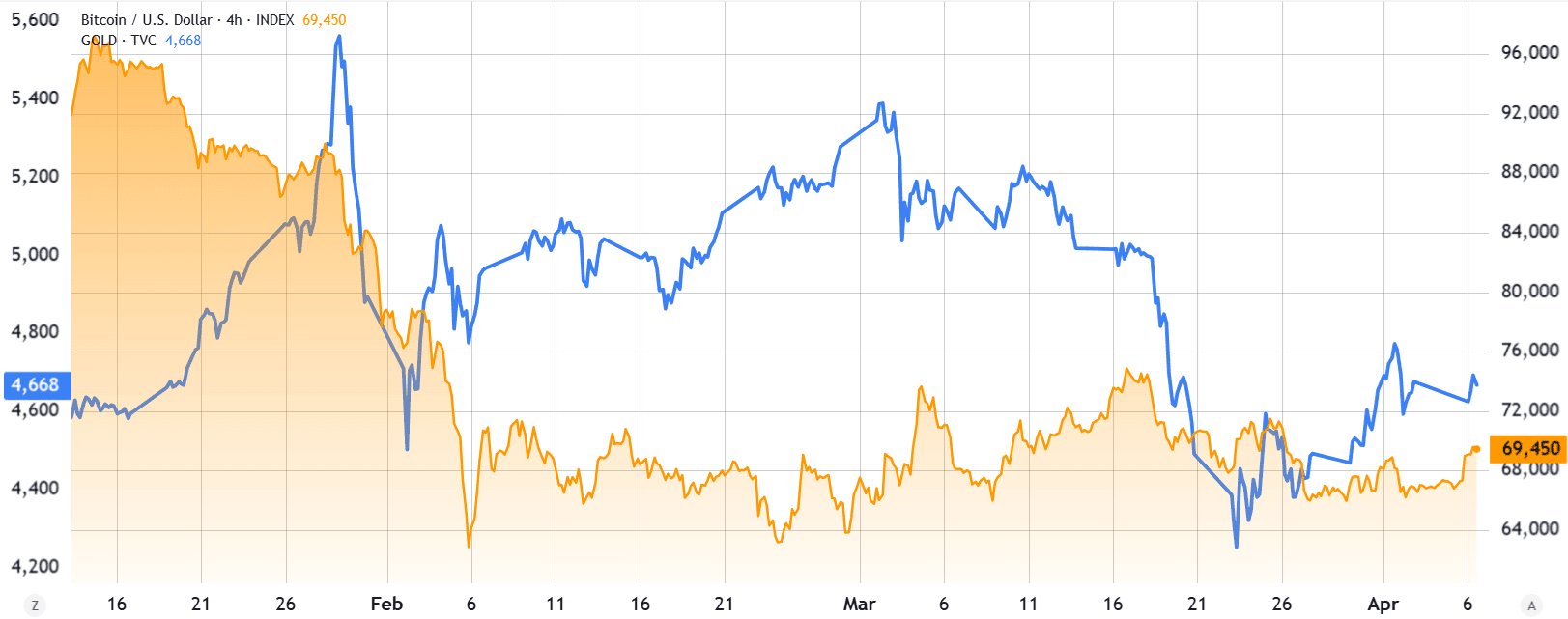
Gold/USD (left) vs. Bitcoin/USD (right). Source: TradingView
These mixed signals failed to convince market participants on Monday, as US stock markets traded mostly flat. In contrast, Bitcoin jumped above $69,000 for the first time in over 10 days—a trend made more notable by gold prices holding near $4,650, down 17% from a $5,600 all-time high.
Traders are increasingly concerned that central banks will be forced to liquidate their gold reserves. The Turkish Central Bank reported sales of 50 tonnes of gold for the week ending March 20, the sharpest decline in over seven years.
According to Reuters, Turkey has also sold $26 billion in foreign currencies to stabilize markets since the US and Israel-Iran war broke out in late February. Similarly, Russian gold reserves measured in tons have dropped to their lowest levels in four years.
A ceasefire in Iran, even if temporary, would almost certainly bolster risk markets, though the implications for Bitcoin are less certain.
Traditional corporations remain heavily dependent on energy costs and global logistics. Therefore, any reduction in geopolitical risk is immediately reflected in equity prices.
However, a deal between the US and Iran would likely have a less direct impact on Bitcoin, as a resolution would likely strengthen the demand for US Treasuries.
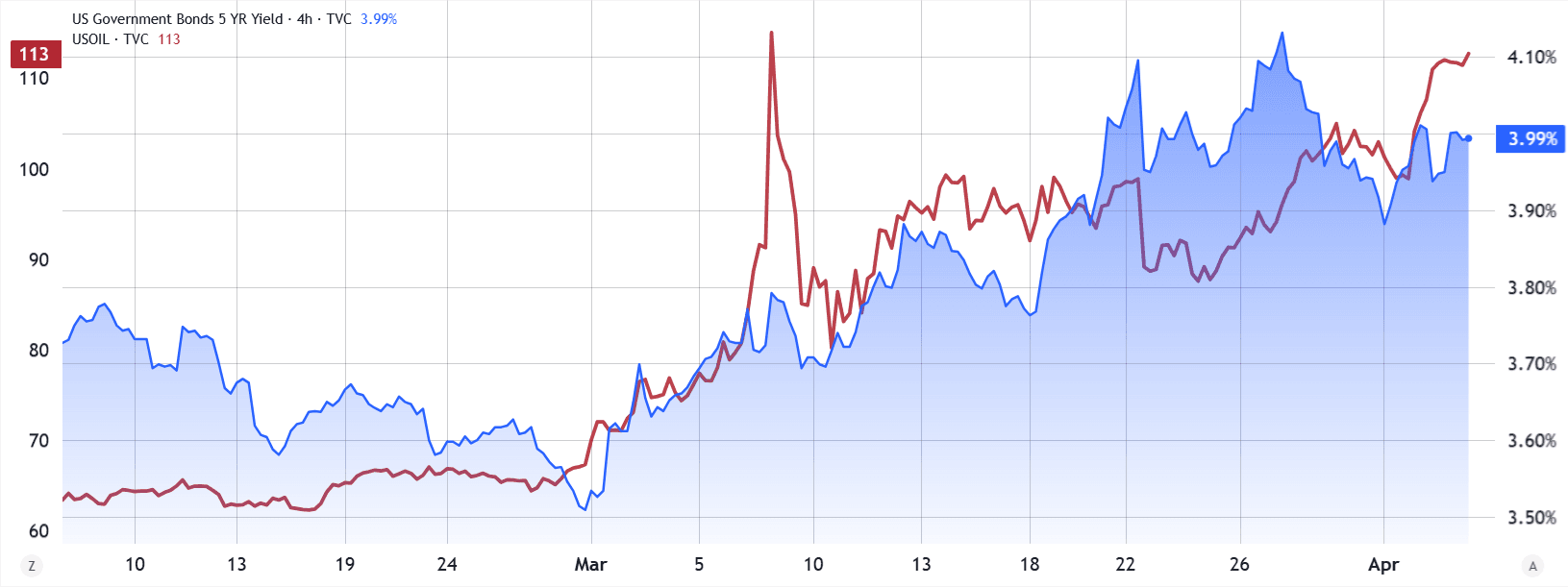
Crude West Texas Oil (left) vs. US 5-year Treasury yield (right). Source: TradingView
Yields on the US 5-year Treasury note surged to 4% from 3.55% in late February, signaling that investors are demanding higher returns to hold those bonds. While part of this selling pressure stems from fears of sticky inflation driven by high oil prices, there is also the added burden on the US fiscal debt due to increased spending on military operations.
An eventual ceasefire and renewed confidence in the US Treasury reduces the necessity for alternative hedges and independent financial systems such as Bitcoin.
However, even if the Strait of Hormuz is reopened, Mohit Mirpuri, an equity fund manager at SGMC Capital, warned that “the damage to confidence and supply chains is already done — things don’t just snap back to normal.”
Related: Iran war bets turn prediction markets into real-time macro radar—Sygnum
Predicting that the Bitcoin price will rally 8% by Tuesday based solely on a potential resolution to the US and Israel-Iran war seems far-fetched. Investors are gradually adjusting to President Trump’s characteristic back-and-forth, especially when negotiations involve unreliable third parties.
Traders are unlikely to provide the benefit of the doubt in this instance, so sustainable bullish momentum for risk markets could take longer to materialize. Nevertheless, the case for a $75,000 Bitcoin rally remains possible in the event of a positive outcome by Tuesday.
Share this article
Trump’s Tuesday deadline could be a catalyst for Bitcoin because it creates a pivotal geopolitical moment for markets. If negotiations fail, Bitcoin may benefit from stronger risk perception and its decentralized, hedge-like appeal. If a deal is reached, risk assets could rise, but Bitcoin’s path to $75,000 would still depend on broader market conditions.
A ceasefire would likely boost risk assets such as stocks, and Bitcoin could also benefit in the short term. However, the article says the impact on Bitcoin is less certain than on equities because a resolution would also strengthen confidence in US Treasuries. That could reduce demand for alternative hedges like Bitcoin.
Bitcoin is being compared to gold because both are seen as potential stores of value during uncertainty. The article says Bitcoin is slowly catching up to gold as traders worry about central bank gold sales and fiscal instability. It also notes that Bitcoin has recently decoupled from gold, with BTC rising above $69,000 while gold stayed near $4,650.
Bitcoin is being discussed as having a possible path back to $75,000. The article says that level could still be possible if there is a positive outcome from the US-Iran situation by Tuesday. It also cautions that a sustained rally is not guaranteed and may take longer to develop.
A US-Iran deal would likely help stocks more directly because corporations are heavily affected by energy costs and global logistics. The article says a resolution would also likely increase demand for US Treasuries, which could reduce the need for alternative hedges like Bitcoin. That makes Bitcoin’s reaction less direct than the reaction in equity markets.




See every story in Crypto — including breaking news and analysis.