
Sports
WWE, AEW power rankings: Roman Reigns, Jacob Fatu set the stage for a chaotic summer
WWE and AEW are heating up this summer with Reigns and Fatu at the forefront of power rankings.
Yahoo Sports1 min read

Ronda Rousey reflects on the end of her UFC career nearly a decade later, revealing she struggled with neurological issues that affected her performance. She shares insights on her mental state following her loss to Holly Holm in 2015.
Mentioned in this story
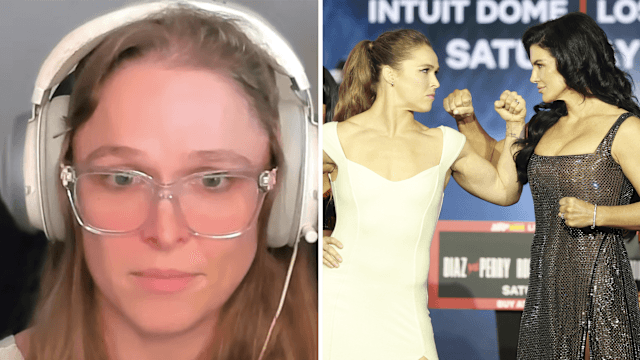
It’s been nearly a decade since Ronda Rousey last fought in MMA. On Saturday, inside the Intuit Dome in Los Angeles, that changes when she collides with Gina Carano under the banner of Jake Paul’s Most Valuable Promotions on Netflix.
In the aftermath of Rousey’s first loss to Holly Holm in 2015, the former UFC bantamweight champion was particularly hard on herself, closing off the rest of the world for several years. It wasn’t until her WWE run that she began speaking more publicly about the end of her MMA career. Appearing Monday on “The Ariel Helwani Show,” Rousey offered a candid assessment of why she reacted in the manner she did once her Hall of Fame title run came to an uncerimonious end.
"I was dealing with these neurological issues for such a long time, and I didn't understand what was going on,” Rousey told Uncrowned. They were getting worse and worse and worse. It just finally came to a head in that fight. I just felt like it finally caught up to me, and my career was over. It was more than just losing a fight. It was, 'Man, I can't fight anymore.'
"There's a lot of people that think I'm making it up or don't believe me. Neurological problems are an injury that nobody else can see, and I think what I hated most about it was the very first time I got hit in that [Holm] fight, it knocked all my lower teeth loose and cut my lip open. I got this huge migraine aura — a big chunk of my vision missing, like losing my depth perception and ability to think clearly, quickly, and track moving objects — but I was still on my feet and balanced. I've been trained my whole life to not show hurt — then they're going to capitalize and know [if I show them]. So that entire fight was just me trying to hide the fact that I couldn't see or think."
Rousey, 39, played a pivotal role in getting women signed to the UFC after running roughshod through Strikeforce in 2011-12. The UFC retained Strikeforce’s women’s roster following its 2011 acquisition of the California-based promotion, pushing Rousey to the forefront as the UFC’s inaugural women’s champion. She enjoyed a historic six-fight stretch of title defenses before suffering that aforementioned first loss to Holm.
Ronda Rousey revealed that she experienced worsening neurological problems that impacted her ability to fight, which she only fully understood after her career ended.
It has been nearly a decade since Ronda Rousey last fought in MMA.
Ronda Rousey is set to return to fighting against Gina Carano under Jake Paul’s Most Valuable Promotions on Netflix.
After her loss to Holly Holm, Ronda Rousey closed herself off from the world for several years, struggling with the mental and physical aftermath of the fight.
WWE and AEW are heating up this summer with Reigns and Fatu at the forefront of power rankings.

Wittenberg baseball earns NCAA tournament berth for the first time in 32 years!
New York Liberty will be without Satou Sabally in their game against Portland due to injury.
Exploring Every Duke Player Drafted by the Golden State Warriors
Victor Wembanyama's ejection sparks debate over staged moment.
Could Justin Herbert finally contend for MVP this season?
See every story in Sports — including breaking news and analysis.
A year later, Rousey returned in silence to challenge Amanda Nunes, who had claimed the bantamweight championship in her absence. The issues Rousey faced in her previous fight persisted, she said, leading to her initial retirement from the sport.
"That's how I knew — I just can't fight anymore because of this,” Rousey said.
"I felt like I was judged on my fighting ability and IQ because of what was happening when I was dealing with not being able to see, and knowing my career was over because of it. No one could understand, and all these people were making judgments and assumptions about me and my fighting ability because of it, and I would never be able to set it right after that. It just got to the point where I couldn't even get hit anymore.
"Thankfully, because [UFC CEO] Dana [White] sent me to the Cleveland Clinic, I had world-famous neurologists check me out and give me a diagnosis of dealing with migraine aura, and giving me medication that can be preventative. It was completely life-changing. That's why I'm able to do this [Carano] fight. But I didn't have any of that information then. I just thought I would be forever misunderstood and only known for those performances. That's just not who I am as a fighter, and I'm always going to be judged for those performances."
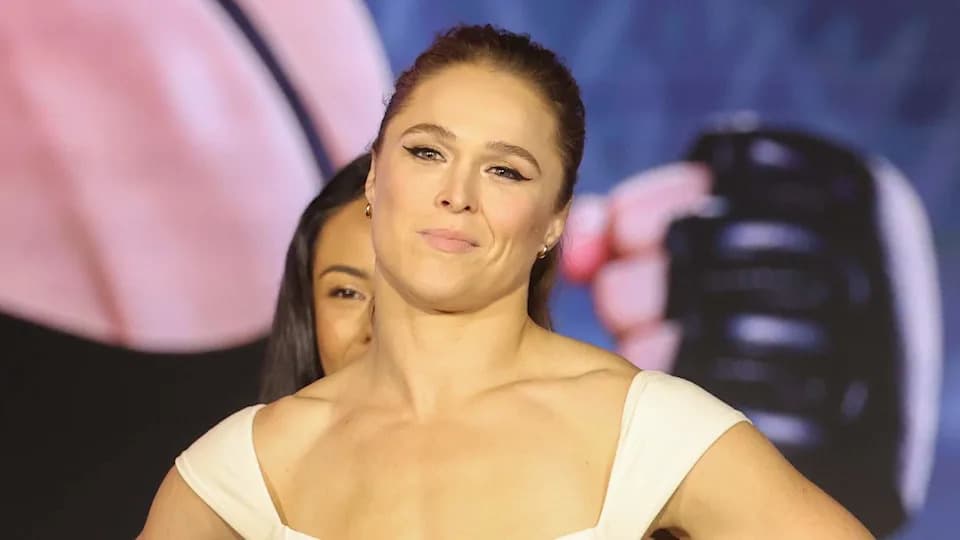
Ronda Rousey believes all roads led her to a big comeback fight against Gina Carano.
(IMAGN IMAGES via Reuters Connect / REUTERS)
Despite Rousey returning for one more go-round and all the motivation it’s brought out of her, she’s promised her husband, former UFC heavyweight Travis Browne, that Saturday’s fight will be one-and-done. Ideally, Rousey hopes to have two more children if possible, and knows she can’t take any more detours with ventures like fighting.
Her departure from the UFC and the sport may have been messy, and internal conflict with her neurological issues was a challenge unto itself, yet more than a decade later, Rousey wouldn’t change anything about how the end of her UFC career played out.
"Everything happens for a reason the exact way that it's meant to go,” she said. “And I think was meant to not win the Olympics so that I would still have that fire in me to come into MMA and pave a way for women and that sport. I believe I did not attain my goal of retiring undefeated [in MMA] because, A, it was the best thing for the sport for me to not leave with my equity. I learned through pro-wrestling that the champ retiring with the belt is one of the worst things that can happen to a division. Look what happened to the [UFC’s] 145-pound division.
"It was meant to go that way so that I would be brought back to MMA, not just to serve myself and my own career, but to change the entire landscape of the sport because of this fight. MVP and Netflix are coming in as a real rival to the UFC that they so desperately need, and it's giving fighters leverage that they never had. This is something that never would have happened if I retired undefeated. It never would have happened if I hadn't come back at the exact time the UFC was switching over to the streaming model. There's too many things that happened in sequence."
Rousey seems adamant that she’ll stick to her guns and only make the walk once more. That’s before she actually does, of course, but it doesn’t mean we’ll never see her involved with MMA ever again.
The UFC Hall of Famer has been louder than ever about disrupting the landscape and driving serious change. If all goes according to plan with Netflix’s big first MMA show, Rousey knows she will have achieved a win from that perspective, along with the potential one she finds against Carano.
"I was always meant to do this,” Rousey said. “Maybe after this, we'll see. I could feasibly be the Dana of MVP MMA. I could be the most powerful figure in the sport since Dana. That’s insane. That’s a goal I never even would have thought to have if I had done nothing but win and win and win and win.
"It's not just for me, it’s giving fighters their power back. I feel like that’s a role I was meant to inhabit. I love being the designated b****, and to take the brunt of the wind. I'm happy to play that role, and I feel like if anything happened any other way, the entire future of the sport would be different. This is meant to be better for all fighters, and I had to go through those things to get to this point where I am now. Now, I get it.”