

Crypto
XRP Price Will Trade At $1,000 If This Happens; Analyst
NewsBTC
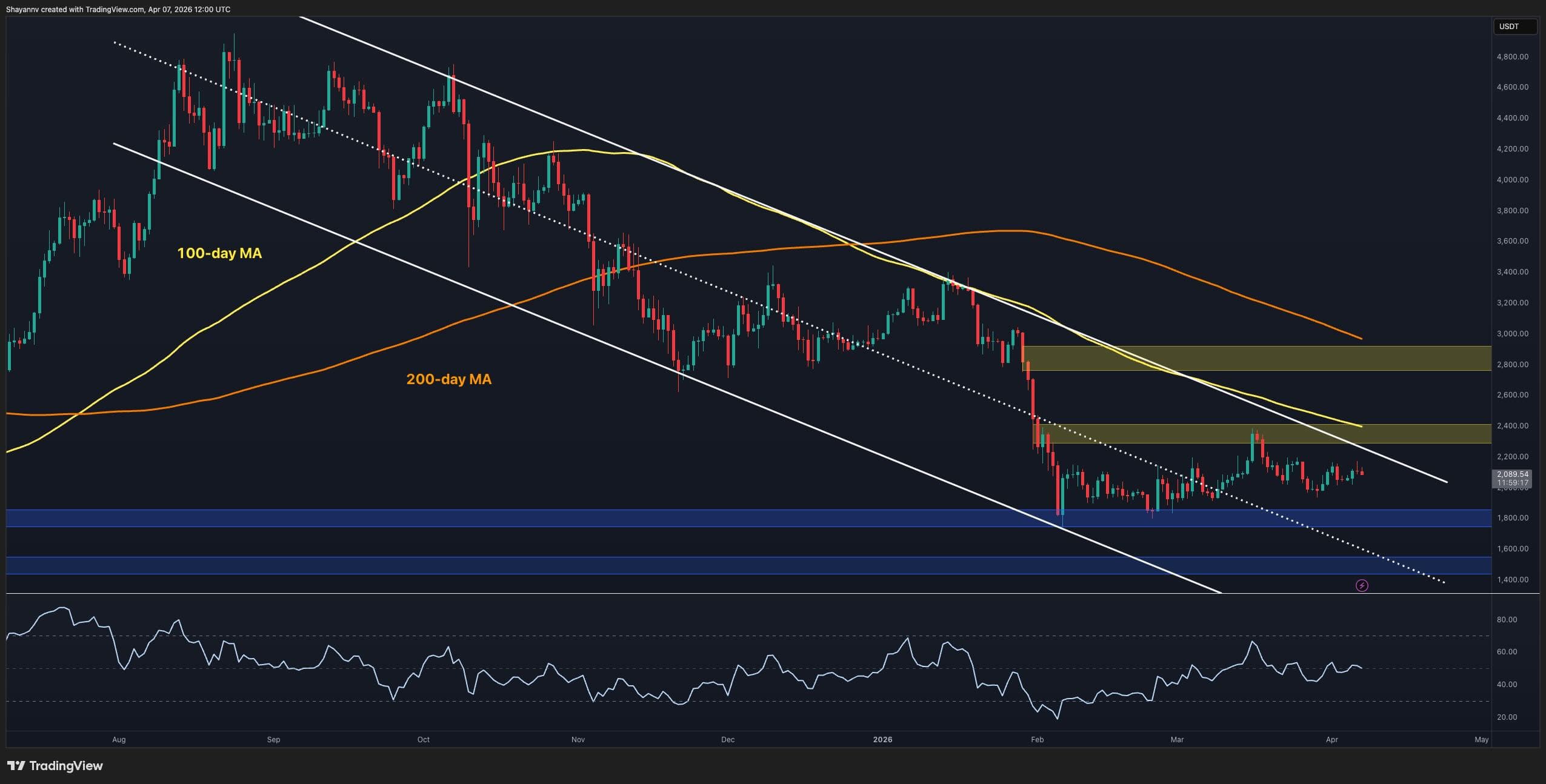
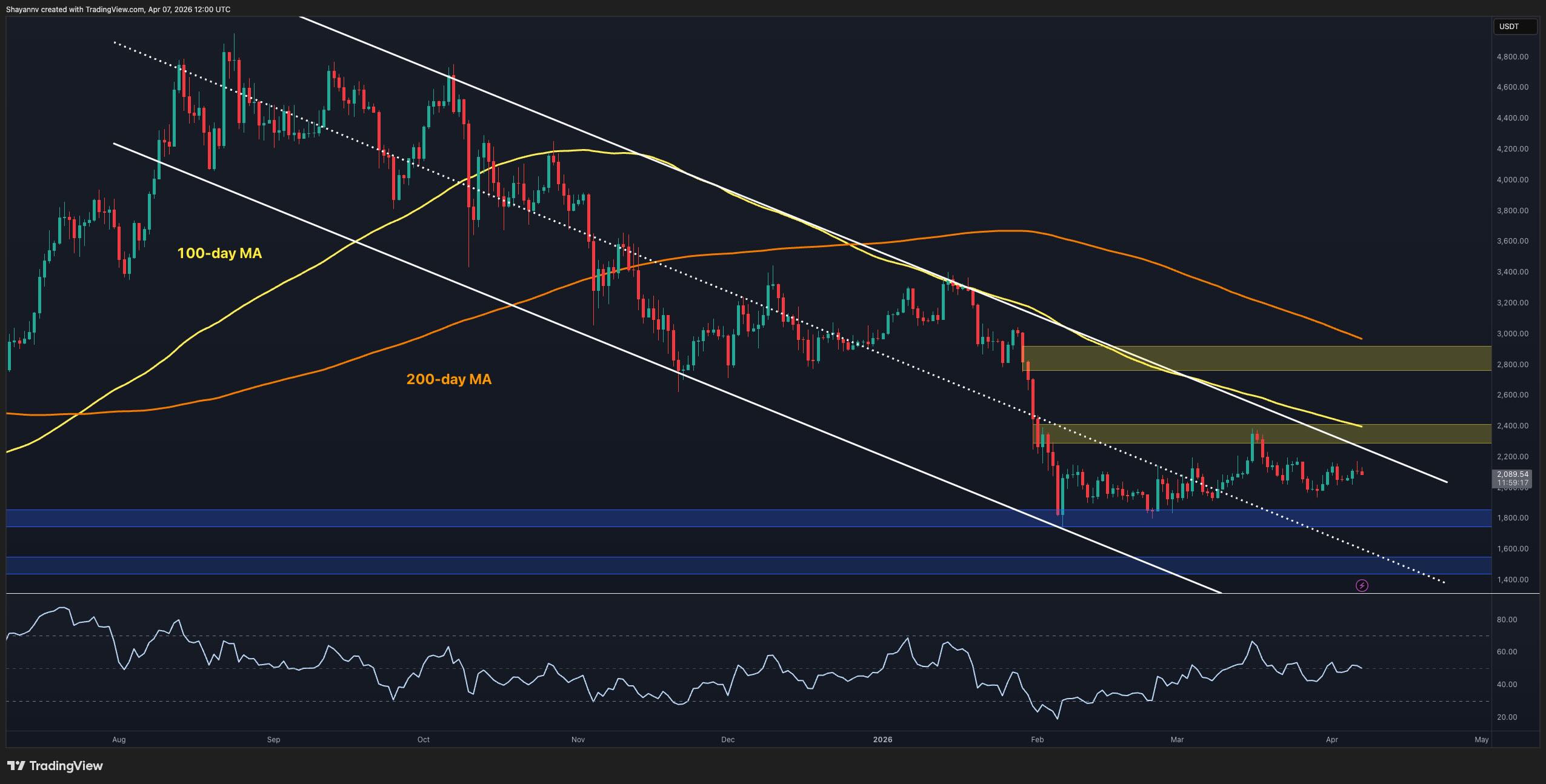
Ethereum is still locked in a broad corrective structure. The price action shows continued indecision rather than directional conviction, which seems fair given the escalations in the Middle East. Despite holding above the $1.8k support base, upside attempts are consistently capped before any meaningful trend shift can develop.
On the daily timeframe, ETH is still trading within a large descending channel. This confirms a broad bearish market structure that began in late 2025. The price also remains below both the 100-day (~$2.4k) and 200-day ($3k) moving averages, which continue to trend downward and act as dynamic resistance layers.
Currently, the $2.3k–$2.4k zone is the key supply area. This region has repeatedly rejected price and aligns with the most recent bearish order block on the daily timeframe. Meanwhile, the $1.8k region acts as a critical support area. This level has held multiple times, and as long as it holds, the downside remains contained within the current range.
A decisive break above $2.4k would invalidate the sequence of lower highs and potentially shift the structure toward a bullish reversal, as it would also mean a break above both the descending channel’s higher boundary and the 100-day moving average. Conversely, losing the $1.8k demand zone would likely trigger a breakdown from the range and open the door for a deeper move toward the next support level at $1.6k.
On the 4-hour timeframe, ETH is consolidating within a narrowing triangle structure. This pattern is defined by a rising trendline from the $1.8k lows and the key horizontal resistance around $2.4k.
The price is currently trading around $2.1k. It has repeatedly tested the $2.2k short-term resistance zone formed with recent 4-hour timeframe highs, but has failed to break through it with conviction. With the lower trendline of the triangle also converging from below, the structure suggests compression, and a breakout is becoming increasingly likely.
If buyers manage to flip $2.2k into support, the next move would likely target the key $2.4k supply zone. However, failure to break higher and a loss of the ascending trendline would shift momentum bearish, exposing the $1.8k support area in the coming weeks.
The Taker Buy/Sell Ratio is currently pushing higher and has been showing consistent readings above 1 over the past month. This indicates that aggressive buyers are becoming more active in the market.
However, this increase in taker buy pressure is occurring within a broader downtrend and range environment. Historically, similar spikes have often appeared near local tops or during short-term relief rallies, rather than marking the beginning of sustained uptrends.
This suggests that while short-term sentiment is improving, it may be driven more by speculative positioning than strong spot demand. As a result, if price fails to break the $2.4k resistance soon, this buildup of aggressive longs could unwind, leading to significant downside volatility, which could further prolong the overall bearish trend.
Share this article
Ethereum is still trading in a broad corrective structure with indecision dominating the market. The article says ETH remains inside a descending channel on the daily chart and has not yet shown a clear directional breakout.
The most important levels are $1.8k support and the $2.3k–$2.4k supply zone. ETH has repeatedly held above $1.8k, while rallies have been capped near $2.4k.
A decisive move above $2.4k would be the key bullish signal. That break would also take ETH above the descending channel’s upper boundary and the 100-day moving average, which could shift the structure toward a reversal.
If ETH loses $1.8k, the article says the range would likely break down. That could open the way for a deeper decline toward the next support around $1.6k.
ETH is consolidating because buyers and sellers are still in balance and the broader trend remains bearish. The article also notes that Middle East tensions have added uncertainty, which may be contributing to the lack of conviction.




See every story in Crypto — including breaking news and analysis.